


 Shkruar nga Pamfleti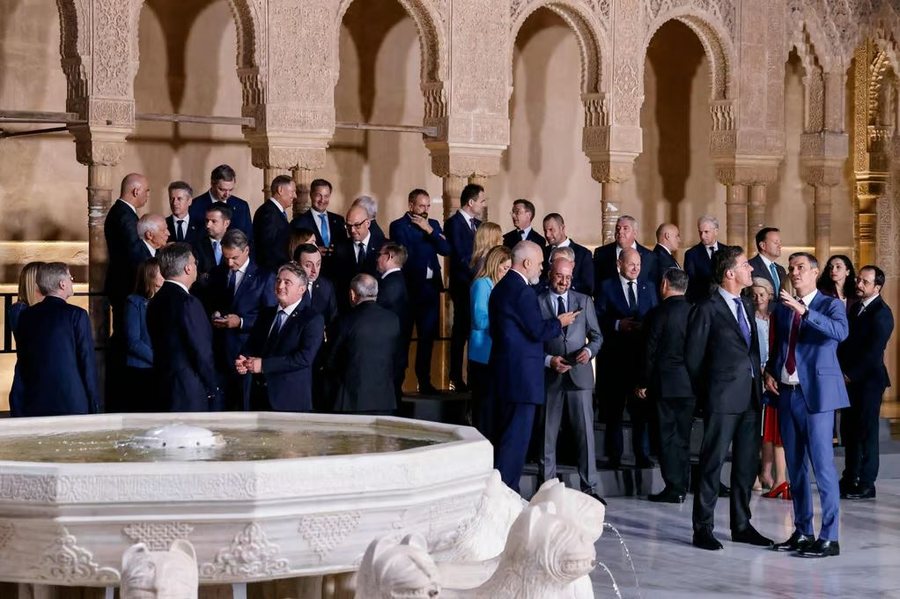
49 leaders, 700 journalists, dozens of bilateral meetings... and no decision.
On Thursday, October 5, around 50 European leaders gathered in Granada, Spain, to discuss issues affecting the region as well as laying out a solution to the conflicts on Europe's doorstep.
In an analysis by Politico, it is written that this meeting ended without any important decision.
Through this summit, it was expected to work on easing the tensions between Kosovo and Serbia, which actually did not happen.
It was the president of Kosovo, Vjosa Osmani, who refused talks with her Serbian counterpart Aleksandër Vucic if sanctions were not imposed against Belgrade, after a Serbian attack in Kosovo.
This third edition of this meeting of the European Political Community, in fact, was presented as an opportunity to mediate peace between Armenia and Azerbaijan as well as to escalate tensions in the Balkans and beyond in order to develop a strategic conversation for the security of the continent.
But in fact, in the absence of key players, no major progress could be made in resolving the conflicts in the area.
"Attendees' hopes of taking steps to resolve the humanitarian crisis in Nagorno-Karabakh were dashed when Azerbaijan's Ilham Aliyev and Turkey's Recep Tayyip Erdoğan decided to skip the meeting," the article reads.
The leaders also expected to hold the first meeting between Aliyev and Armenia's Nikol Pashinyan since Azerbaijan launched its blitzkrieg offensive in Nagorno-Karabakh, triggering an exodus of 100,000 refugees.
Initially, Azerbaijan accused France of bias in the negotiations and eventually agreed to talk, but only under the auspices of the EU in Brussels.
It all came to a head, writes Politico, when the host country, Spain, canceled at the last minute a planned press conference that was supposed to be the highlight of the summit for about 700 journalists. It was intended to include declarations and formally mark the handover of the administration of the European Political Community from Spain to the United Kingdom.
A 'marketplace' for leaders
The lack of enthusiasm of the leaders was seen even before the summit started, while the leaders were not ready to answer for the journalists.
Meanwhile, during a press conference, the French president spoke about the talks held.
In addition to strengthening cooperation to fight cybercrime among the EPC's 47 members, he cited talks on Armenia – held in the absence of main antagonist Azerbaijan – as evidence of the meeting's usefulness.
Meanwhile, when asked about the suspension of US aid to Ukraine, the French president called the billions of dollars in US support a complement to the EU's contribution, but warned that "it cannot replace European mobilization ".
On the other hand, the Spanish presidency refused to explain why the main press conference was cancelled. According to one EU diplomat, while there were no "substantive issues", there was almost no need for press statements.
Perhaps the only progress made on conflict resolution, the talks focused on migration, a hot topic for the UK's Rishi Sunak, whose country has had little opportunity to discuss the issue with European countries since Brexit.
According to Macron, a second meeting was held between Sunak, Meloni and Albanian Prime Minister Edi Rama, who gave promises to increase cooperation on information sharing and anti-trafficking operations in transit and departure countries.


Lini një Përgjigje