


 Shkruar nga Leila Abboud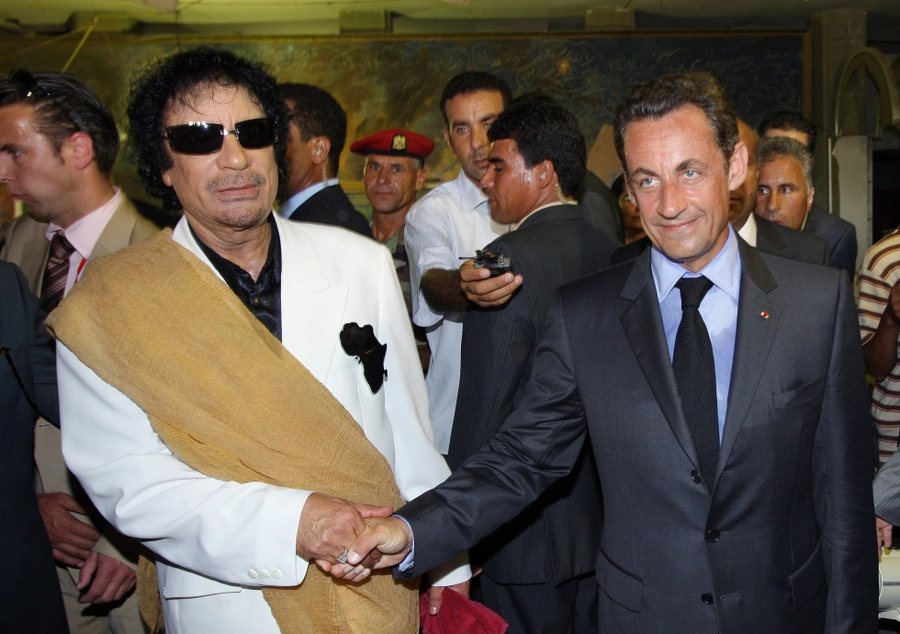
A Franco-Lebanese businessman and arms dealer named Ziad Takieddine, who is also on trial, is accused of transporting around 5 million euros in suitcases to Paris in 2006 to give to Sarkozy and his top aide Claude Guéant.
A few months into Nicolas Sarkozy's presidency, Libyan dictator Muammer Gaddafi pitched his Bedouin-style tent in the gardens of the official guest residence near the Elysée palace.
The high-profile visit shocked many in France as Gaddafi – who was overthrown and executed – had long been shunned by the international community for human rights abuses and support for terrorism. A particular controversy was his regime’s role, proven by French courts, in the bombing of a plane in 1989 that killed all 170 people on board, a third of them French.
That week-long stay is now under scrutiny as part of a high-profile trial against Sarkozy on charges of corruption, embezzlement and illegal campaign financing. Prosecutors allege the visit was part of a "quid pro quo" in which the French president sought to rehabilitate Gaddafi in exchange for millions of euros to finance his presidential campaign.
The right-wing French politician, who was president from 2007 to 2012, has denied any such agreement and insists he is innocent of the other charges.
"Once I was elected, the enthusiasm was considerable, I had a big job and I had to endure two and a half days of Gaddafi in Paris. Honestly, I could have done without him ," Sarkozy told the court during a hearing.
When in Paris, the Libyan leader did not keep a low profile: his entourage filled 100 limousines, causing traffic jams as they toured the Louvre, visited Versailles and went on a hunting trip in a former royal forest.
Sarkozy told judges that the visit was in exchange for Libya releasing several Bulgarian nurses it had imprisoned - a deal he brokered - and had nothing to do with his campaign. The trial is due to end on April 8. Prosecutors have asked for a sentence of seven years in prison, a 300,000-euro fine and a five-year ban from politics.
" Behind the public image, investigations are gradually revealing the silhouette of a man driven by an overwhelming personal ambition, willing to sacrifice core values such as integrity, honesty and fairness on the altar of power ," prosecutors said on Thursday.
But Sarkozy's reputation was damaged even before the verdict. There are other investigations into corruption allegations - a reflection, his critics say, not only of how he bent the rules when he was in power, but also typical of a more corrupt era in French politics.
Sarkozy is the first former French president to serve a prison sentence. In February, he was fitted with an electronic ankle bracelet to serve a one-year sentence under house arrest. He is only allowed to leave his home between 8 a.m. and 9 p.m. and is banned from traveling.
The sentence came after Sarkozy was convicted on appeal of conspiring with his lawyer to try to bribe a judge to obtain confidential information on another investigation into him.
Another conviction came in the latest in an illegal party financing scandal related to his 2007 election bid. He was found guilty, along with other UMP colleagues, of using a system of false invoices to spend almost twice the amount allowed under French electoral law. He has pleaded not guilty and has appealed the verdict.
The legal troubles are a fall from grace for Sarkozy, once seen as a preeminent right-winger. But he remains popular with older conservative voters, who remember how the charismatic and hyperactive interior minister under President Jacques Chirac swept into France's highest office in 2007, promising to shake up the country with economic reforms and a tough approach to law and order.
At the time, Sarkozy broke the mold of French politicians educated at elite schools and hanging out in the same affluent circles. He was the middle-class son of a Hungarian immigrant father, went to a mediocre French university and worked as a lawyer. After taking office, he earned the nickname "le president bling-bling" for his habit of wearing luxury watches and designer clothes.
"Sarkozy is a man who was willing to do anything to gain power ," said Gaspard Gantzer, a former adviser to Sarkozy's rival, François Hollande, who won the presidency in 2012. However, despite the accumulation of criminal investigations against Sarkozy, Gantzer stressed that no one is accusing him - but he is seeking to enrich himself in political campaigning.
It was also a reflection of how politics had changed since France passed tough campaign finance laws in the 1990s that limited donations to 4,600 euros per election for a single candidate and 7,500 euros per year for a political party. Several other laws were then passed aimed at cleaning up political practices, such as asset declarations to prevent conflicts of interest, said Chloé Morin, an author and political analyst.
“ Sarkozy is really one of the last of a generation [in which] politicians were financed by untraceable donations, often in cash and often of dubious origin. Both main parties were doing the same things, so no one had any interest in opening Pandora’s box by reporting it ,” said Morin, recalling how, when she was a staff member in the prime minister’s office under Hollande, her senior colleagues revealed that they were sometimes paid with envelopes of cash.
In the Libya trial, the 70-year-old Sarkozy has been combative, using his oratorical gifts to strike out repeatedly against a justice system he claims is biased against him.
" It's a conspiracy. Ten years of slander, 48 hours in the police, 60 hours of interrogation, 10 years of investigation, four months before the court. You will never find, not a single euro from Libya, not even a single cent ," he said on the opening day of the trial.
Prosecutors allege that a "corruption pact" was sealed on a 2005 trip when the Frenchman, who then harbored presidential ambitions, traveled to Tripoli as interior minister to discuss illegal migration with Gaddafi. The pair met in a Bedouin tent, prosecutors say, and stayed alone for a short time when the deal was supposedly signed.
Also on trial are four of Sarkozy's closest aides, who have also denied wrongdoing, and two defendants from the Libyan side, who are being tried in absentia.
A Franco-Lebanese businessman and arms dealer named Ziad Takieddine, who is also on trial, is accused of transporting around 5 million euros in suitcases to Paris in 2006 to give to Sarkozy and his top aide Claude Guéant.
The judges asked Guéant at trial why he had rented a safe in a Parisian bank that was so big he could walk into it; wasn't it to store illegally obtained campaign money?
No, Guéant insisted, it was to preserve important documents like Sarkozy's campaign speeches./ Adapted from "Pamphlet" by "Financial Times"




Lini një Përgjigje