


 Shkruar nga Pamfleti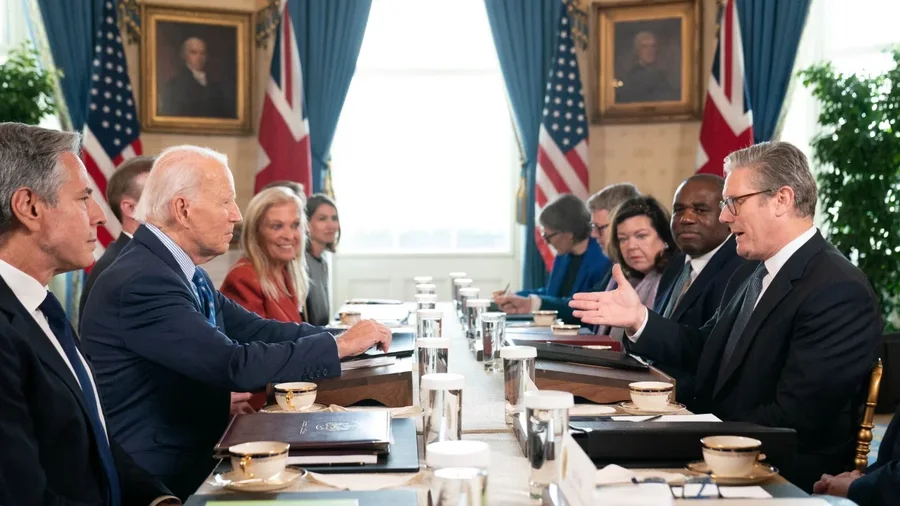
Britain and the US have raised the alarm that Russia has shared nuclear secrets with Iran in exchange for Tehran supplying Moscow with ballistic missiles to bomb Ukraine.
During their summit in Washington DC on Friday, Keir Starmer and US President Joe Biden acknowledged that the two countries are strengthening military cooperation at a time when Iran is in the process of enriching enough uranium to meet its long-held goal of build a nuclear bomb.
British sources said concerns were raised about Iran's trade in nuclear technology, part of a deepening alliance between Tehran and Moscow.
On Tuesday of last week, Antony Blinken, the US secretary of state, made a similar warning during a visit to London for a summit with his British counterpart, David Lammy, although he paid little heed to it, as the focus then was the announcement of the US - about Iran supplying Moscow with missiles.
"For its part, Russia is sharing the technology that Iran is looking for. This is a two-way street, including nuclear issues as well as some space information," said Blinken.
Britain, France and Germany jointly warned last week that Iran's stockpile of highly enriched uranium had continued to grow significantly, without any credible civilian justification, and that it had amassed four significant quantities, each of which could be used to make a nuclear bomb.
But it is not clear how much technical know-how Tehran has to build a nuclear weapon at this stage, or how quickly it can do so. Working with experienced Russian specialists or using Russian know-how would help speed up the production process, although Iran denies it is trying to build a nuclear bomb.
Iran had reached a deal in 2015 to halt the production of nuclear weapons in exchange for sanctions relief with the US and other Western countries, only for the deal to be abandoned in 2018 by then-US president and current Republican candidate Donald Trump. Trump.
Iran responded by violating agreed limits on the amount of enriched uranium it could hold.
Western concern that Iran is close to being able to produce a nuclear weapon has been circulating for months, contributing to tensions in the Middle East, already at a high level due to Israel's ongoing assault on Hamas and Gaza.
Iran and its proxy in Lebanon, Hezbollah, are supporters of Hamas, and Tehran's nuclear development is seen as a direct threat from Jerusalem.
Shortly after Vladimir Putin launched a full-scale invasion of Ukraine, Iran began supplying Moscow with Shahed delta-wing drones and helped Russia build a factory to make more to bomb targets across Ukraine.
In April of this year, Iran launched a Russian-style missile and drone attack on Israel, although it was largely preempted and stopped with the help of the US and UK.
Russia and Iran, though not historically allies, have become increasingly united in their opposition to the West, part of a wider axis of unrest that also includes China and North Korea to varying degrees, reflecting a return to a era of state competition reminiscent of that of the cold war.




Lini një Përgjigje