


 Shkruar nga Renato Caputo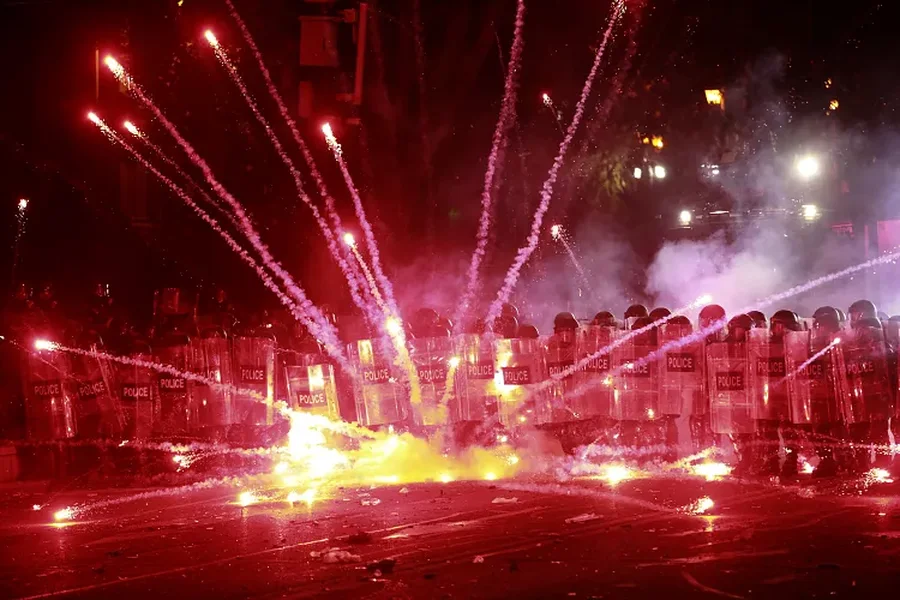
Georgia is far from a lost cause. However, it requires strong support from the Western leadership, always if the latter wants to prevent the violent introduction of this country into the Kremlin's sphere of influence...
The controversial parliamentary elections of October 26 in Georgia have plunged this country into a serious democratic crisis, jeopardizing its candidacy for joining the European Union and its Euro-Atlantic trajectory.
At the heart of this crisis are evidence of election rigging, extensive Russian interference, and a ruling party that is clearly determined to do anything to consolidate its positions. With no other institutional means available to defend democracy, the united Georgian opposition, led by President Salome Zourabichvili, has launched a peaceful protest movement.
The country today finds itself at a crucial crossroads in its modern history, where the outcome of the current clashes will have geopolitical consequences that will reverberate far beyond Georgia's borders. President Zourabichvili's complaint that the October parliamentary elections were illegal has shocked the nation.
She said evidence of Russian interference and systematic manipulation of policies shows that the ruling Georgian Dream party is embracing increasingly authoritarian and openly pro-Russian tactics.
Zourabichvili and other opposition figures are accusing the ruling party of using anti-Western and anti-Ukrainian narratives to gain advantage during the election campaign.
This includes the claims that the opposition forces are part of a "global war-mongering party" led by the West, or the even more imaginary hypothesis, that the latter is trying to open a "second front" against Russia through Georgia.
Critics argue that the events of October 26 in Georgia were more of a show to consolidate the political status quo in the country than a true electoral event. Independent polls revealed a large majority of votes for pro-Western opposition parties. However, the Georgian Dream declared itself victorious despite documented evidence
of vote manipulation. Reports from international observers and Georgian civil society reveal a disturbing reality, including abundant evidence of apparent irregularities, such as altered voter turnout figures and statistical anomalies.
The voting process itself was accompanied by many examples of violence and intimidation. Developments in Georgia are geopolitically important for the surrounding region. Located at the crossroads between Europe and Asia, the country serves as a vital hub of energy transit lines, and a potential model of democratic resilience, in a region where autocracies and empires have long struggled for dominance.
Since coming to power in 2012, the Georgian Dream has increasingly aligned itself with Moscow and Beijing. This has led to favoring Chinese companies for projects such as the reconstruction of the port of Anaklia, and allowing Russia to circumvent Western sanctions.
Allowing Georgia to slide into authoritarianism would send a dangerous message: that democratic values are negotiable. For the United States and the European Union, the risk is not just about this country. At stake is the credibility of the West throughout the region.
Without the manipulations used by the Georgian Dream party, Tbilisi would be aligned with Western foreign policy priorities, such as opposing the expansion of Chinese, Russian and Iranian influence in the Black Sea region.
Georgia's united democratic opposition and civil society there have shown their willingness to lead a peaceful transition of power, and to position Georgia as a reliable ally of the West. However, fulfilling this vision requires coordinated action from Washington, Brussels and London.
First, new elections must be held under international supervision. Only transparent elections, monitored by independent actors, can succeed in restoring democratic integrity and advancing Georgia's prospects for EU membership.
Second, the West should impose specific sanctions on the leaders of the Georgian Dream party, but also on others in Georgia who facilitate Russian interests and undermine democracy. These sanctions would send a clear message of support for Georgia's democratic aspirations.
Washington and Brussels may add more financial restrictions to the visa ban that has already come into force. The swift passage of laws currently awaiting approval in the US Congress to support the people of Georgia would further demonstrate decisive commitment.
Third, Georgian civil society and independent media need greater protection from the oppression of the current government. With the Russian-inspired law on "foreign agents" currently in force in Georgia, targeted funding and diplomatic support are critical to ensuring these democratic pillars remain free and accountable.
In this case, the key is a coordinated transatlantic pressure. A decisive action against Georgia could help strengthen a Western ally and stabilize a very important region, while also strengthening democracy at a crucial moment.
Georgia is far from a lost cause. However, it requires a strong support from the Western leadership, always if the latter wants to prevent the violent introduction of this country into the Kremlin's sphere of influence./ Pamphlet adapted from "Opinione.it".


Lini një Përgjigje