


 Shkruar nga Pamfleti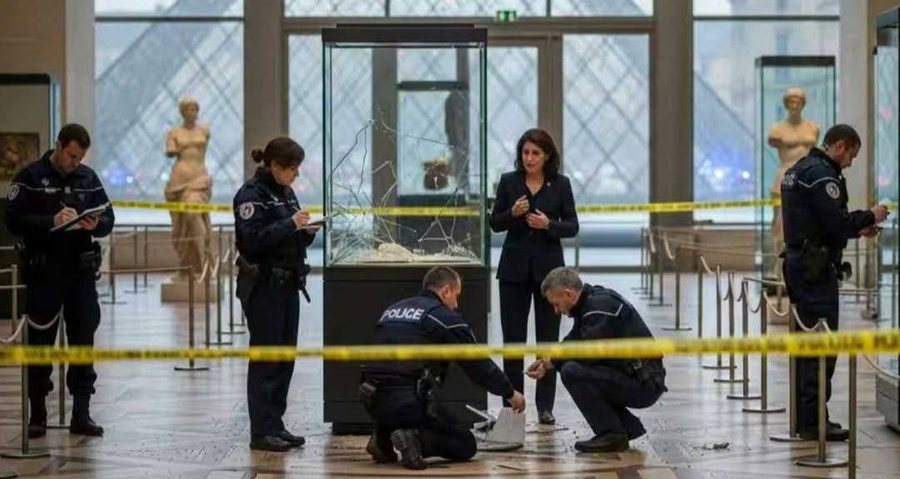
" Jewelry of inestimable, unrepeatable value has been stolen. And the famous robbery in Dresden, when the famous 'Verde di Dresda' emerald, part of the award of the Order of the Golden Fleece, was also stolen, has not served as a lesson. " This is what Stefano Papi, a deep connoisseur of European crown treasures and one of the most authoritative figures in the field of historical jewelry, declares, regarding the recent robbery of eight jewels from the Louvre Museum in Paris.
Papi, former head of jewellery at Sotheby's in London in the 1990s, has closely followed many of the auctions of European royal treasures, including the "Bijoux Napoléon" and "Bijoux des Souveraines", parts of the Louvre collection that were stolen. He says: " At that time I followed the sale of the large diamond ribbon of the Empress Eugénie, wife of Napoleon III, one of the most precious pieces on display in the Louvre. Also in 1992, her tiara was sold at auction for 1 million Swiss francs. An extraordinary work of pearls and diamonds that later ended up in the collection of the Thurn und Taxis princely family - Princess Gloria Thurn und Taxis wore it at her wedding in 1980, along with a pearl and diamond brooch. Later, the friends of the Louvre returned these treasures to France and to the museum, exactly where they were stolen again ."
The empress’s tiara and brooch are among eight objects looted from the Apollo Gallery. “ Eugénie’s tiara is probably the most important treasure among the entire collection of Napoleonic and royal jewels exhibited at the Louvre ,” Papi points out. He adds that it was once thought that the old shapes and cuts of diamonds reduced their value, but the market has proven otherwise: in 2018, Queen Marie Antoinette’s pearl was sold for 36 million euros by the Bourbon-Parma family, while a pair of three-row diamond bracelets from the last queen of France fetched 6 million euros. “Today, the historical value of these jewels is more powerful than carats – they are irreplaceable.”
But why talk about Napoleonic jewelry and the crown jewels of France? Papi explains: “The jewelry of the Napoleonic period was created using precious stones and objects from the French royal treasury, which, after the French Revolution, partially passed into the ownership of the state and was redistributed. One such example is the Crown of Empress Eugénie.”
Ironically, it is this crown that was found alone after the robbery – damaged, near the museum building. “ The crown is enclosed with eagle symbols and is adorned with 102 clear diamonds totaling 32 carats, which were gifted to the jeweler Lemonnier by the emperor himself in 1855. The diamonds were previously part of the jewels of the Royal Treasury of France, but they were not enough and other stones, including emeralds and gold, were added to complete a masterpiece of craftsmanship of that era. For years, this crown was kept in its original box, designed according to its exact shape .”
In 1887, the French government decided to auction off most of the crown jewels. “ They were considered too burdened with monarchical symbolism and unsuitable for a secular republic. Essentially, they were historical treasures that were frightening for what they represented .” Only a small portion of them, such as the diamond reliquary brooch of Empress Eugénie, made with diamonds from Cardinal Mazarin, was not sold and remained in the Louvre – exactly where it was stolen.
Papi also dwells on a parallel story with Italy: "My grandmother, Giulia, was very close to the sister of Count Cao di San Marco. It was precisely this count, secretary to the king, who hid and saved the jewels of the Savoia family during World War II, for fear of Nazi looting. Those jewels are still in the Bank of Italy and no one dares to expose them."
Finally, the Pope warns: “We are losing parts of our cultural identity. These are not just ornaments – they are living stories, testimonies of the eras that have shaped Europe. And every time one of them disappears, a part of our collective memory also disappears.”








Lini një Përgjigje