


 Shkruar nga Pamfleti
Not having children means destroying yourself...
“A spectre is haunting Europe,” Marx and Engels once wrote. Today, if things continue like this, not even the spectre will remain. Europe is gripped by a demographic crisis that is accelerating year by year. The latest Eurostat data confirm that the fertility rate on our continent fell to 1.38 children per woman in 2023 and is likely to have fallen even further in 2024. Since 2012, the number of deaths has exceeded births and, as a result, Europe’s population is decreasing at a frightening pace.
This phenomenon has immediate economic and social consequences: businesses are finding it increasingly difficult to find employees to replace those who retire, while countries are facing great financial pressure on pension systems, also due to the increase in life expectancy. But the problem is not only financial. Without a new generation, there is a lack of those who will take care of the elderly, and the demographic gap is turning into a social crisis of new proportions.
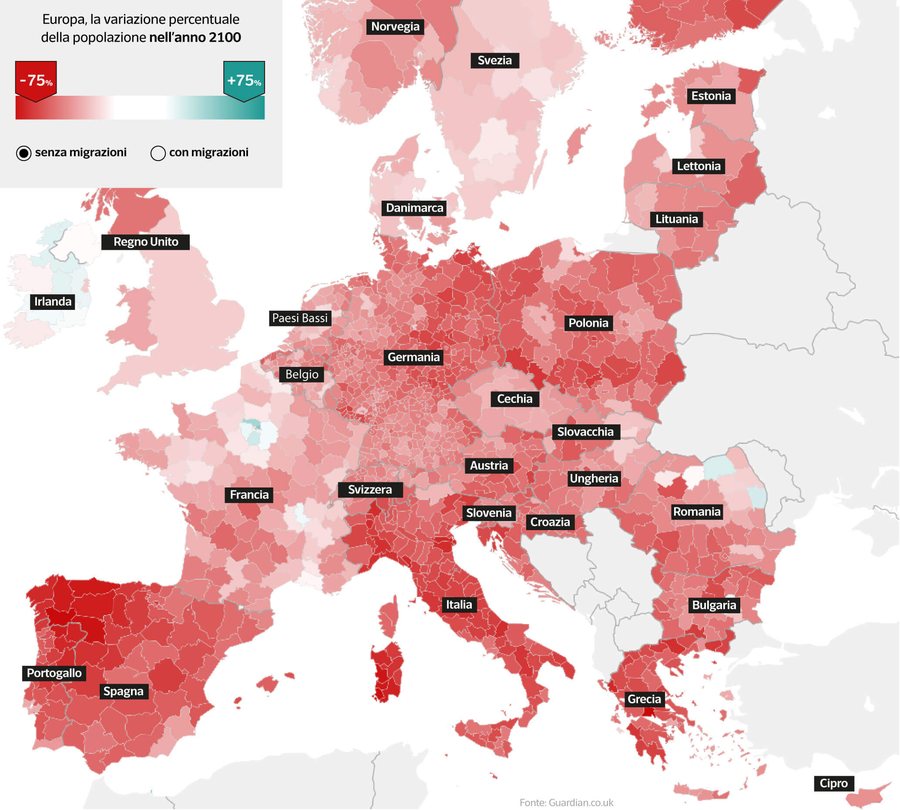
Eurostat’s latest projection, published in The Guardian, warns that in the absence of immigration, the EU population will fall from 447 million to just 295 million by 2100, a catastrophic 34 percent drop. Public policies to boost fertility, implemented in countries such as Sweden and France, have shown very limited effect. At best, an increase in public spending by 1% of GDP brings a very slight increase in fertility by 0.1, far from the 2.1 level that would stabilize the population.
Paradoxically, Sweden is the best example of this failure: despite extensive financial support for families, the fertility rate there in 2024 was only 1.43. This does not mean that family policies should not be implemented; on the contrary, they are necessary to avoid falling below the critical threshold of 1.5, below which countries fall into the “demographic trap”, where the lack of potential parents makes any efforts to increase fertility worthless. But the reality is that fertility policies alone are not enough. Without immigration, Europe cannot survive.
Here lies one of the EU's greatest political failures. With a few exceptions, the continent lacks a common migration policy that guarantees regular, sufficient and integrable flows. Currently, migration to Europe is insufficient, irregular and often unsuccessful in integration. The daily tragedies in the Mediterranean are a reflection of this failure, while the migrants who do manage to make it often face poverty, unemployment and social exclusion.
Italy is an illustrative example. In 2023, the country experienced a record wave of landings that was somewhat mitigated in 2024-25 thanks to the Meloni government's agreements with North African countries. But these agreements are fragile, because African countries have no interest in completely stopping irregular flows; they serve as a tool to pressure Brussels for financial aid and other concessions. Meanwhile, the number of regular immigrants is still too low to balance the demographic decline. Although the Meloni government increased work permits from 30,000 to 160,000 by 2025, at least 350,000 immigrants are still needed per year to maintain the balance between workers and pensioners.
The solution is clear: the creation of regular and controlled channels for economic migration, accompanied by strong integration and training policies. This includes the creation of recruitment and training centers in countries of origin, language teaching and cultural orientation for migrants, and the construction of a sustainable system of coexistence and cooperation with host communities. A model that is already being successfully implemented in countries such as Spain, which has benefited from migration from Latin America, where language and culture are shared.
It should not be forgotten that increasing productivity can partially alleviate the crisis. Fewer workers can produce more if they are better qualified, better equipped and more efficient. But this is not the only solution, as the long-term public finance projections in many member states show. Without a clear strategy for regular and integrated immigration, Europe will continue to age, shrink and lose its weight in the world.
In this battle for survival, the question is no longer whether Europe will accept immigrants or not, but how it will accept them: as a force that revives the continent, or as a consequence of crises and failed policies. Because in the end, history does not forgive emptiness. And Europe is being emptied. / Adapted from Corriere Della Sera






Lini një Përgjigje