


 Shkruar nga Pamfleti
Xi Jinping's visit to Belgrade coincides with the 25th anniversary of the bombing of the Chinese embassy in Serbia...
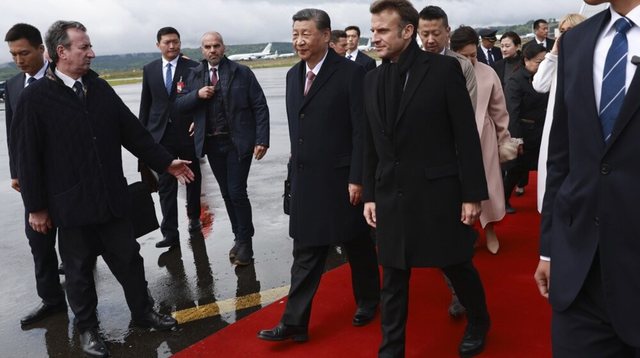
The Chinese leader's visit to Europe began on Monday in Paris, where he met with French President Emmanuel Macron, followed by a tripartite meeting with European Commission President Ursula von der Leyen and an evening state banquet at the Elysée Palace.
Macron today took Xi to the Tourmalet pass at 2,000 meters in the Pyrenees mountains, an area where the French president spent childhood holidays with his grandmother. The two last met in April 2023 during Macron's three-day state visit to China.
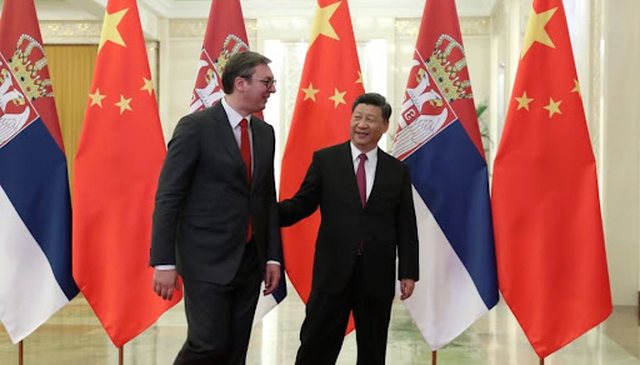
He then left Paris for Belgrade to meet Serbian President Aleksandar Vucic and on Thursday he will be in Budapest, where he will meet Hungarian Prime Minister Viktor Orbán. The two pro-Russian countries and big beneficiaries of Chinese investments.
What is the purpose of his visit?
Officially, Xi's visit to Paris was meant to mark 60 years since the establishment of diplomatic relations between France and China: France was the first Western country to officially recognize the People's Republic of China on January 27, 1964.
His visit to Belgrade coincides with the 25th anniversary of the bombing of the Chinese embassy in Serbia, when three people were killed after a US strike accidentally hit the compound during a NATO air campaign against Serbian forces occupying Kosovo.
In Serbia, where China is the single largest source of inward investment, Xi is believed to be playing an anti-US and anti-NATO agenda: one of the reasons why China has maintained its support for Russia since its invasion of Ukraine .
In Hungary, Xi will outline the close economic and diplomatic ties between the two countries, including security cooperation, and discuss progress on China's "One Belt and One Road" initiative, which includes the Budapest high-speed rail link -Belgrade.
What are the issues on the table?
The visit has been overshadowed by EU concerns about China's support for Russia two years after the war against Ukraine, and Beijing's concerns over the bloc's economic security agenda, including the threat of high tariffs on Chinese imports.
Beijing, for its part, aims to avoid the threat of European tariffs on Chinese electric vehicles following an EU investigation into state support for the industry in China. Studies show that China's subsidies are three to nine times higher than other major economies.
Human rights groups said the issues of Tibet and Xinjiang, where the UN believes China has committed crimes against humanity by placing up to one million ethnic Uyghur Muslims in re-education camps, should be raised.
What will be the result?
Most analysts doubt the EU and its messaging about the looming trade dispute and China's support for Russia over Ukraine will make much headway with Xi, whose visit appears designed to exploit the bloc's internal differences. .
China's economy is struggling and the US is increasingly reluctant to open up to Chinese companies, meaning the EU may have some leverage, but its 27 members are not fully aligned on policies. of China, undermining its influence.
Macron advocates a more aggressive EU stance on subsidies and has warned that the bloc risks falling behind without subsidies, but other leaders, such as German Chancellor Olaf Scholz, stress the importance of the Chinese market for its exporters.
Janka Ortel from the European Council on Foreign Relations, estimates that Xi's visit to Paris "is unlikely to have a significant impact on China's behavior".
And Shen Dingley, an analyst from Shanghai, said that his visits to Belgrade and Budapest are part of China's efforts to deepen divisions in the West. / Adapted "Pamphlet" from "Guardian"



Lini një Përgjigje