


 Shkruar nga Pamfleti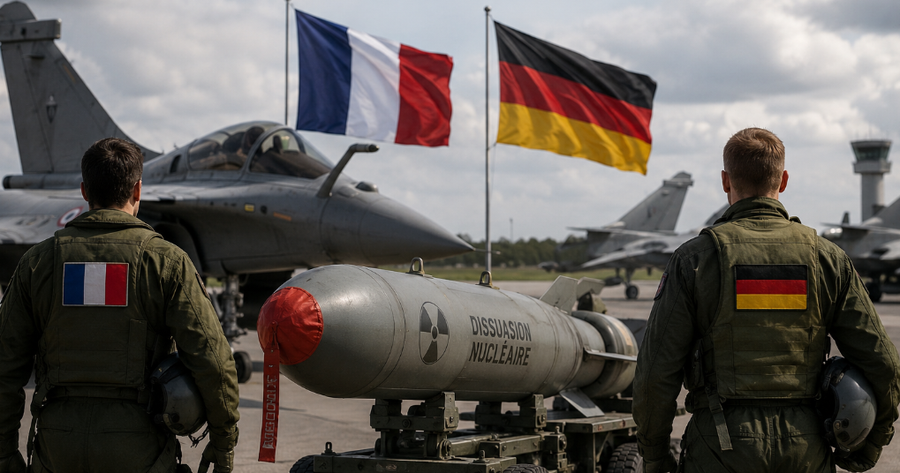
In March, Macron announced a strategic shift...
Is the embryo of a fully European nuclear defense taking shape? The fact that Germany will participate for the first time in the "French Poker" nuclear exercises this fall, as announced by Chancellor Friedrich Merz during his recent meeting with President Emmanuel Macron, marks a decisive step towards a continental approach to new collective security practices. For the time being, Berlin will participate with conventional forces, Merz reiterated, but it is important to emphasize that the ambition of France and Germany today is to build a credible security architecture that brings together all areas to respond to the changing challenges of Europe and the deteriorating global landscape.
Germany is not a nuclear-armed power, but it is developing a program aimed at making it the main conventional military force in Europe by the middle of the next decade. In a context of increasing uncertainty, acquiring the ability to manage the dynamics associated with scenarios in which French nuclear forces could be put on alert represents a step towards increased strategic integration. This action follows the path set out by France and Germany in recent months and could enhance the Republic's new nuclear deterrent capability.
The concept behind the Paris strategists is that of "advanced deterrence", which evolves the traditional French paradigm of nuclear deterrence, which was based solely on the so-called "countervailing value" theory. Historically, Paris had an autonomous deployment doctrine that identified only an existential threat to the metropolitan area as the scenario potentially capable of causing the president to press the red button. Countervailing value, in essence, was based on the possibility of accumulating a sufficient number of nuclear warheads to enable a response to any type of attack capable of inflicting losses on a potential enemy that would discourage it from using nuclear weapons against France.
In March, Macron announced a strategic shift. The aim is now to significantly expand Europe's nuclear-armed perimeter and seek partners with whom to build coordination capabilities, both for the possibility of deploying French nuclear-armed fighter jets forward and for the development of concrete adaptation capabilities for allied countries to manage potential nuclear threats.
Three-level prevention
Initially, France worked to build a coherent policy framework to manage the potential provision of deterrence to third countries, according to a process that the European Leadership Network wrote about in March: “This framework is structured at three distinct but interconnected levels: a French sovereign nuclear component, a conventional European division of labor, and a network of institutionalized bilateral dialogues.” This kept the keys to deployment firmly in the hands of the French and sought to understand whether, in a future where American nuclear deterrence might not be guaranteed, the United Kingdom could also have its say in Paris’ support for a European umbrella.
France, being outside the Atlantic Alliance's Nuclear Planning Group, has seen the atomic bomb as an instrument of power, prestige and a real life-saving policy for national sovereignty since the time of General Charles de Gaulle. In this regard, War on the Rocks, in a profound and well-regarded analysis, highlighted the difference between the French proposal for Germany and other European partners and the nuclear sharing agreements that countries like Italy (and Germany itself) have signed with the United States: temporary rather than permanent deployment of nuclear warheads and no French training for an operational role in the deployment decisions of the armies of the countries that will open their doors to Rafale fighter jets, the cornerstone of deterrence.
To date, the risk is largely political, and it remains to be seen whether the partner powers will accept a pan-European version of the “countervalue”, based on the Paris security guarantee offered in a flexible and scalable form, but with French leadership. It remains to be seen whether this will ultimately be the optimal deterrence scenario for countries like Germany. The participation of the Berlin military in the Poker exercise is a step forward towards a European security model that seems to have structured two principles: on the one hand, Germany’s pursuit of centrality in conventional forces and, on the other, France’s leadership in ultimate deterrence, nuclear deterrence.
Can all this be strategically sustainable? NATO in Europe, after all, remains united because the hegemon is known and clear, the guarantor of the ultimate means of collective security: the United States. France and Germany are seeking parallel paths to expand a European security incubator, and the nuclear issue is inevitable. In the long term, the challenge will be to understand whether these trends will intersect and complement each other, perhaps even seeking NATO’s own space as a reinforcement zone, or whether rivalries and protagonisms will emerge. The recent case of the FCAS fighter jet, which sank after years of tension, is a reminder that the Franco-German axis can, in some cases, be destroyed. The challenge of strengthening security cooperation must take these issues into account and determine how to address them./ Adapted from “Pamphlet” by “InsideOver”


Lini një Përgjigje