


 Shkruar nga Diplomatico | Pamfleti.net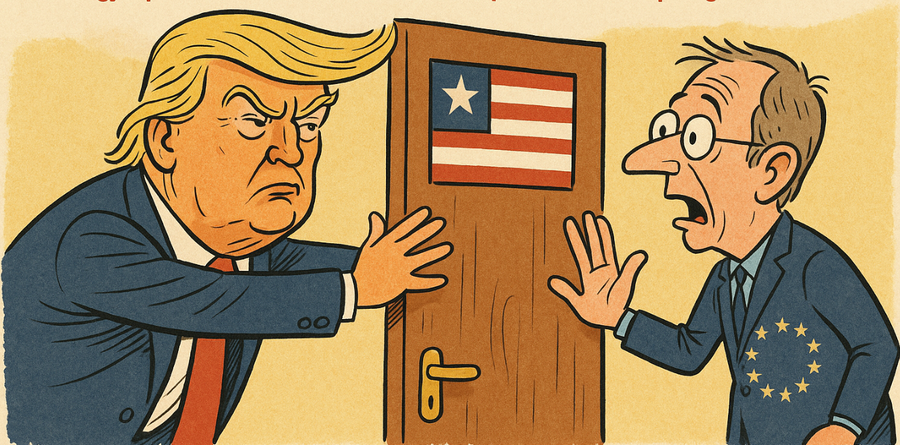
Washington is abandoning traditional diplomacy and entering the game of geopolitical business, putting the EU in its most precarious position of the decade...
US-EU relations are entering a period where new political, economic and strategic realities are pushing both sides towards a profound reformatting of the transatlantic partnership. At the heart of this transformation lies the sharp contrast between two visions: the traditional policy of alliances, which built the Western order after 1945, and the new policy of “geoeconomic business”, with which the US is reading the world today.
For decades, the US-EU alliance has been an architecture that operated on the principle that global security and stability are not costs but investments. America bore the brunt of collective defense not because it sought immediate financial gain, but because it guaranteed a united, secure, and politically predictable Europe. The EU, for its part, built its identity on rules, multilateralism, and the idea that the West’s real strength lies in the alignment of values and institutions. In this logic, Washington saw Brussels as the main partner for maintaining international order.
But today, in a transformation that many analysts consider the biggest since the end of the Cold War, the US is moving towards a completely different philosophy: foreign policy as “economic balance”. Strategic interests are being measured in numbers, trade, production, supply chains and direct national benefits. In this new perspective, alliances are useful only if they deliver immediate results. The EU is seen more as regulatory competition, a “bureaucratic machine” that slows down American innovation and constrains American industry through common standards. This also explains the growing skepticism towards institutions like the EU, the WTO, and even NATO itself, not because of strategic distrust, but because of their political and economic cost in today’s American perception.
This is precisely the moment when the US and the EU are reading the world with different eyes. Brussels thinks of long-term equilibrium and common rules; Washington thinks of quick profit and industrial advantage. The EU wants stability; the US wants flexibility. Europe aims to preserve institutions; America seeks to bypass them to negotiate directly. The result is a new structural uncoordination, which is creating dangerous gaps in global politics.
For Europe, this shift has direct consequences. It can no longer automatically rely on American security guarantees, especially if Washington sees NATO as an expensive project and the EU as a difficult partner. This pushes the continent towards an urgent need for “strategic autonomy”, a concept that until yesterday was a theoretical debate, while today it is a practical emergency. Meanwhile, Russia and China benefit from every transatlantic rift, increasing their influence in the European neighborhood, in energy markets and in sensitive areas such as the Balkans.
This is where the importance for Albania and the region comes in. The Balkans is an area where any vacuum between the US and the EU immediately becomes a playground for revisionist players. If Washington focuses primarily on economic gain and Europe gets bogged down in its own political bureaucracy, the region risks entering a new period of uncertainty. For Albania, this requires more active diplomacy, a clear Euro-Atlantic positioning, and the ability to maneuver in a world where alliances no longer function solely as “values” but also as “transactions.”
In essence, US-EU relations are not weakening; they are changing shape. From a partnership based on ideals and strategic architecture, they are evolving towards a relationship that more closely resembles an ongoing negotiation between two economic powers. Washington is bringing business logic to the field of diplomacy; Europe is trying to uphold the principles of the liberal order. The question that remains is whether these two philosophies can coexist without undermining Western security and global equilibrium. /Pamphlet


Lerini keto dengla se edhe ju te Shqiperise jeni shitur te sebet e ruset sllave si dhe Kina e tani derdellisni ne ajer. I gjithe Perendimi i mencur kujtoi e kujton se eshte i mencur perdhunoi e vodhi tere boten e trete e i beri parate qeffe e rrush e kumbulla. Shihni kryeqytetet e qytet e Europes te ndertuar ne kohetn e arte te tyre. Ndertime gjigande me arkitekture fantastike klasike, te nderuara ne kohen kur populli European vdiste per buke e mbreterit benin ballo neper pallate. Kur dolem ne Shqiptaret e varfer neper bote te terhequr nga qytetet e praruara u zhgenjyem ne fund. I urrej bukurite e "qyteterimit" qe te Egjypti, Athina, Roma, e Europa sepse ne themelet e tyre jane gjaku e kockat e sklleverve. Sot skllaveria eshte me e eger por me e sofistikuar. U perdor Kina si krah i lire pune e sot eshte superfuqi. Kollaj te shvendosesh fabrikat ne Kine e nje plale Nike dalin me koste $10 e shiten ne Perendim $200. Ata vodhen e kopjuan teknologji e tani te thone sus. Perendimi i premtoi ish vendeve komuniste parajsen, zhvillim e perparim e i la ne balte t'i perdore si vasale. Politiqenet jane kafshe te ndyra per xhepin e tyre por, popujt e provojne politiken me urine e ngricen ate dhe e shohin realisht. Kur nje politiqen leh ne podium dhe e sheh turmen nga larte si injorante qe qesh, nuk e kuptojne se turma nga poshte qesh me gruan e tij qe nuk ka veshur breke e i sheh bukuroshken e rruar.
Europa eshte si puna atyre pleqeve te mocem zevzek, qe krijojne vete konflikte Artificiale mes veti qe me pastaj te shkojne te zgjidh in gjoja problemin qe vete kane krijuar. Ata vijne rende rende, trokasin ne dere hyjne brenda, pastaj duan kafen, duhanin, rakine so fillim dhe thone qe problemi eshte I veshtire ne zgjidhje do e shqyrtojme perseri. Dhe vijne perseri tani duan edhe pule te pjekur dhe meze, me vone duhet tu presesh dashin e kmones E keshtu me radhe. Amerika nuk ka kohe per keto gjera te vogla te egzagjeruara. Ajo eshte praktike e shpejte dhe frytdhenese. Te vjen ne shpi dhe madje nuk ulet fare, ne oborr te thote eshte ky problemi si do veprosh. DHE me e mira eshte se cdo pergjigje jotja per te eshte ok. Kush ka force dhe stabilitet te brendeshem nuk pyet per cfare do thote tjetri I Jashtem. Do paqe ok, nuk E do ok?