


 Shkruar nga Pamfleti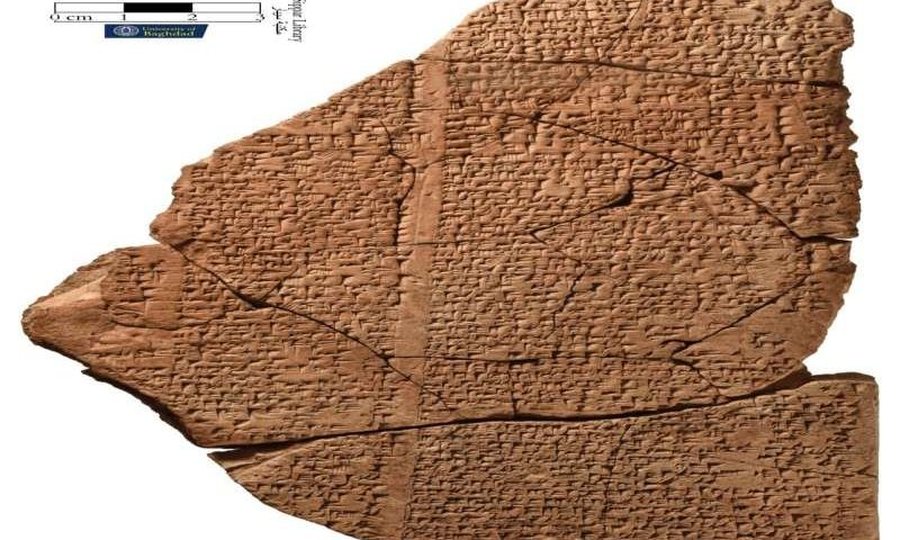
A text lost for a millennium has been discovered during a collaboration between Enrique Jiménez, professor of Ancient Near Eastern Literature at the LMU Institute of Assyriology, and the University of Baghdad. A paper on the discovery has been published in the journal Iraq.
"It is a captivating hymn that depicts Babylon in all its glory and gives a glimpse into the lives of its inhabitants, men and women," says Jimenez.
Babylon was founded in Mesopotamia around 2000 BC. Once the largest city in the world, it was a cultural metropolis in which works were written that are part of our world literary heritage today.
Babylonian texts were written in cuneiform script on clay tablets, which have survived only in fragments.
One of the goals of the collaboration with the University of Baghdad is to decipher hundreds of cuneiform tablets from the famous Sippar Library and preserve them for future generations. Legend has it that Noah hid them here from the flood waters before boarding the ark.
With the help of artificial intelligence, they "read" the fragments and identified 30 other manuscripts, thanks to which, the researchers were able to fully decipher the hymn of praise on the clay tablet, parts of which were missing.
"The anthem was copied by children at school. It's unusual that a text so popular in its time was not known to us before," says Jimenez.
Apparently, the paean dates back to the beginning of the first millennium BC and consists of 250 verses.
"It was written by a Babylonian who wanted to praise his city. The author describes the buildings of the city, but also how the waters of the Euphrates bring spring and green the fields. This is all the more spectacular since the surviving literature of Mesopotamia is sparing in descriptions of natural phenomena," Jimenez notes.
The information about Babylonian women, their role as priestesses and the duties associated with them, has also surprised experts, as no texts were previously known to describe these things. In addition, the hymns provide information about coexistence in urban society. For example, the inhabitants are described as people who respected foreigners.
The ruins of the ancient city of Babylon are located about 85 kilometers south of Baghdad and are a UNESCO World Heritage Site.
Fragment from the recently discovered hymn
The poet now turns his attention to his fellow citizens, "the race of Lugal-abzu," "the descendants of Alalgar" (125, 127, Alalgar being Alulu's successor as king of Eridu in Mesopotamian tradition).
The “free citizens” (ṣābū kidinni) of Babylon are, for the author of this hymn, essentially the priests of Babylon, an indication that its author was probably a member of this class. The Babylonians are just, they protect the orphans and the humble (136-138), they follow the divine commandments and enforce justice,” the study’s authors write.
The following verses are from a recently discovered hymn. They describe the Euphrates River, on the banks of which Babylon was located at the time:
The Euphrates is its river, founded by the wise ruler Nudimmud
The Leah is quenched, the bridle of reeds is full,
It discharges its waters into a lagoon and the sea,
Its fields are full of herbs and flowers,
Its meadows, in bright bloom, sprout barley,
From which, gathered together, the wheels are assembled,
Herds and flocks lie in green pastures,
Wealth and greatness – what befits humanity –
They are rewarded, multiplied, and given royally.








Lini një Përgjigje