


 Shkruar nga Corriere della Sera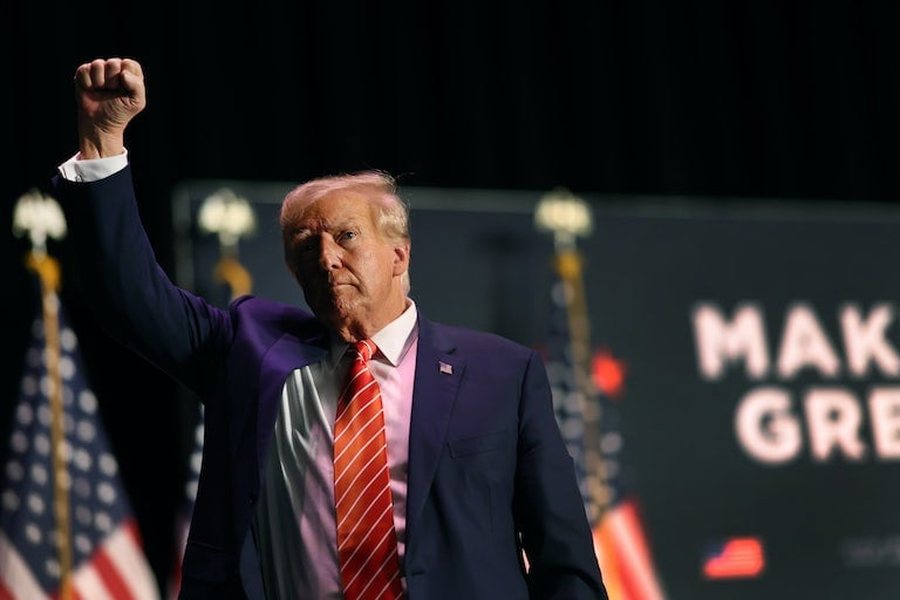
The theory according to which "America's enemies rejoice when there is a Democrat in the White House" will be used to attack Biden on what was once his strength, that is, his experience in the international field...
"There is no war with Donald Trump". Let's get ready to hear this slogan. It will accompany us throughout the 2024 American election campaign. It may seem crude and simple, but we must admit that it contains a grain of truth : the Trump presidency did not see the fire of major conflicts. Ukraine and Israel exploded under the Joe Biden presidency. Of course, for the former Republican president, this is evidence that his foreign policy was much more effective.
However, an unexpected reaction reassures Zelensky. Trump's man in Congress, namely the new Speaker of the House of Representatives, Mike Johnson, said: "We will not abandon the Ukrainians, Putin must not prevail." A reassuring message, at least in part (we'll see the details), given the isolationist tendency of the Trumpian right.
Although foreign policy does not usually decide elections, there are some exceptions: the Vietnam War in 1968, the taking of American hostages in the Tehran embassy during the Khomeinist revolution in Iran in 1979, defeated the candidacies of Lyndon Johnson and Jimmy Carter, two Democrats (the former decided not to run again, the second was defeated by Ronald Reagan). At the moment, neither Ukraine nor the Middle East has such an influence on the American population as to seem decisive. Between now and next November, he doesn't know. In any case, the visibility of international crises is increasing, with effects on both sides: just look at how much Gaza divides the democratic left between pro-Israeli and pro-Palestinian. Therefore, foreign policy is likely to be discussed more than usual during the 2024 campaign.
Trump maintains a wide margin of advantage over other contenders for the Republican nomination; in some polls he is slightly ahead of Joe Biden for the final duel. So we should pay attention to his positions on the great crises of the moment. In detail, as always, he is capable of saying shocking, perhaps absurd things even to a part of his base: to attack Biden, he has occasionally exalted Putin, even Hamas.
But his general reasoning is not so far-fetched. Under his presidency there was no major conflict, nothing comparable to the global chaos that characterizes the Biden era. Putin waited until a Democrat was back in the White House to invade Ukraine, just as he had invaded Crimea during the presidency of Barack Obama (whom Trump blames for other mistakes or weaknesses, from Libya to Syria).
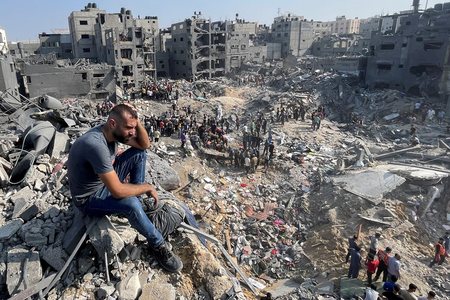
Iran and its armed wing Hamas unleashed its own "9/11" on Israel under the Biden presidency. Kim Jong-Un has resumed his missile tests that threaten South Korea and Japan. The People's Liberation Army under Xi Jinping is carrying out a crescendo of aggressive actions against Taiwan, the Philippines and other US allies, even coming close to shooting down US military aircraft. Let's put aside Trump's egomania, narcissism, arrogance and incompetence; the conclusion many Republicans draw seems to be based on the facts: the world was less dangerous and unstable in the four-year period from January 2017 to December 2020. So Trump was clearly more credible.
Trumpians remember the following facts. Kim Jong-Un may be a madman and a criminal, but he was flattered in his vanity by the honor that Trump did him by meeting him face-to-face at the Singapore summit, and in turn he was probably intimidated by the threats of Trump that he will destroy North Korea. The fact is that his provocations had a period of moderation.
Iran, after daring to attack several American bases in the Middle East, was punished in early January 2020 with the assassination of General Qassem Suleimani, the head of Tehran's paramilitary forces. The Abraham Accords, with the recognition of Israel by important Islamic countries (the Emirates, Bahrain, Morocco, Sudan), were carried out under the leadership of Mike Pompeo, Trump's Secretary of State. The American withdrawal from Afghanistan was negotiated by the Trump administration in Qatar with Taliban leaders and finally ended a twenty-year war, then it was Biden's inept and clumsy application that turned that withdrawal from Kabul into a devastating debacle.
Putin and Xi kept Trump at bay with a strange mix: on the one hand pampering autocrats with the respect and even admiration that a "strongman" might pay his peers; on the other hand with the unpredictability created by Trump's combative language. (Relatedly, the "crazy leader theory" now in vogue during Richard Nixon's presidency was revived: we make our enemies believe that I am not in control of my mind, that I can press the nuclear button first, so to make them more careful).
Individual facts can be interpreted differently. However, behind Trump's foreign policy we can see a pragmatic doctrine that is typical of conservative thought. Realpolitik in a world of antagonistic superpowers might advise us to treat rivals with respect, recognizing their respective spheres of influence, while at the same time arming ourselves to the teeth to protect our vital interests. Trump is an isolationist, but he has spared no resources for his armed forces. He is skeptical of NATO, does not believe in the value of alliances, but has invested in his army. The theory according to which "America's enemies rejoice when there is a Democrat in the White House" will be used to attack Biden on what was once his strength, namely his experience in the international arena. More than Ukraine, the crisis in the Middle East could damage Biden's image as a competent leader on global affairs. / Pamphlet



Lini një Përgjigje