


 Shkruar nga Pamfleti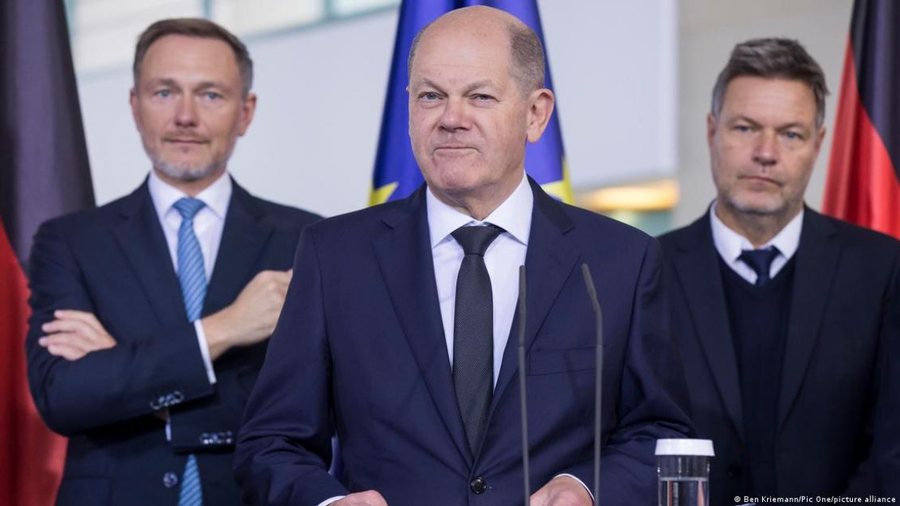
Sometimes the visits of politicians come at the right moment for them. Such was Chancellor Scholz's visit to Dresden on Tuesday (20.08.), where the first shovel was symbolically laid for the establishment of a chip factory. This factory, backed by billions from the German government, will supply Germany and Europe with semiconductor chips. Scholz calls semiconductors "the oil of the 21st century" and personally came to the opening of the foundation of the factory under the motto: crisis? What crisis?
These days, the chancellor's mere presence plays a role. Recently, he was given the title of "temporary chancellor". And for this, the initiator was not the German opposition, but a partner of the coalition itself. The head of the Green party, Omid Nouripour, in the summer interview for ARD, described the government of the current coalition between the Social Democrats, the Greens and the liberals as a "temporary government" after the Merkel era.
"Every government is the government before the next government"
A wording that has caused debate. It should be remembered that the chancellor himself does not see himself as an interim chancellor, Scholz himself points out in his own dry way that: "Every government is the government before the next government - and sometimes it is the same one". After all, Scholz admitted in a dialogue with citizens in Bremen on Monday that the real governing performance of the coalition was overshadowed by the difficult decision-making processes in the coalition. And he called on his coalition partners to "govern well" and "behave well".
It is debatable whether Scholz's public rebuke of Finance Minister Christian Lindner in the recent budget dispute was "good manners". Scholz looked more like someone who wanted to publicly show his finance minister that he himself understood monetary policy better. However, it was this argument - even Nouripour called it "perhaps the most useless of all arguments" - that has further accelerated the centrifugal forces within the coalition, whose partners had long been estranged from each other. It seems that there is an effort to hold together what can hardly be held together anymore, just to contradict one's sense of the temporality of politics. Of course, who wants to be a transitional government?
Wissing: Another stance from Nouripour
While the chancellor in Dresden talked about the future of the economy, FDP Transport Minister Volker Wissing used a visit on Tuesday to talk about the future of German railways precisely at a site for the general renewal of the tracks, a central segment for transport long distance rail. Currently, the German railway has become a symbol of what does not work in Germany. The Transport Minister spoke of the rail network as an "oldtimer" that the coalition government has taken over from the previous government. It is pronounced in relation to the voices of the "provisional government". "The FDP does not want to govern temporarily, but in the future," said Wissing, leaving it open whether all of this should be with the current coalition. The Liberals themselves have long been unhappy with the coalition government, but they sidestep it. the notion of "temporary".
Habeck will become a candidate for chancellor
We move on to the third coalition partner, the Greens. The politician who can become a candidate for chancellor of the Greens, Robert Habeck, currently the Minister of Economy, invited the citizens to a dialogue in the Ministry of Economy on Tuesday. Habeck will listen to the citizens, make the Ministry of Economy close to them. "The office is as tidy as ever." Habeck will improve the image when his gaze is directed by the chancellor's office.
Even if the chances are not that great at the moment, Habeck still has a message ready: "If I ever become chancellor, Christian Lindner will not be finance minister." How disappointed Habeck is with the coalition, it became clear after the compromise minimum achieved with the budget negotiations: "How to say: that's how it is".
More distance with your coalition, you hardly find. Regardless of whether one talks about a temporary government or not, later on this sentence is understood as the bells ring: everyone in the German governing coalition is now doing their own thing./DW




Lini një Përgjigje