


 Shkruar nga Pamfleti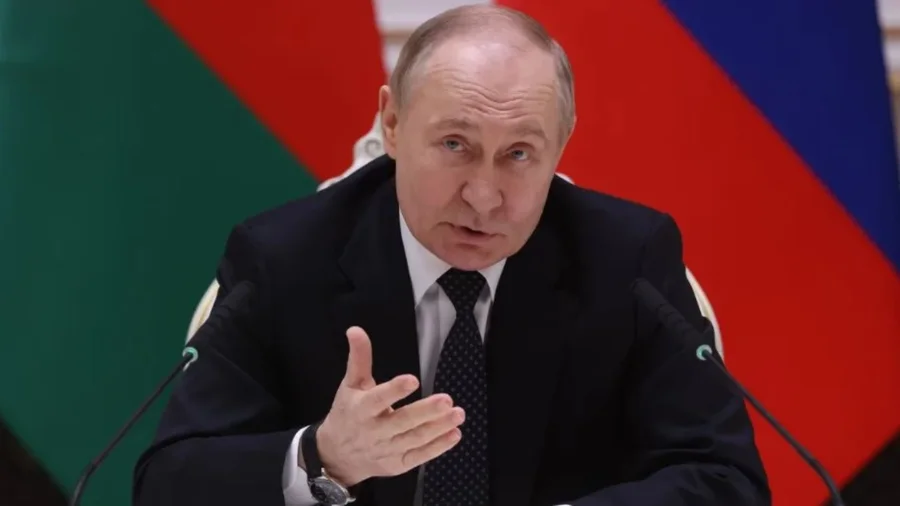
The Kremlin's less brutal goal in Ukraine — other than full or partial invasion — has involved a president in Kiev it considers loyal, who will halt the country's march toward the European Union and NATO.
Russian President Vladimir Putin's signaling this week that he is open to peace talks should be viewed with great caution.
On Friday, there was much buzz about the negotiations, the same month Moscow launched a third invasion of Ukraine from northern Kharkiv.
Reuters news agency cited four sources, in a report by two reporters with deep experience and ties to Russia, that Moscow was willing to consider peace talks that would freeze Russia's current occupation of about a fifth of Ukraine. .
Putin responded to that report by suggesting that Russia was willing to talk about peace, based on previous agreements. He hinted at a deal broken down in Istanbul shortly after the start of the war in 2022, which fell apart, largely because Moscow's forces were still across Ukrainian territory and the massacres around Kiev had come to light.
The idea floated in the Reuters report would not only fulfill Moscow's stated goal of capturing all of eastern Donetsk, but also undermine Kiev's insistence that it must not surrender any territory.
The context of Putin's comments was key. They came during a visit by Belarus President Alexander Lukashenko - something that in the past happened shortly before the Kremlin used Belarusian territory for military moves in Ukraine, while on Friday it took place during joint tactical nuclear weapons exercises between the two countries.
Putin questioned the legitimacy of Ukrainian President Volodymyr Zelensky, who Moscow has repeatedly attacked, after Kiev was forced to postpone elections due to the war Putin started. At the same time, there were unconfirmed reports that the private plane of former Ukrainian President Viktor Yanukovych had landed in Belarus. The pro-Russian Yanukovych fled Ukraine in 2014 after forces loyal to him killed dozens of protesters in central Kiev. The mere possibility of his presence during the meeting between Putin and Lukashenko led to speculation that Moscow was again hoping to create a proxy return to power in Ukraine.
The Kremlin's less brutal goal in Ukraine — other than full or partial invasion — has involved a president in Kiev it considers loyal, who will halt the country's march toward the European Union and NATO. It was fantastic before the 2022 invasion and emerged during the stalled Istanbul 2022 talks. But now it will likely need a Russian invasion force to impose it on a population seething with Kremlin brutality.
So why the talk of peace, especially when Russia appears to be having its most successful moment on the front line in months, if not since the invasion?
Diplomacy has always been a military tool for the Kremlin. He spoke for peace over Syria in 2015, after their planes struck civilians in rebel-held areas. He spoke of peace in 2015 with Ukraine while Russian troops and their proxies were in the throes of an all-out assault against the strategic Ukrainian town of Debaltseve.
It is not cynical to distrust Russia's sincerity when it negotiates, but a practical necessity. Experience shows that they consider talks worth pursuing if they unexpectedly bring about a beneficial non-violent outcome, or give their adversary cause to pause in the fighting to try and encourage a deal.
Moscow can also talk about peace again now for two reasons. First, Ukraine and its allies are calling a peace summit in Switzerland in June, where they will discuss, without Russia, what kind of deal they can accept. It is likely aimed at building momentum for an off-ramps that the Kremlin can take when its forces are eventually militarily exhausted or at a stalemate.
Zelensky has said he hopes China — Russia's most powerful ally but only a partial supporter of the war in Ukraine — will participate. Putin may be talking peace now to suggest to Beijing not to engage in diplomacy for Russia without Russia present. There is little serious chance that the Switzerland summit will end the war, but it could cement in the minds of the West how serious a threat Moscow poses to a real peace deal.
Ukrainian Foreign Minister Dmytro Kuleba said Friday that Putin's suggestions for peace talks were aimed directly at sabotaging the summit. "Putin currently has no desire to end his aggression against Ukraine," he wrote in X, adding "this is why he is so afraid" of the Switzerland summit.
Second, and more importantly, Putin is sending messages to governments in the West and the current US presidential campaign. He is trying to vaguely suggest—perhaps to populists in Europe, or MAGA Republicans in the United States—that a simple deal is at hand, one in which the front lines, in which Ukraine is currently losing casualties considerable, may freeze suddenly.
Western support for the war is costly and increasingly unpopular — although the recent $61 billion approved by Congress has probably given the issue a break from being at the mercy of electoral opinion for about a year.
The Reuters report allows those in the West who want to see an end to the war to believe that the Kremlin can stop the war, as it is, immediately. Kremlin spokesman Dmitry Peskov made the report sound like it reflected Russia's permanent position. But after all it may sound new and interesting to key Western figures: Donald Trump – who has failed to explain how he would implement his claim that he could stop the war within 24 hours – and other NATO members -s that are less favorable than France, Great Britain and the Baltic states, for the need to never trust Russia at the negotiating table.
Putin is a pragmatist. He started the fight thinking it would be easy. He went on to think that his tolerance for pain, autocratic certainty, and patience for victory would triumph. He might be right, just now. He now sees a moment of electoral weakness in the US and other European states, which he has met with a vague and murky signal that there may be a time for diplomacy.
It has the potential to gain some traction among those who desperately hope that the war in Ukraine will go away and who are less aware of the existential threat that a victorious and hypermilitarized Moscow poses to NATO's eastern members. But it must be seen through the lens of the deep cynicism of Moscow's previous diplomacy in Syria and Ukraine : used as a time to ferociously pursue the same military objectives, but against the backdrop of the illusion that peace may be around the corner./CNN


Lini një Përgjigje