


 Shkruar nga John Thornhill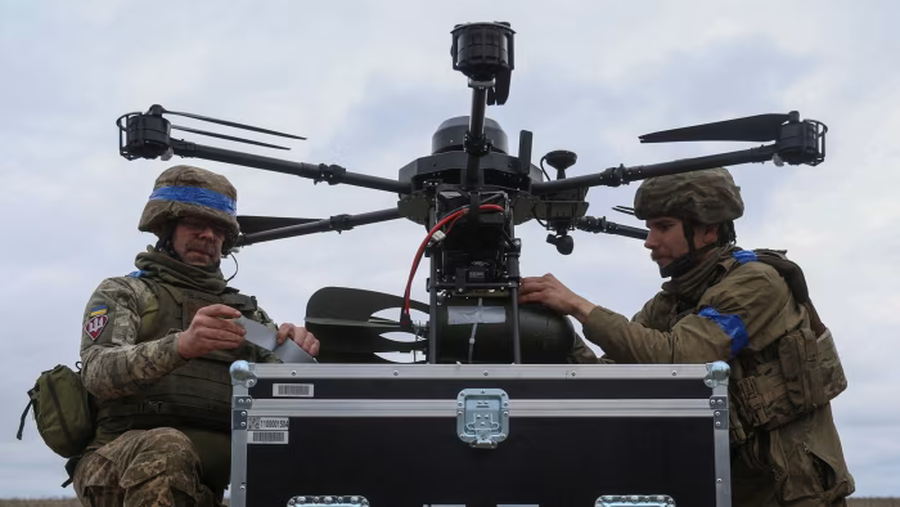
This innovative ecosystem has enabled Ukraine to experiment with more than 100 types of drones on the battlefield.
In a cramped basement in Kiev, a team of volunteers, including a florist, a professional dancer, a 77-year-old retiree and a former British soldier, are assembling drones for the Ukrainian military. Basic in design and costing $350 to produce, the 10-inch quadcopters boast distinctive red antenna mounts. “They call them red drones,” says Kseniia Kalmus, founder of Klyn Drones, a charity funded by donations.
Despite the cheerful humor, the workshop serves a deadly purpose. Once completed, the drones rush to the front lines, where they are in hot demand by the military units that have put them to work. They have quickly become a critical component of modern warfare, serving multiple purposes: surveillance, logistical support, mines, and deadly strikes against enemy soldiers, tanks, infrastructure, and ships.
More than three years after Russia launched its full-scale invasion, Ukraine remains largely unarmed and under-controlled. It still relies on its American and European allies for most of its traditional military equipment and intelligence. But it is quickly emerging as a “world leader” in drone technology, enabling it to continue to resist Russian aggression, says Giorgi Tskhakaia, a military adviser at the ministry of digital transformation.
“Unfortunately, Ukraine is not a very wealthy country, so we realized that we need to have very cheap and smart solutions that can bring game-changing potential to the front lines,” he tells me.
Drones have quickly become indispensable to Ukraine, but it is the country's technological-industrial infrastructure that may prove its greatest military asset. It is an example that other European countries should study closely as they urgently rearm.
Battlefields are the most demanding research and development laboratories for any technology, and the conflict has sparked a fierce cat-and-mouse race to experiment quickly. The Russians have a larger industrial base, ready access to Chinese components, and excel at electronic warfare that jams enemy drones. But Ukraine believes it is winning the initial battle thanks to its highly adaptable network of domestic manufacturers, who benefit from immediate feedback from frontline forces, clever use of artificial intelligence software, and supply chain localization.
As of 2022, the number of Ukrainian drone manufacturers has grown from four to more than 500 with the capacity to produce 5 million units per year, according to Tskhakaia. With sufficient funding that could increase to 10 million, he says.
To support this army, Ukraine has accelerated the arms approval process and provided economic and tax incentives to investors to support new private sector businesses. It has allowed frontline units to deal directly with manufacturers, accelerating innovation and deployment. It has also created the Brave1 platform to provide organizational and financial support for defense technology projects.
A research paper published last month by the Massachusetts Institute of Technology and the Kiev School of Economics examined how Ukraine has adopted a “whole-of-nation” approach to mobilizing civilian resources for drone development. Its defense technology cluster is driven by the interaction of five forces: start-ups; venture capital; universities; government agencies; and established defense companies.
This innovative ecosystem has enabled Ukraine to experiment with more than 100 types of drones on the battlefield, including unmanned aerial vehicles piloted via unbreakable fiber-optic cables and autonomous ground vehicles to resupply frontline troops. It has developed fixed-wing kamikaze drones that have a range of more than 1,000 km, enabling strikes against Moscow. And its Sea Baby and Magura naval drones have harassed the Russian Black Sea fleet, destroying several ships, costing tens of millions of dollars.
Drones are only fully effective when combined with heavier weapons systems. A recent report by the Royal United Services Institute estimated that up to 80 percent of drones flown by a pilot failed to reach their target. However, the sheer volume that Ukraine deployed meant that it was responsible for 60-70 percent of all Russian systems damaged and destroyed.
Ukrainian experts suspect that some military drones developed in the US and Europe risk becoming obsolete within weeks of any new conflict. Few military commands understand the constant need to adapt technology – or are structured to do so. Tskhakaia’s three main lessons from the conflict? “Technology, technology, technology. Innovation, innovation, innovation. AI, AI, AI.” European arms manufacturers need to learn quickly./ Adapted from “Pamphlet” by “Financial Times”








Lini një Përgjigje