


 Shkruar nga Federico Ferraù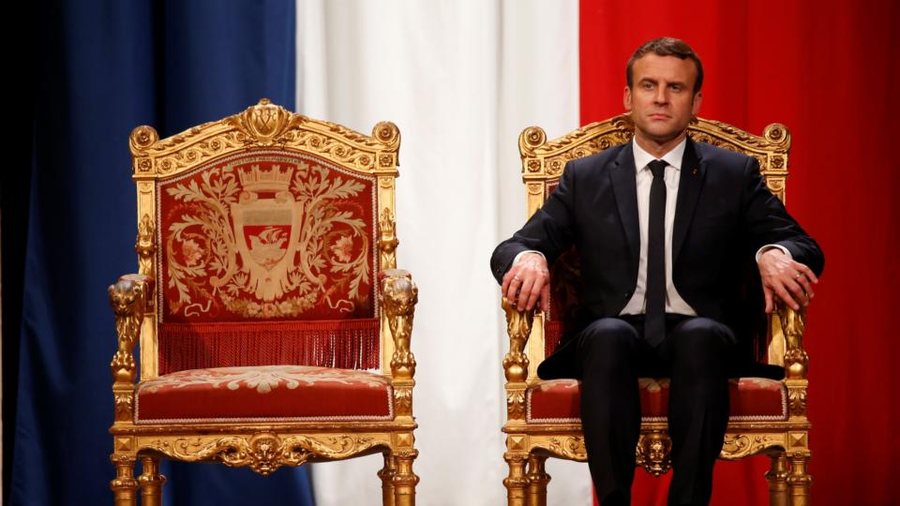
It is paradoxical that Macron describes as "anti-republican" all the parties that have the most votes. And therein lies the problem. We have a president who ignores the very foundation of the Fifth Republic: universal suffrage.
A reckless and unconstitutional operation that hastens the end of the Fifth Republic.
With his obsession with thwarting the popular will just because it is not what he wants, Macron is embodying a form of "post-republican" monarchy.
The French president should resign, thinks Mario Esposito, professor of constitutional law at the University of Salento and professor at the Luiss University in Rome. According to him, he is aiming to advance the idea that it is up to a minority of "wise men" to choose the best, and not the numerical majority. A dangerous operation, maybe not in Bucharest, but certainly in Paris.
After his address to the French nation last Thursday December, Macron is trying to dismantle the new Popular Front by separating the Socialists from Mélenchon. Will he make it?
According to a poll by the French newspaper Le Figaro, after the motion of no confidence in the Barnier government was passed, 6 in 10 French people believe that Macron should resign. This opinion reflects very well the dynamics underlying this very serious institutional crisis.
It is true that according to the 1958 Constitution, the president is not responsible for the actions performed in the exercise of his functions, except in cases of serious violations, which are incompatible with the exercise of the mandate. But beyond any hypothesis on the possibility of an initiative for his dismissal, even Macron is the bearer of a popular "mandate".
What does this mean?
That he too is subject to a form of political responsibility. It is true that Macron was elected as a counterpoint to Marine Le Pen, and more generally to the extremes of the political spectrum. But in the last parliamentary elections, the majority of voters expressed themselves in favor of the extreme left and the extreme right. Macron should take this into account.
In his address to the nation, Macron accused the "anti-republican front" that brought down the Barnier government. He promised to stay in office, saying he would work for a "government of the general interest"...
It is paradoxical that Macron describes as "anti-republican" all the parties that have the most votes. And therein lies the problem. We have a president who ignores the very foundation of the Fifth Republic: universal suffrage. On Thursday, Macron declared that the decree to dissolve the parliament in June was not understood, although it was necessary to give the floor to the voters again. But voters once again responded against Macron. And the lack of confidence in the Barnier government is simply a consequence of the presidential decision to dissolve the National Assembly.
How can he say that?
The dissolution of the parliament constituted a turning point in the plebiscite sense. In the European elections, Macron's party was overtaken by the National Rally. But instead of resigning, he chose to
to play a very dangerous card, bordering on constitutional legitimacy: to temporarily avoid the effects of the vote of no confidence in the National Assembly, hoping that he would be able to "correct" the will expressed by the voters in the European elections.
But the results of the June 30 elections were not what he expected...
Yes. After a first round in favor of the so-called extreme right, a second round followed, which reduces its success through a clever game between heterogeneous political forces, without any programmatic compatibility between them. And the largest bloc, that of the New Popular Front, is the bearer of a political course very different from the Macronist one.
Some analysts say that the objective of the parties that have rejected the government is to create the conditions to win the position of the President of the Republic....
Yes, and we should not be surprised, because Macron himself, with his declared insensitivity to the will of the voters - has made it clear that he has no intention of leaving the Elysee until the end of his term - is showing that the president can greatly limit, if not abolish, the parliamentary regime.
How?
Taking advantage of the constitutional provision that imposes an interval of at least 10 months between the two dissolutions of parliament, Macron has enough space to keep the deputies and with them the French under control.
Earlier you talked about the "ancient regime", where do you see this approach?
In his "speech" to the French, Macron spoke of the parties and their disagreements as if they were the representatives who sat in the States General: so the king "talks" with them, but his decision-making power remains intact. What matters is not so much the numerical majority, but the main principle: in the end it is up to wise men to choose which is the best of the country. However, there is one element that would be too dangerous to underestimate.
From Elysee or Brussels?
From both.
Which one?
It is the French themselves and the history of their sovereignty./ Adapted "Pamphlet" from "Il Sussidiario"





Lini një Përgjigje