


 Shkruar nga Pamfleti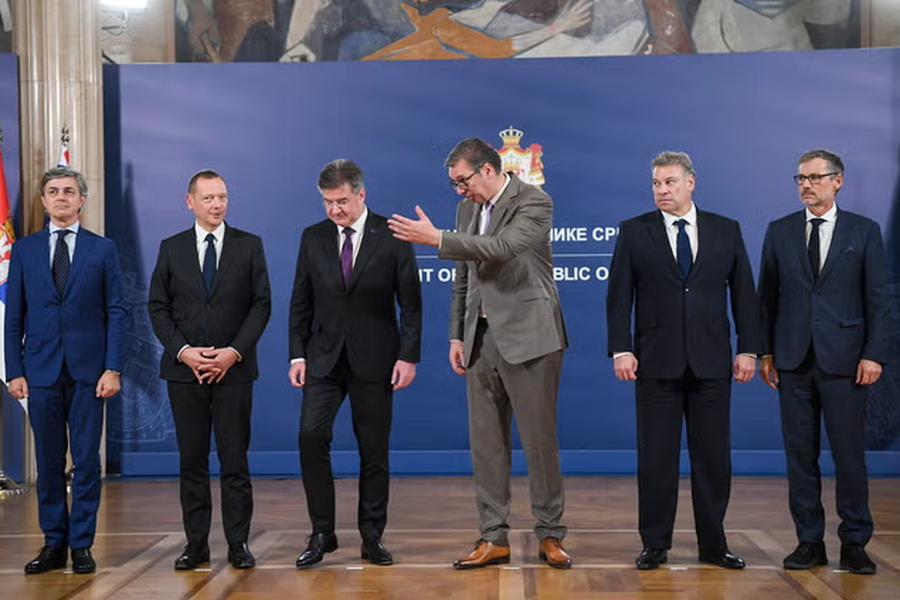
The democratic result and a foreign policy close to Russia cast doubt on whether Belgrade really wants to join the EU...
No country has joined the EU since Croatia in 2013. But judging by last Wednesday's recommendations from the European Commission, there is indeed new momentum behind the once stalled EU enlargement project. Brussels proposes opening enlargement talks with Ukraine, Moldova and Bosnia-Herzegovina and making Georgia a candidate for membership.
A few carefully chosen words accompany the initiative. All potential members – including six Balkan states, but not Turkey – are reminded that they must implement the political, economic and administrative reforms necessary to make them eligible for accession. But the overall message is clear: EU enlargement is desirable, even necessary, because of the dangers Europe faces following Russia's full invasion of Ukraine in February 2022.
However, if you take a look at the individual country reports in the commission's survey, the picture is unclear. No aspiring member comes close to meeting all the entry criteria for democracy, rule of law and economic standards. A clear example is Serbia, the largest candidate in the Balkans in terms of population and territory.
Serbia, we are told, is doing very little to resolve its differences with Kosovo, the majority-Albanian state that declared independence from Belgrade in 2008. Its foreign policy is insufficiently aligned with the EU, particularly because proximity to Russia. Serbia has made limited progress in tackling corruption and organized crime. Media independence is weak.
Indeed, the commission would have been justified in using even stronger language. The Kosovo dispute is a major obstacle for Serbia's entry into the EU. But no less serious is the question of whether President Aleksandar Vucic and his Serbian Progressive Party are sincere about wanting to join the 27-nation bloc. A more realistic reading of Serbia's policies suggests that the main objective of the ruling elite is simply to stay in power, limiting political opposition and controlling the judiciary, the security apparatus, the public sector and the media in ways that challenge the EU's fundamental values. . A second aim is to preserve a measure of independence for Serbia by cultivating relations with Russia and China.
Where have these policies led? In July, the US announced sanctions against Aleksandar Vulin, the head of Serbia's state security agency and a Vucic ally, for alleged involvement in international organized crime, narcotics operations, ties to Russia and "promoting ethno-nationalist narratives that promote instability in Serbia and the Region".
The allegation against Vulin, who resigned this month, refers to the emergence under Vucic's rule of the concept of a "srpski svet," or Serbian world — a notion reminiscent of President Vladimir Putin's promotion of a "Russian good," or world Russian. Moscow and Belgrade claim the right and duty to "protect" ethnic Russians and Serbs living outside the mother country.
In Ukraine, this serves as Putin's justification for annexing lands he considers part of the "Russian world." For Serbia, this means that not only Kosovo, but Montenegro and Republika Srpska, the Serb-inhabited part of Bosnia and Herzegovina, should be part of a Greater Serbia political sphere.
Such goals are completely incompatible with EU membership, but the problem does not stop there. Vucic this month dissolved parliament and called early elections for December in order to extend his party's rule. The vote is sure to make the electoral system no fairer than the April 2022 election, which independent monitors said favored the incumbents.
Brussels deserves credit for pushing ahead with EU enlargement plans. But in Serbia, the process is deadlocked and losing credibility - casting doubt on whether these plans will solve the problem of regional instability in the Balkans./ Adapted "Pamphlet" from "Financial Times"


Lini një Përgjigje