


 Shkruar nga Pamfleti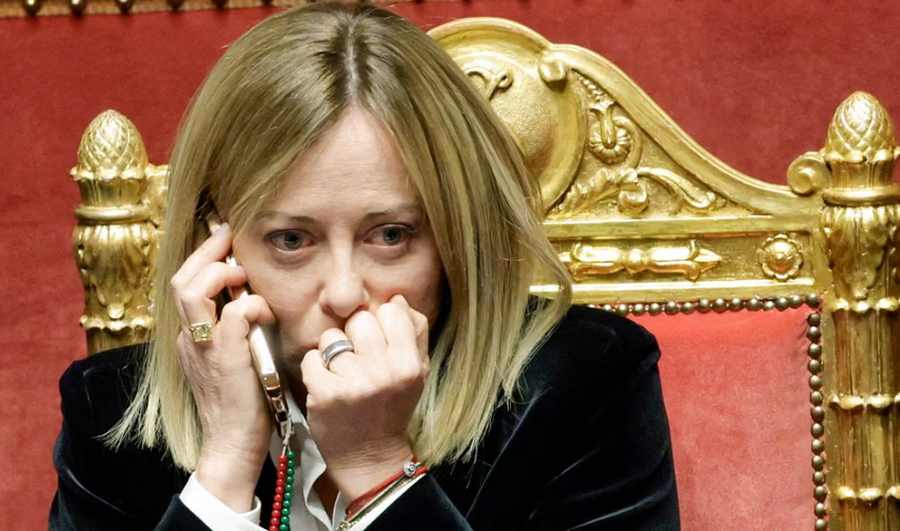
Meloni said she has always been with Italy and consistently with Europe. "I do not blindly follow Europe or the United States. But I am also for the unity of the West and I think this is necessary for both Europe and Italy," she said.
Amid strong questions from opposition members in the Italian Parliament this month, Prime Minister Giorgia Meloni noted that she had been repeatedly asked: "are you with Europe or with the United States?"
Meloni replied that she was always with Italy and consistently with Europe. "I don't blindly follow Europe or the United States," she said. "But I am also for the unity of the West and I think that this is necessary for both Europe and Italy."
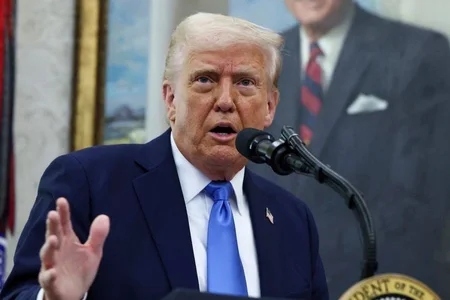
Just a few months ago, when President Donald Trump was inaugurated, Meloni seemed perfectly positioned to be a bridge between him and Europe. She was the only European leader at his inauguration, matched his hostility to liberal ideals, befriended Elon Musk, and seemed eager to take on the role.
Instead, as tensions between Europe and the United States escalate, she finds herself caught in the middle, balancing her ideological affinity with Trump with the need for Italy to help strengthen the continent's security and economy.
It is not clear whether Trump, who has been openly antagonistic to Europe, wants a bridge. Moreover, the leaders of Britain and France, both of which outweigh Italy as nuclear powers, have sought to play the role of liaison between Europe and the White House.
As Europe increases military spending and braces for a potential trade war, Meloni continues to preach pragmatism while trying to avoid choosing sides. The balancing act may become harder to sustain.
Each new crisis with Trump — over a possible peace deal with Russia, over NATO, over tariffs — further highlights Mellon's middle ground, analysts said.
"She is wisely not taking sides until she is forced to do so, even though she hopes she is never forced to," said Giovanni Orsina, head of the political science department at Luiss Guido Carli University in Rome.
But she added that "if the Atlantic alliance comes under greater stress and there is a distancing between the US and Europe, this position will be more difficult to maintain."
Meloni has presented herself as a credible leader in Europe, largely thanks to her unwavering support for Ukraine and NATO.
Domestically, she has built up her hard-line base, including introducing a “universal” ban on surrogacy, while simultaneously pursuing a conservative fiscal policy that has allayed the worst fears of European leaders. Some called it pragmatism, while others accused her of “double-dealing.”
On the international stage, Meloni has created a series of contradictions: an Italian nationalist seemingly in tune with Trump's international hard-right movement, leading a country whose fate is inextricably linked to the fate of Europe.
In the past two months, her main tool for not alienating either the United States or Europe was a studied silence, or when that proved impossible, calls on the West to maintain its strength through traditional unity.
Now, she tries more and more to have it both ways.
Meloni's comments in the Italian Senate ahead of a late-March summit of European leaders in Brussels were some of her most outspoken about the many controversies stirred up by Trump and his administration.
A staunch supporter of Ukraine, Meloni endorsed Trump's efforts to negotiate a ceasefire, calling it "an important first step on a path that should lead to a just and lasting peace for Ukraine."
But while she has backed its commitment to providing security guarantees for Ukraine, she has been less vocal in her support of Ukrainian President Volodymyr Zelensky.
After he was reprimanded by Trump and Vice President J.D. Vance in the Oval Office in early March, she, like other European leaders, did not rebuke the president or express support for Mr. Zelensky. Instead, Meloni responded to the exchange by calling for a U.S.-Europe summit. No such meeting has taken place.
She has criticized the response of some European leaders to the Trump administration as "too little political" and suggested it is "childish" to expect Italy to choose between Europe and the United States.
While Italy would gladly help Europe avoid a confrontation, she said in an interview with the Financial Times published on Friday that "I'm not interested in saying, 'I'm in the middle, I'm a protagonist.'
Not now, the stakes are too high.
Unlike France and Britain, which have led efforts to organize a European force for Ukraine, Italy rejected the idea of deploying its troops.
As Trump threatens to pull back on U.S. commitment to Europe, Italy has largely supported the idea that Europe should invest in rearmament. Although Meloni has described the United States as Italy's closest ally, Rome's relatively low military spending could create friction with Trump.
It falls short of the 2 percent of gross domestic product required by NATO guidelines, not to mention the 5 percent pushed by the Trump administration. One of its coalition partners staunchly opposes any increase.
On tariffs, Meloni has called for moderation and negotiation. She warned that retaliatory tariffs could cause a "vicious circle" in which everyone loses, increasing inflation and limiting economic growth.
“I am convinced that we must work concretely and pragmatically to find common ground and avoid a trade war that would benefit no one,” Meloni told parliament. For now, Meloni’s relations with Trump and his team appear good, even if no visit to the White House has been announced.
Trump praised Meloni in late February, calling her “a wonderful woman” and noting that “Italy has very strong leadership.” Meloni reposted Trump’s comments on the social platform X.
On the other hand, she has praised Trump and Vance, as she did in a live video address at the annual CPAC conference near Washington, where she has been a regular speaker for years.
She highlighted their shared political agenda and characterized Trump's reelection as a major development in the rise of global conservatism.
How long her balancing act can last is the question that worries her.
In the coastal town of Viareggio, Italy, the spectacular annual carnival parade is famous for its political satire. This year, there was a 50-foot statue of the prime minister.
Alessandro Avanzini dressed Meloni's figure in a pink suit jacket, rocking a pair of oversized gray trousers, the style once favored by fascist dictator Benito Mussolini.
Various observers said this accurately reflects the current political discussion in Italy about the ambiguity in which the prime minister excels.
"She's very smart about figuring out when to wear them," said Stefania Giusti, 48, a project manager.
“When she meets with Trump, she wears them, but when she goes to Brussels, she takes them off,” Giusti said. “But I don’t think she can keep it up for long.” / Adapted from The New York Times Pamphlet /



Lini një Përgjigje