


 Shkruar nga Pamfleti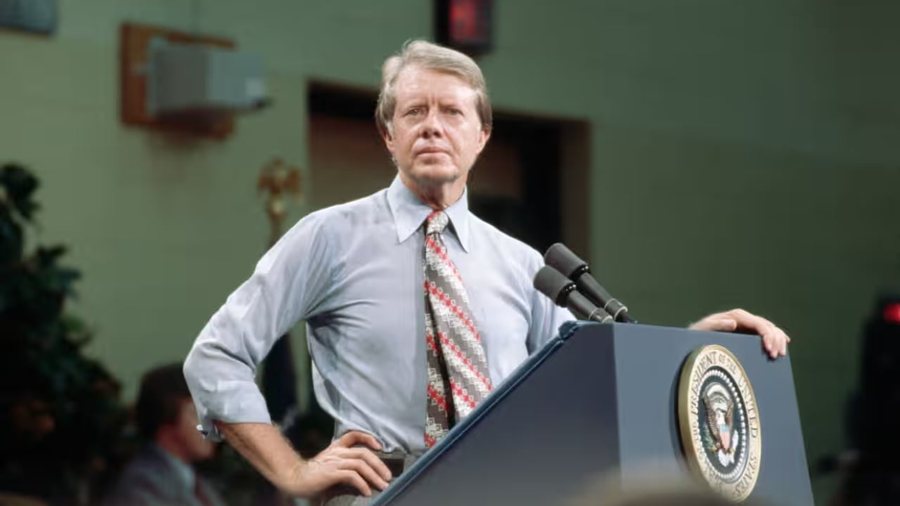
The Carter Center said the 39th president died in Plains, Georgia, surrounded by his family.
The longest-serving former president, who spent decades in office campaigning for better global health and human rights, has died.
Jimmy Carter, the man who vowed to restore morality and truth to politics after an era of scandal in the White House and who redefined post-presidential service, died on Sunday at the age of 100.
The Carter Center said the 39th president died in Plains, Georgia, surrounded by his family.
"My father was a hero, not only to me, but to all those who believe in peace, human rights and selfless love. My brothers, sister and I shared it with the rest of the world through these shared beliefs. The world is our family because of the way he brought people together, and we thank you for honoring his memory by continuing to live out these shared beliefs ," said his son, Chip Carter.
Carter became the oldest living former president when he surpassed the record held by the late George HW Bush in March 2019.
The Jimmy Carter Story:
Born in 1924 in the southeastern state of Georgia - to a nurse mother and a peanut farmer father - Carter never forgot his beginnings.
After attending the US Naval Academy, where he did graduate work in nuclear physics and worked on the development of America's nuclear submarine program, Carter returned to the family farm, which he turned into a peanut business.
It was there that he entered local politics and was elected to the Georgia Senate before serving as the state's governor from 1971 to 1975.
During his tenure as governor, Carter began to demonstrate the progressive values he had learned from his parents. He publicly called for an end to the incarceration of African Americans, increased the number of African American officials in state government, and promoted education and prison reform.
Five years later, Carter—who was little known outside his home state—took a giant leap, winning the Democratic Party's nomination for the 1976 presidential election.
He defeated the Republican president, Gerald Ford, who had taken over from Richard Nixon after the Watergate scandal. Carter made it clear from the start that his presidency would lobby for global human rights.
One of Carter's first goals after becoming president was to work on a second strategic arms limitation treaty—known as SALT II—with the Soviet Union. The treaty was created to further limit the nuclear weapons of both countries.
Negotiating the treaty with Soviet leader Leonid Brezhnev was difficult, due to Carter's continued criticism of the Kremlin regarding human rights.
But in June 1979, the two leaders signed the SALT II Treaty. The US Senate did not ratify it after the Soviet invasion of Afghanistan in December 1979, but its terms were respected by both sides.
In response to the Soviet invasion, Carter announced what became known as the Carter Doctrine. According to her, the United States would protect its interests in the Persian Gulf with military force if necessary. The United States also boycotted the 1980 Olympics in Moscow.
But it was the US hostage crisis in Iran that would come to define Carter's presidency.
In the fall of 1979, the Iranians—dissatisfied with the rule of Shah Mohamed Reza Pahlavi—overthrew him and installed an exiled Muslim leader, Ayatollah Ruhollah Khomeini, as their new leader. Carter granted political asylum to the ailing Shah - angering many Iranians.
In November 1979, Iranian militants with the tacit support of the Khomeini Government attacked the US Embassy in Tehran and took 52 Americans hostage. They demanded the Shah's return and an apology from the US.
Carter said the US could not give in to the demands of the hostage-takers, and the crisis lasted 444 days. After negotiations with the Iranians failed, Carter, in April 1980, ordered US Special Forces to try to rescue the American hostages.
The mission ended in tragedy - eight American soldiers died in the accident caused by equipment failure. Carter informed the nation of the failed mission:
The American hostage crisis and Carter's inability to resolve it dominated the news in America during 1980 - the year of the presidential election. He was easily defeated by Republican Ronald Reagan, a former Hollywood actor. In a final blow to Carter, Iran decided to release the hostages on January 20, 1981—the day Carter left office and Reagan was inaugurated as president.
Although his presidency was often characterized as a failure, Carter also had his share of triumphs. He created an effective national energy policy and spurred the creation of 8 million new jobs, albeit at the cost of high inflation. He also improved the operation of the US federal government by reforming the civil service.
Carter's greatest achievement as US president was the 1978 Peace Treaty between Egypt and Israel. Egyptian President Anwar Sadat and Israeli Prime Minister Menachem Begin were subsequently awarded the Nobel Peace Prize.
Carter as a former president was widely praised for his efforts to bring peace and dignity to the world.
After retiring from politics, Carter discovered that his peanut farm had been destroyed by those overseeing him while he was in office.
Thus, he offered his services as an election monitor and peace broker in conflicts, while in 1982 he founded the Carter Center. He also worked to provide housing for the poor through the organization "Habitat for Humanity" - a private program that provides assistance to the needy who want to build their own homes.
In 2002, Carter won the Nobel Peace Prize for his work in diplomacy and promoting social justice.
Carter formally accepted the award at a time when the United States was mobilizing for the invasion of Iraq. He referred to military training during his speech.
"War, sometimes, can be a necessary evil. But no matter how necessary it is, it is always bad, never good. "We're not going to learn how to live together in peace by killing each other's children," Carter said.
Carter was often photographed with a hammer in hand, working alongside other volunteers to build houses. His health deteriorated in recent years after a type of cancer spread to his brain and liver.



Lini një Përgjigje