


 Shkruar nga Pamfleti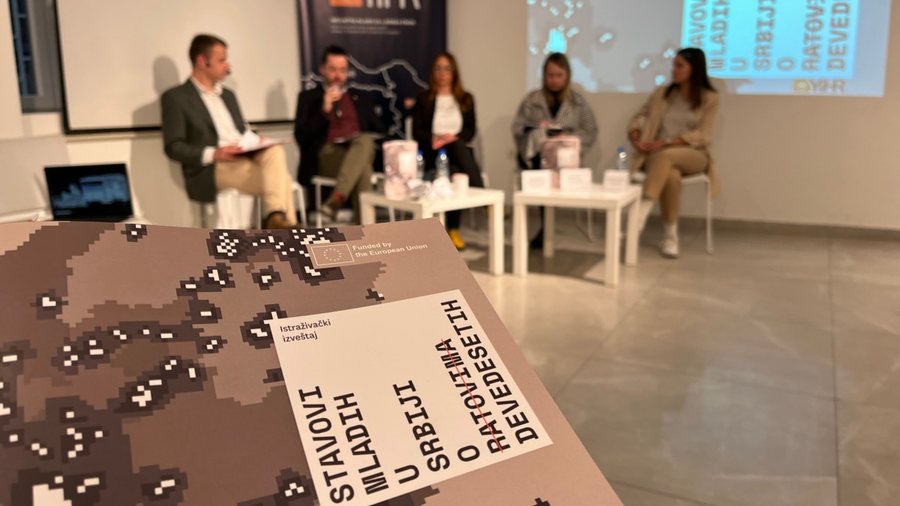
Lessons from history that are "mostly skipped over" and "barely mentioned". This is how young people from Serbia describe the knowledge they received in school about the wars of the 90s in the territory of former Yugoslavia.
Kata, 19 years old, from Belgrade, says that this topic "doesn't interest her".
"A part of young people is interested in this topic, but a large majority is not", she believes.
The research "Attitudes of young people in Serbia about the wars of the 90s", conducted by the non-governmental Youth Initiative for Human Rights (YIHR), shows that young people in Serbia know little about the wars of the 90s.
Three quarters of the respondents, between the ages of 18 and 30, believe that this topic is covered "little" or "at all" in schools.
Nevena, 26 years old, also says that "she is not interested in this topic".
"First of all, I don't have that culture of political conversations at home. I have never been interested in politics, unlike my peers who are very interested in it", says Nevena for Radio Free Europe.
She says she remembers being taught at school, but not much.
"The First and Second Serbian Uprisings [uprisings against Ottoman rule in the 19th century] and the First World War were covered more, while the 1990s were very superficial," says Nevena.
Jovani, 20 years old, says that schools teach about the wars of the 90s, but "not objectively".
"Young people only know what their parents have told them, and this is probably quite one-sided. It's interesting to see real numbers, real motives... Reliable information is always hard to find," says Jovani.
Marija Vasić, professor of sociology at the "Jovan Jovanović Zmaj" high school in Novi Sad, said during the presentation of the research that young people are not disinterested, but they have not been offered adequate knowledge about the wars of the 90s.
"The lessons are placed at the end of the book and what we see is that the teachers avoid them, so they always justify themselves, saying that it is the end of the year and they haven't achieved it", said Vasiq, adding that many teachers do not agree with what is written in the textbooks .
Anja Zlloporubović, from the Initiative for Human Rights in Serbia, says that avoiding conversations about the wars of the 90s creates a kind of fear among young people.
"Young people don't dare to ask the elders, to ask the professors... they don't dare to ask anyone about these topics, because they will either get a one-sided answer, very subjective, or they won't get it at all. There comes the moment when this fear causes ignorance, and then that ignorance causes hatred and everything else that goes along with it", says Zlloporubović for Radio Free Europe.
According to Professor Vasiq, it is necessary to find a way to approach young people, so that the content is more accessible to them.
"First of all, we must have a culture of remembrance and confrontation, to see what is the truth, who did what, in whose name, are we guilty or are we responsible if we remain silent and if we do not react... and only then to start with some reconciliation processes", says Vasiq for Radio Free Europe.
Vasiq says that the whole society must go through a "complete redefinition of those things".
"But this is done through cultural consensus, through the adoption of values... and it is a long and difficult process," she says.
According to her, the first thing that should be done is the acceptance of crimes, but also the removal of persons convicted of war crimes from public spaces.
For example, the former general of the Yugoslav Army, Nebojsha Pavkovic, convicted of war crimes in Kosovo during 1998-99, joined the program of the "Gjura Jakšić" Elementary School in Vojvodina, in May of this year, through a video connection from prison in Finland, where he is serving his sentence.
At the Book Fair in Belgrade, this year, as in previous years, books were also promoted by Vojislav Sesel, leader of the Serbian Radical Party, convicted of war crimes in the village of Hërtkovci in Vojvodina in 1992.
The research "Attitudes of young people in Serbia about the wars of the 90s" shows that when it comes to trust in the Hague Tribunal - where those responsible for war crimes in the territory of the former Yugoslavia were tried - almost 41 percent of respondents believe that the main purpose of this court was "to place the blame for war crimes on the Serbs".
Although Serbia has cooperated with the Hague Tribunal and has extradited the defendants for war crimes who are hiding in its territory, the government leaders have not accepted the verdicts and the responsibilities of the Serbian leadership for war crimes, while they have also denied the involvement of the state in the events of the 90s.
In addition to the police and military leadership, the former president of the Federal Republic of Yugoslavia, Slobodan Milosevic, who died in custody in 2006, was tried before the Hague Tribunal for war crimes.
The Socialist Party of Serbia, led by Milosevic, is still part of the Government in Serbia today.
The author of the research, Rodolub Jovanovic, says that young people in Serbia know the most about the events that have threatened the Serbian ethnic group.
"Their attitude is based less on knowledge and more on feelings", says Jovanovic.
As the biggest crimes from the wars of the 90s, young people have mentioned the operations of the Croatian army and police "Olluja" and "Blesak" in 1995, with which Croatia regained control over the self-proclaimed Republika Srpska Krajina.
Croatia describes "Olluja" as its decisive victory in the 1991-95 Patriotic War, while Serbia marks it as the ethnic cleansing of Serbs from Croatia.
Depending on the source, estimates for the number of Serbs who left Croatia during the "Olluja" range from 130,000 to 300,000.
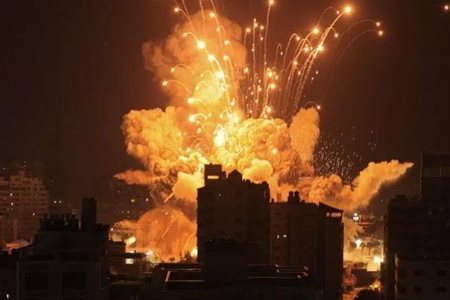
The interviewees also mentioned the NATO bombing of Yugoslavia in 1999 as a key event in the 90s.
NATO began bombing Yugoslav army targets on March 24, 1999, following numerous reports of violence by the Serbian army and police against the Albanian population in Kosovo.
The bombings ended with the signing of the Kumanovo Agreement on June 9, 1999, after which the Serbian army and police withdrew from Kosovo.
In the NATO bombings, 756 people lost their lives, namely 452 civilians and 304 members of the armed forces, according to the data of the non-governmental Fund for Humanitarian Law in Serbia and Kosovo.
However, the Serbian state has never compiled any list of victims, so their numbers are often subject to manipulation by government officials.
Just under five percent of respondents to the non-governmental Youth Initiative for Human Rights poll singled out Srebrenica as the biggest crime of the 1990s.
In 1995, Serbian forces killed more than 8,000 Muslim men and boys in Srebrenica, Bosnia and Herzegovina.
The authorities in Serbia, despite the decisions of international courts, do not accept that genocide was committed in Srebrenica.
One-sided attitudes occur because in Serbia only crimes in which Serbs were killed are commemorated, but not those against other populations, according to Professor Vasić.
"For example, Srebrenica is one of the most taboo topics in Serbia, for which few dare to say what the decision of the international court was. Very few people dare to say that the decision was genocide, not just a war crime," says Vasiq.
She adds that the textbooks themselves speculate about the number of victims.
The procedure for approving history textbooks, as well as others, is regulated by the Law on textbooks in Serbia.
First, the curriculum for a specific subject is approved, which is brought by the state and not the publishers.
Publishers write texts according to the approved plan, while the Institute for the Advancement of Education and Training gives the professional assessment.
If the text meets all the criteria, the procedure ends with the decision of the Ministry of Education to put the text into use. After that, the schools choose which texts they will use from the catalog of the Ministry./REL



Lini një Përgjigje