


 Shkruar nga Pamfleti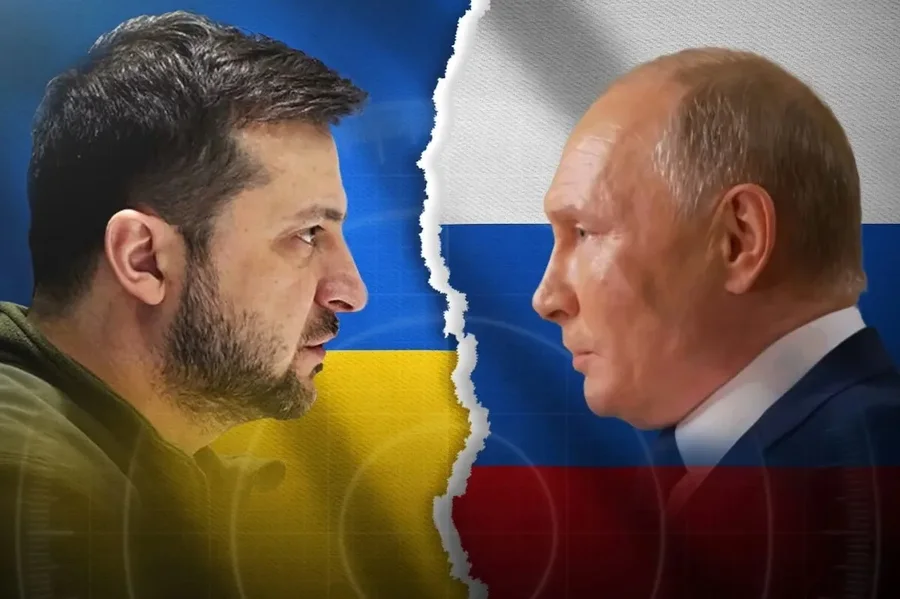
The negotiation game reopens after the re-election of Donald Trump. On March 11, 2025, Ukraine accepts a thirty-day ceasefire proposed by the United States.
We are in a familiar movie. These days, Vladimir Putin maintains a kind of detached ambiguity about his intentions. It is a stance that has represented his preferred strategy for many years and in a way allows him to rise to the role of supreme judge of any negotiation or endeavor. But even if we ignore the words of spokesman Dmitry Peskov, who speaks of "modest tendencies" towards an end to the current conflict, the end seems already written. Either Russian peace, or war. With the finger pointed at evil Europe.
This is certainly nothing new. There is no need to go back to the 2014 “Normandy format” and the Minsk agreements, which were never implemented for many reasons, including, as a minor detail, the fact that Russia continued to occupy territories that rightfully belonged to Ukraine, or to the diktats of December 2021, when Moscow proposed a package of security guarantees to NATO but rejected the Alliance’s willingness to discuss individual points, demanding instead the simultaneous acceptance of any commitments. Almost four years of war can already teach us something.
A few days after the invasion, three meetings were held in Belarus between February 28 and March 7, 2022. Volodymyr Zelensky proposed direct talks with Putin. The Kremlin never responded. In the spring of that year, the first negotiations took place in Istanbul. Ukraine accepted neutrality, non-aligned and non-nuclear country status, while Russia appeared to accept security guarantees offered by the permanent members of the UN Security Council.
Issues still on the table, such as limiting Ukraine’s armed forces, were postponed for a personal meeting between the two presidents. Immediately after the summit, the Kremlin formulated new demands: Russian as Ukraine’s second official language, the lifting of mutual sanctions, the withdrawal of legal actions in international courts, and a cap on Kiev’s army at just 85,000 troops. Then came the Bukha massacre. Russia has always accused the West collectively of sabotaging agreements that were already ready for signature. It will do so many more times. In May 2024, Putin cited Zelensky’s expired presidential term and the lack of elections, in a country under its own bombardment, as reasons for rejecting any discussion. In June, just before the International Conference on Ukraine in Switzerland, where representatives of 92 countries discussed a “peace formula,” the Russian president listed his very tough preconditions. They remain the same today.
The Return of Donald
The negotiation game reopens after Donald Trump's re-election. On March 11, 2025, Ukraine accepts a thirty-day ceasefire proposed by the United States. Secretary of State Marco Rubio declares that "the ball is in Russia's court." Two days later, Putin responds that numerous logistical issues must be resolved before Russia will accept a ceasefire. It is a veiled refusal.
The Kremlin's counter-proposal for a month-long moratorium on attacks on energy infrastructure was followed by another night of bombing in Ukraine. The Easter ceasefire proposed by Russia on April 19 was seen as a ploy to appease Trump. Both sides accused each other of violating it.
And so we return to Istanbul. Putin and Zelensky planned to meet in the Turkish metropolis, and Trump suggests that he too will be present. However, the Russian president rejects the offer, citing the usual issue of his enemy’s expired mandate. The two delegations agree only on humanitarian issues. Vladimir Medinsky, the head of the Kremlin’s negotiating team, reiterates that Russia is ready to continue the war for as many years as necessary to achieve its objectives.
On May 19, Putin declared that the main thing for Russia was to "eliminate the root causes" of the crisis and achieve "all the objectives of the Special Military Operation." Former President Dmitry Medvedev wrote on Telegram that "the Istanbul talks are about ensuring our speedy victory and the complete destruction of the neo-Nazi regime."/Corriere della sera


Lini një Përgjigje