


 Shkruar nga Orhan Dragas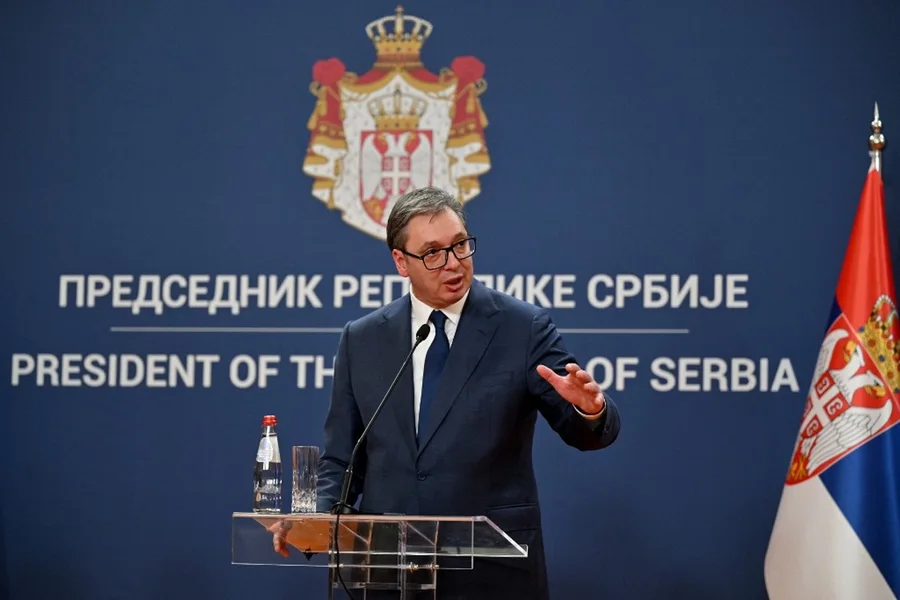
Under these conditions, Serbia has no choice but to suspend ownership of Gazprom and Gazprom Neft and regain full control of NIS. Lavrov's statements underscore Moscow's long-standing stance toward Serbia, a policy that treats Belgrade not as a sovereign partner, but as a submissive vassal.
Russian Foreign Minister Sergey Lavrov recently issued threatening messages during a media conference, warning Serbia and its president, Aleksandar Vučić, of "painful consequences" if Belgrade imposes sanctions on Russia or takes any action deemed hostile by Moscow.
The cause of these threats is related to the fate of the Oil Industry of Serbia (NIS), a Serbian company largely owned by the Russian companies Gazprom and Gazprom Neft, which has recently been sanctioned by the US. Serbia now faces a big choice: to succumb to Russian pressure and threats, or to prioritize the interests of its citizens.
her and follow her own path.
At the beginning of the Russian aggression against Ukraine, President Vučić declared that Serbia would not impose sanctions against Russia, emphasizing that 85 percent of Serbian citizens support and have love for this country. But he added that the position could change if the failure to impose sanctions begins to directly threaten Serbia's economic stability.
But is this policy sustainable for the largest country in the Western Balkans, now that Russia has been excluded from all of Europe and the West and from civilization itself? Given the huge challenges that sanctions pose to Serbia's oil industry, the answer is clear: no.
So the only discussion worth having is when, not if, Serbia will make a significant change of approach. Vučić's claim about the high percentage of pro-Russian sentiments among Serbs may be true. However, such sentiments cannot and should not serve as a parameter for a leader making decisions for the nation.
It is the duty of a statesman to set aside the emotions of the majority - whether real or imagined.
no - and make decisions based on reason and facts. In the case of NIS, the situation is clear. The US has imposed sanctions on the company because of its predominantly Russian ownership. The UK has joined these sanctions, and the EU is likely to follow suit.
Under these conditions, Serbia has no choice but to suspend ownership of Gazprom and Gazprom Neft and regain full control of NIS. Lavrov's statements underscore Moscow's long-standing stance toward Serbia, a policy that treats Belgrade not as a sovereign partner, but as a submissive vassal.
Serbia finds itself in an unstable situation, where the only solution seems to be the nationalization of NIS to ensure the continuity of the refinery's operation and the supply of the domestic market. While such a move would undoubtedly be in line with Serbia's national interests, the Russian leadership would see it as a betrayal and is already threatening retaliation.
The time has come for Serbia to put its citizens before Moscow, and to begin retaking control of the NIS as a first step towards independence. Among Western partners, there is growing impatience with Serbia due to its reluctance to join the largest European response to Moscow's violence and state crimes since World War II.
The daily lives of not only the 85 percent mentioned by Vučić, but of all Serbian citizens, are very much intertwined with Europe and not with Russia. Serbia conducts almost two-thirds (61 percent) of its trade with EU economies, while only 5 percent of its trade is with Russia.
Of all foreign investments in Serbia, the largest in the region, almost 70 percent come from
from the EU, compared to less than 10 percent from Russia. Western investors, alongside domestic companies, are the largest employers in Serbia, with hundreds of thousands of jobs.
And what will Serbia's economy lose when (and not if) it imposes economic sanctions on Russia? Less than $1 billion in exports, mostly food and industrial products (of course, before Russia's aggression against Ukraine). This amount is less than Serbia's annual exports to neighboring Bosnia and Herzegovina ($1.35 billion) or roughly equal to its exports to Kosovo, which it does not yet recognize as a state.
As Serbia contemplates a change in its policy toward Russia, the situation is reminiscent of 1948, when Yugoslavia's leader, Josip Broz Tito, broke ties with Stalin and the Soviet Union. For the leader of communist Yugoslavia, that decision was far more challenging than it would be for Vučić today.
Because at that time, hundreds of thousands of Soviet troops and their allies were stationed along Yugoslavia's borders with Hungary, Romania, and Bulgaria, ready to invade any rebellious country.
Domestically, pro-Stalin sentiment was so strong that thousands of Yugoslav Stalinists were ready to support a Soviet invasion, even at the cost of their own imprisonment.
Many generals and security officers saw Moscow and Stalin as their bosses, not Belgrade and Tito. They were ready to die for the USSR and Stalin. In today's Serbia, no such threats exist. Moreover, Serbia is surrounded by NATO members, and this means that despite warm feelings for Russia, no one in Serbia is willing to risk imprisonment, let alone life, for Vladimir Putin.
Tito's decision was fraught with great dangers, not only for the nation, but also for himself. Stalin tried several times to kill him. Some testimonies speak of up to 22 assassination attempts. It was a confrontation with the then USSR, which was stronger than today's Russia. The danger was incomparable with the small consequences that today's Serbia could have, but the decision was made.
For years, Russia has behaved in a destructive manner towards Serbia, treating it as a
as its province and believing that everything is permissible. Russian secret services are the main exponents of this aggressive attitude, not only towards Serbia, but also towards the entire Western Balkans.
When we talk about the “umbilical cord” between Serbia and Russia, which is the alliance for Kosovo, we must calmly say that Putin’s attack on Ukraine on February 24, 2022, severed this connection. Isolated even earlier in the most important international forums, Russia now faces the rejection of the global community.
Therefore, its support is no longer necessary or achievable. Moscow will continue to defend Serbia and Kosovo as part of it, both within the UN and other important organizations, but this assertion comes from a powerless and isolated aggressor country, whose voice in international relations carries little weight.
After the brutal invasion of Ukraine, alliance with Russia is not an option. Supporting crimes against humanity cannot be an option for any nation or its leadership. Connection today
With Putin's Russia, it means being its collaborator. It is not simply a geopolitical choice but a matter of civilization.
President Vučić has a historic opportunity to secure Serbia’s place among the world’s most advanced nations. Dante Alighieri once wrote that “the hottest places in Hell are reserved for those who, in times of great moral crisis, maintain their neutrality.” Serbia cannot continue to remain neutral. That would be disastrous for it.
Note: Dr. Orhan Dragaš, Serbian expert on security and international relations. / Adapted from the pamphlet by “Kyiv Post” /


Lini një Përgjigje