


 Shkruar nga Pamfleti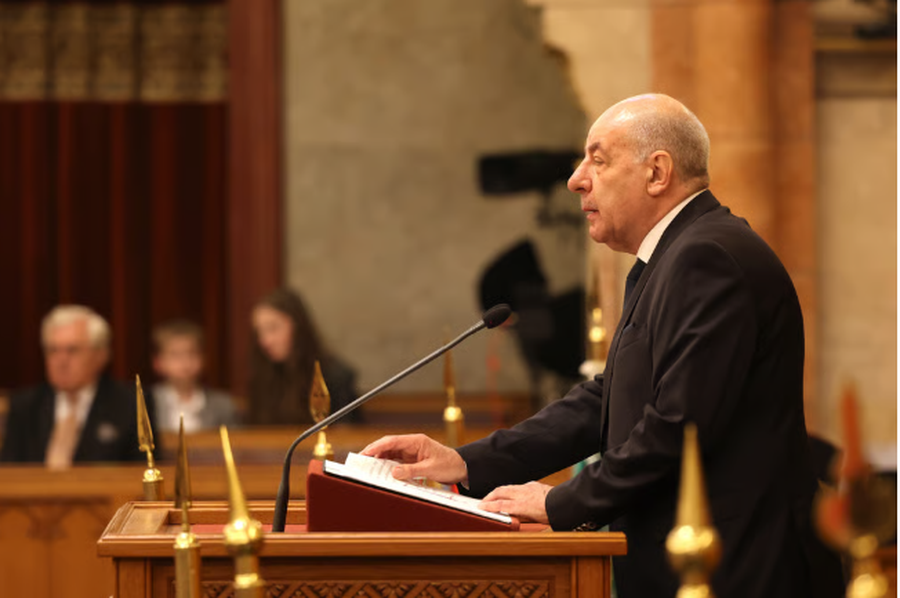
The head of state accuses Prime Minister Peter Magyar of concentrating power, while the government argues that it is dismantling structures inherited from the Orban era...
Hungarian President Tamas Sulyok has said he will oppose the new government's efforts to remove him from office, warning that he will use all legal means available to protect his mandate.
Prime Minister Peter Magyar, who won the April parliamentary elections with a landslide victory over former Prime Minister Viktor Orbán, had promised during the campaign to replace officials appointed during Orbán's rule, saying they had contributed to the maintenance of a clientelistic system and the capture of state institutions.
In an interview with Politico, Sulyok argued that efforts to remove him and other officials appointed during the Orban era constitute an abuse of the new government's parliamentary majority. "No parliamentary majority can authorize disregard for the rule of law and European values," the president declared.
He accused the ruling Tisza party of trying to centralize power faster than Orban's Fidesz party had done during his 16 years in power. On the other hand, the government and Magyar's allies view these accusations as an attempt to protect the status quo established during the previous government.
Marton Hajdu, a Tisza party MP and chairman of the Parliamentary Committee on Foreign Policy, said that measures are being considered to remove Sulyoku, as well as the heads of the Constitutional Court and the Supreme Court, who are considered linked to the previous regime.
According to Hajdut, these officials did not act to curb what he described as corruption, rapprochement with Russia, and the weakening of democratic institutions during Orbán's rule.
The debate has turned into an institutional clash with possible constitutional consequences. Sulyok has turned to the Constitutional Court to review in advance the legality of any initiative aimed at removing him from office. However, seven judges of the court have withdrawn from considering the case due to their direct involvement in it.
The president has also addressed the Venice Commission, the Council of Europe's advisory body on constitutional matters, seeking its opinion on the situation he describes as a "constitutional crisis."
Venice Commission spokesman Andrew Cutting confirmed that the institution is preparing an urgent opinion on the matter.
The Hungarian government argues that its actions are aimed at avoiding a situation similar to that of Poland, where President Karol Nawrocki has used his powers to block important parts of Prime Minister Donald Tusk's agenda.
Although the Hungarian president has more limited powers than his Polish counterpart, Sulyok has signaled that he is willing to use them to defend his position.
Recently, he announced that he would sign a constitutional amendment passed by parliament, which limits the maximum term of a prime minister to eight years and effectively prevents Viktor Orbán from returning to power. However, Sulyok criticized the move, arguing that such limits are not considered necessary in European parliamentary democracies.
According to polls published at the end of May, around 64 percent of Hungarians want Sulyok removed from office.
Former Hungarian minister Bálint Magyar told Politico that the president never opposed Fidesz's policies during Orbán's years in power, and is now resolutely defending his position.
During the interview, Sulyok rejected accusations that he is acting politically and presented himself as a guarantor of constitutional order.
"A constitutional crisis is harmful for the country," he said, adding that the current conflict could also damage Hungary's international image.




Lini një Përgjigje