


 Shkruar nga Pamfleti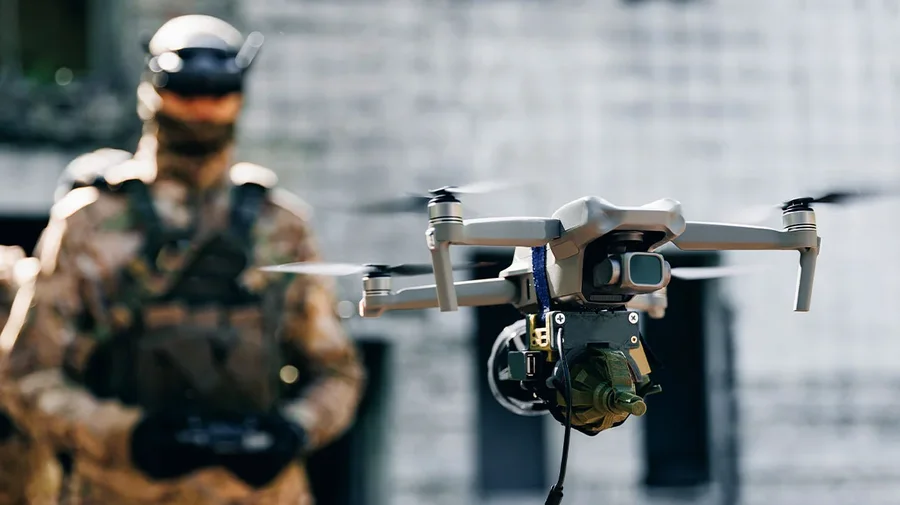
A debate that overstates the role of drones and prevents governments from justifying real defense needs would only serve Russia...
Ukraine is gradually influencing the course of the war that began with the full-scale Russian invasion in 2022. It has achieved this in several ways, but the extensive and innovative use of drones has attracted the most attention.
Ukrainian successes have created the belief that drones could become a kind of “miracle weapon” for European NATO countries. However, while they are changing the way war is waged, they cannot alone transform a country’s defense.
The enthusiasm for drones is based on concrete results. According to the Kyiv Post, on July 9, Ukraine announced that it had struck 14 Russian ships in the Sea of Azov overnight, including 12 tankers suspected of belonging to Moscow’s so-called “shadow fleet.” The Ukrainian drone command said that, within 96 hours, its forces had struck a total of 35 ships and 45 military targets in occupied Crimea and southern Ukraine.
Ukraine uses drones against Russian ships in the Black Sea and the Mediterranean, against oil refineries and terminals, and against military targets inside Russian territory. The attacks have reached as far as Siberia, showing that drones can operate over great distances and inflict ongoing military and economic costs on Russia.
These results have added to calls for European NATO countries to invest more in unmanned systems, which often cost less than missiles, aircraft or other traditional platforms. The argument is simple: if Ukraine has achieved so much with limited resources, other countries can also strengthen their defenses with relatively small investments.
Drones will undoubtedly be part of the future of warfare. However, their technology continues to develop and their use is not yet based on clear, unified rules of engagement. Russia also uses drones extensively. Some of them have entered the airspace of NATO countries, while Russian electronic warfare systems have interfered with the flights of Ukrainian drones, causing some of them to lose control near Alliance territory.
NATO countries are also buying and developing more such systems. Vice Admiral Ewa Skoog Haslum, Sweden's head of joint operations, believes that the war in Ukraine has accelerated technological development and increased public awareness of the role of drones. According to her, the Swedish armed forces are constantly training both in their use and in defending against them.
However, drones are not a decisive weapon on their own. Retired Swedish officer Hans Granlund, who served as defense attaché in Ukraine, points out that Kiev has managed to push the Russian Black Sea Fleet away from the western part of the region and protect its civilian maritime traffic. But Ukraine has not taken control of the Black Sea because it does not possess a fleet capable of exercising that control.
Many small drones operate in groups, strike targets, and are easily replaced. But armed forces are not only tasked with damaging an adversary. They must occupy or defend territory, transport troops, secure supplies, and control land, air, and sea space.
In the Baltic Sea, for example, NATO countries cannot limit themselves to striking Russian ships. They must be able to send troops and equipment to the Baltic states and Finland. Likewise, a land army cannot stop an invasion with drones alone. They can inflict heavy damage on the aggressor, but they cannot win the war alone.
Drones can also perform reconnaissance, surveillance, and logistical tasks. For this reason, they need to be integrated into a broader arsenal. Ukraine also continues to ask its allies for missiles, air defense systems, artillery, and other traditional equipment, despite its progress in drone production.
Every new technology spurs the development of countermeasures. Skoog Haslum predicts that high-power microwave weapons and laser systems could become among the most effective tools against drones. These technologies require large power supplies and suitable platforms, such as warships. This maintains the importance of frigates and other traditional systems.
Overreliance on drones could create a political problem. The public and some commentators might conclude that spending on ships, planes, missiles, or armored vehicles is an outdated and costly approach. But that conclusion would be wrong and dangerous.
Military systems are becoming increasingly interconnected. Drones can serve as sensors, weapons platforms, and logistical tools, while artificial intelligence and digitalization can increase their efficiency. However, rapid technological development means that a large number of drones in storage today could become obsolete within a few years.
Governments must use public money responsibly, but they should not present new technology as a replacement for all other defense capabilities. The Ukrainian experience proves that drones are a very important tool. It also proves that victory requires a combination of new technology with traditional forces, weapons, and platforms.
A debate that overstates the role of drones and prevents governments from justifying real defense needs would only serve Russia./ Adapted from "Pamphlet" by "Politico"






Lini një Përgjigje