


 Shkruar nga Pamfleti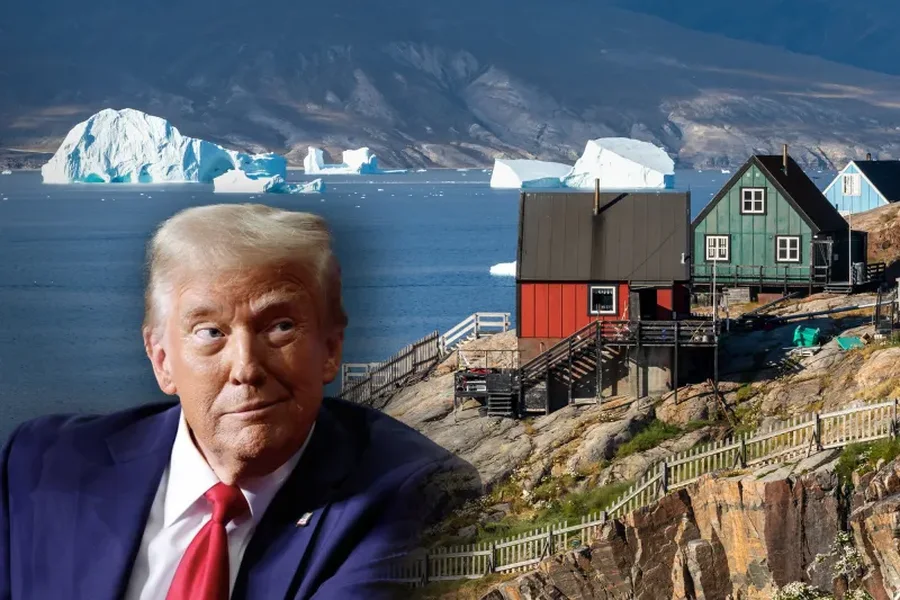
You won't see consistency from a Donald Trump press conference, but his administration's security policy strategy is more consistent than it appears to Europeans. Taking Greenland is part of a broader strategy, but not for the reason Trump says.
The US does not need to turn Greenland into a protectorate in order to build military bases. Denmark would be more than happy to give the US some real estate on the island. The broader issue at stake for the US, one that has long been neglected by Europeans, is the growing geopolitical importance of the Arctic Sea. Russia has been an Arctic superpower forever. Now it is joined by China in a strategic alliance in the region. As Michel Paul, an Arctic security specialist at Germany’s SWP think tank, explained in a German television interview, the US Arctic strategy predicts that less than a million square kilometers of ice will cover the region by 2030. That would turn it into a viable shipping lane.
China treats the Arctic Sea as part of its Eurasian infrastructure project “Silk Road.” China sees the Arctic route as an important support for existing routes.
One of China's biggest strategic sticking points is the Strait of Malacca between Malaysia and Indonesia.
This is often called China's Malacca dilemma. About 25% of all global trade passes through the narrow strait that connects the Indian Ocean and the South China Sea.
China needs an alternative trade route in the event of a naval blockade by the US Navy, which would be very likely if China were to invade Taiwan.
NATO has neglected the Arctic, in part because NATO's Nordic members, particularly Canada, did not want NATO to become active in the Arctic sea region.
That has changed with Russia's invasion of Ukraine. Germany has purchased Boeing's P8 Poseidon maritime patrol aircraft for use in the North Sea and Baltic Sea, as well as the North Atlantic.
Boris Pistorius, the German defense minister, is in talks with Iceland about a strategic partnership. Denmark also bought three maritime patrol aircraft, not dog sleds, as Trump alluded to during the press conference.
We also believe that Greenland's raw materials are part of the reason for US interest in the island, especially its deposits of rare earth metals. Estimates vary widely. One estimate we have seen, in the Internationale Politik Quarterly, is for a total of 42 metric tons, which would be about the same size as China's. We would be very surprised if this wealth of minerals and metals, much of which is unexplored, is not another important reason, perhaps the main reason, for the US to occupy the island.
One question Europeans should ask themselves is why they didn't give Greenland a better deal when it chose to leave the EU. And why didn't they show a greater interest in regional Arctic security?
/Adapted from Eurointelligence /




Lini një Përgjigje