


 Shkruar nga Pamfleti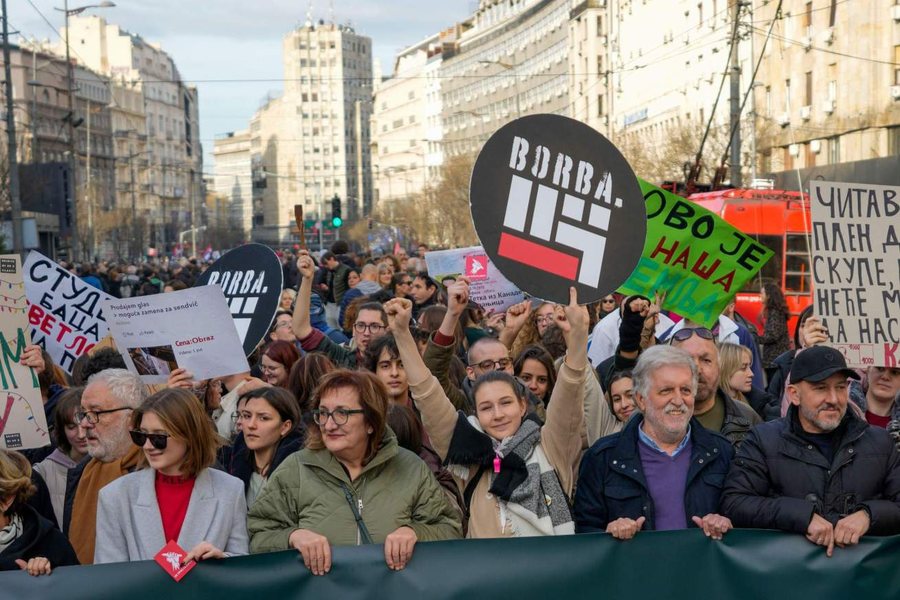
Although the Serbian opposition is protesting, the US has not contested the elections and is aligned with Moscow...
As Europe celebrated Christmas and the New Year, the pro-Western Serbian opposition held a series of protests over suspected election rigging. But the fact that both the United States and Russia — despite being geopolitical rivals — openly support Serbia's populist president Aleksandar Vucic gives opposition leaders little hope in their fight to annul the election.
On December 17, the Southeast European country held early parliamentary and municipal elections, in which the ruling Serbian Progressive Party (SNS) won 46.72% of the vote. Since then, the opposition has held several daily protests, not accepting the result.
Marinika Tepic, one of the opposition leaders, was on hunger strike, demanding the annulment of the country's parliamentary and local elections, while the main opposition alliance, 'Serbia Against Violence', claims the elections were stolen.
Furthermore, international observers from the OSCE office, the European Parliament and the Parliamentary Assembly of the Council of Europe said that the SNS had "gained an unfair advantage through media bias, pressure on public sector workers and misuse of public resources".
Although "The Independent" broadcast the opposition rally on December 30, the West does not seem to be unified when it comes to the situation in Serbia. The United States, as the main foreign power operating in the Balkans, appears to have openly supported the SNS-dominated Serbian government.
After protesters, on December 24, tried to enter Belgrade's city council and clashed with police, US Ambassador to Serbia Christopher Hill wrote in X that "the legitimacy of democratic processes depends on transparency and the willingness of all parties, to win or lose, to respect the will of the people expressed in the ballot box". He also emphasized that "violence and vandalism against state institutions have no place in a democratic society".
Such a statement was a clear signal that Washington, despite urging Serbia to work with the OSCE to address the "unjust conditions" surrounding the election process, is unlikely to support what Moscow portrays as "attempts to "Maidan-style coup" in Belgrade.
Indeed, both the Kremlin and the pro-government media in Serbia have promoted the narrative of the "new Maidan", referring to the ousting of Ukrainian President Viktor Yanukovych from power in 2014. It is therefore not surprising that, after the violent protest in On December 26, Vucic met with the Russian ambassador to Serbia, Alexander Botsan-Kharchenko, who accused Western countries of "trying to take revenge against the Serbian leader" because he reportedly refuses to join the sanctions against -Russians imposed on Moscow after its invasion of Ukraine.
Serbian pro-government tabloids have adopted the same rhetoric, claiming that Germany is involved in ongoing protests over Belgrade's policy toward Moscow. In reality, neither Germany nor any other Western country has ever put serious pressure on Serbia to impose sanctions on Russia, but the Kremlin uses such a narrative to create the illusion that Putin still has friends in Europe.
Vucic also benefits from such Russian rhetoric, as in the eyes of his pro-Russian voters he can portray himself as a "statesman who refuses to follow Western orders and impose sanctions on Moscow."
That is why he is among three European leaders (Hungarian Prime Minister Viktor Orbán and Turkish President Recep Tayyip Erdogan are two others) who received New Year's greetings from the Russian President.
The United States, for its part, does not seem to be paying much attention to this situation. Washington remains focused on Belgrade's implementation of the European Union's proposal for the normalization of relations between Serbia and Kosovo.
Thus, it is unlikely to be a pure coincidence that the Serbian government, following Hill's statement, recognized the license plates issued by Kosovo, a move that could be interpreted as Serbia's tacit recognition of Kosovo's unilateral declaration of independence in 2008 .
Aware of this, Kosovo Prime Minister Albin Kurti said that Belgrade's decision was taken "in an effort to reduce the criticism of the international community after irregularities and fraud" in the last elections. But his government seems to have followed Serbia's path and also made a "gesture of goodwill".
According to reports, the chief prosecutor of the Kosovo Special Prosecutor's Office lifted the arrest warrant against Vucic's ally, Milan Radoicic, who played a leading role in the September 24 gunfight with the Kosovo police.
Therefore, both Belgrade and Pristina are using alleged Serbian election irregularities as a bargaining chip, while quietly working to normalize relations, which appears to be one of the top US priorities in the region.
As a result, the Serbian opposition is unlikely to achieve its goals and cancel the elections. Although it advocates faster EU integration, fair elections, media freedom and the rule of law, for some influential political forces in the West, especially the United States, stability in the Balkans – and especially in Serbia – seems to take precedence. to democracy. / Adapted "Pamphlet" from "Byline Times"


Lini një Përgjigje