


 Shkruar nga Gordon G.Chang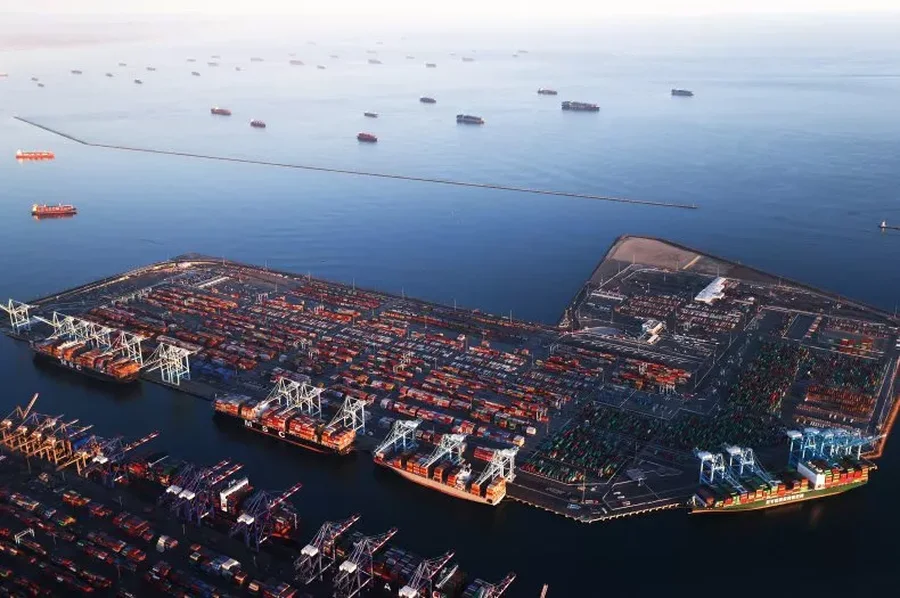
Not so long ago, globalization seemed unstoppable. And in the era of rapid integration that began after the Cold War, business did not have to worry about political barriers to trade.
Last year, Mexico replaced China as the largest source of US imports. And there is no mystery why this happened. Imports from China fell by 20.3 percent. Part of the decline in Chinese imports is attributed to Chinese companies moving their production to countries with tax breaks such as Mexico, which benefits from the USMCA agreement, as well as in Vietnam and other Southeast Asian countries.
But there are also data anomalies, so the actual decline in Chinese imports may not be as large as the US Census Bureau reported. In any case, the trend shows that the US and Chinese economies are "decoupling" from each other. US exports to China also fell 4.0 percent last year.
Overall, US-China two-way trade fell 16.7 percent last year. But it's not just China and America. Global trade took a big hit overall in 2023. In December, the UN Conference on Trade and Development (UNCTAD) predicted that global trade would fall 5 percent compared to the record reached in 2022.
At the same time, UNCTAD stated that the outlook for 2024 is "highly uncertain and generally pessimistic" due to "ongoing geopolitical tensions, high levels of debt and widespread economic fragility". On the other hand, it does not help at all that this year there will be "a reduced demand in developed countries as well as a less than expected performance from the economies of East Asia".
Not so long ago, globalization seemed unstoppable. And in the era of rapid integration that began after the Cold War, business did not have to worry about political barriers to trade. Companies realized that they no longer needed to manufacture near their customers, so they built factories where costs were extremely low, such as in places like China.
As a result, supply chains became longer. Businesses became very efficient and were able to produce products at a much lower cost and at a high speed. Everything could be delivered "just in time". Now, this production model no longer seems viable.
"The Russian invasion of Ukraine has put an end to the globalization we have experienced over the past 3 decades, " Larry Fink wrote in his March 24, 2022 letter to BlackRock shareholders. He suggested that the war in Ukraine killed globalization, which had already been weakened by the Covid-19 pandemic, which had reduced the connection between nations, between companies and between people.
Fink, the world's largest asset manager with $10 trillion, and one of the biggest beneficiaries and proponents of global integration, is not alone in seeing a historic transition. Even the late Henry Kissinger spoke of a "completely new era". Meanwhile, when Xi and Vladimir Putin met in Uzbekistan in September 2022, the Chinese leader spoke of "a chaotic world". And in the new age of chaos and war, the skies and seas are no longer safe for trade.
For example, attacks in the Red Sea by Yemen's Houthi militants have forced many shipping companies to reroute, adding weeks and thousands of miles to voyages to avoid the Suez Canal. They travel around the Cape of Good Hope in the southernmost part of Africa.
But now companies are taking the next step: producing products close to customers, reversing a trend that had started for at least 3 decades. UNCTAD reported that as of the first quarter of 2022, trade between “geopolitically close” countries had grown over 6 percent, and trade between “geopolitically distant” and “geopolitically very distant” countries had fallen by more than 4 percent.
This is what US Treasury Secretary Janet Yellen famously called "friend-shoring" (the act of producing and receiving resources from countries that are geopolitical allies). Governments are accelerating this trend. Starting during the Trump administration, the US has begun pulling US supply chains away from China to make them more sustainable.
Meanwhile, Xi Jinping has encouraged the departure of foreign companies from China, because he is trying to reserve the country's market for his state-owned companies. By relentlessly pursuing foreign businesses and issuing vague national security regulations, China's most powerful leader since Mao has made China a hostile environment.
But Xi's actions are cutting his country off from the world. Last year, China's exports fell by 4.6 percent, while imports by 5.5 percent. If the growth of trade promotes peace, as everyone believes, does its decline pave the way for war? Samuel Huntington said yes.
In his famous 1996 work, The Clash of Civilizations and the Reformation of World Order, the Harvard University political scientist argued that the direction of trade, not its volume, matters. He emphasized that economic interdependence promotes peace only when states expect high levels of trade to continue for the foreseeable future.
If trading partners see their interests shift, Huntington wrote, "war is likely to break out." Of course, war is not inevitable when countries cut off their economies from some countries. But in such conditions the threshold for the use of force falls very low.
As countries are being cut off from the global economy, war is starting to spread. At the moment there is war in Ukraine; rebellions across North Africa that look like wars; and the war that began in Gaza and is now destabilizing Lebanon, Syria, Iraq and Jordan.
As wars disrupt societies, companies move their factories closer to home, while foreign trade declines. And as the latter happens, countries have less reason to keep the peace. The world is now stuck in this destructive and self-reinforcing cycle. And the end of this cycle is not on the horizon./ Adapted "Pamphlet" from "Newsweek"







Lini një Përgjigje