


 Shkruar nga Julian McBride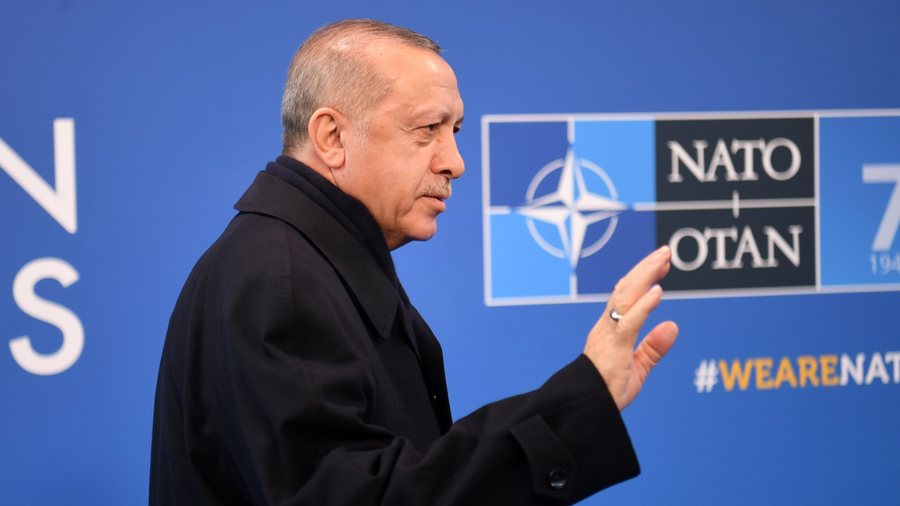
With its ever-growing defense industry, Turkey could fill some of the void in Ukraine if the United States reneges on its previous obligations.
The current US policies, characterized by indecisive actions, populism, and domestic political turmoil, will have long-term consequences in various regions. America is leaving behind a power vacuum that will be filled by others.
In Africa, Ukraine and the Middle East, and especially in Syria, Turkey is intervening as the United States withdraws, transforming itself into one of the world's greatest military powers and leading diplomatic mediators.
By exerting influence in several regions, Ankara is emerging as a major player with an independent foreign policy that does not need a green light from Washington, Beijing or Moscow. Relations between the United States and Turkey began to deteriorate around the time of the rise of ISIS.
Ankara did not allow US forces to use the joint bases for attacks against the extremist organization. But at the same time, to fight the Islamic State, America supported Kurdish forces, some of which are terrorist organizations banned in Turkey.
Beginning to establish its own independent foreign policy, Turkey took the lead in various regional conflicts, even though it still maintains open official diplomatic relations with America, as both countries represent the highest military powers in the NATO alliance.
During the ongoing but fragile ceasefire in Gaza, the Biden administration praised Turkey for keeping Hamas at the negotiating table when the latter wanted to abandon the negotiations.
Distancing itself from much of the Arab world and losing the support of Hezbollah in Lebanon and the Revolutionary Guard Corps in Iran due to heavy losses against Israel, Hamas will increasingly rely on Turkey, as well as Qatar and Egypt, as its main negotiators.
Meanwhile, Turkey is focusing heavily on Syria, as the consequences of the multi-year unrest have greatly affected border areas and the Turkish economy, from the increase in Syrian refugees to clashes in the area with Islamic State fighters and the Syrian Democratic Forces (SDF).
Turkey would intervene militarily in 2016, and several more times until 2022. After Russian intervention helped Bashar Al-Assad and his Iranian allies retake most of Syria during 2015-2019, Turkey helped broker a ceasefire to freeze the conflict.
However, during 2019-2024, Syria’s and Russia’s unwillingness to resolve the refugee crisis prompted Turkey to coordinate with various Syrian rebel groups to resume military operations against the Assad regime. Two weeks after rebel factions led by Hayat Tahrir Al-Sham (HTS) launched a major offensive in November, the disorganized, unmotivated, and outnumbered Syrian army capitulated, and Assad fled the country.
Turkey immediately assumed a protective role over the new transitional government led by HTS, while allowing its main representative, the Syrian National Army (SNA), to conduct operations against the Kurdish SDF. Furthermore, Ankara is investing heavily in the energy, transport and defense sectors of the new Syrian government. Various wars have erupted on the African continent with serious consequences such as ethnic cleansing, genocide and future geopolitical confrontations over resources such as water.
In Libya, several factions emerged to vie for power after the fall of Muammar Gaddafi’s regime, including General Khalifa Haftar, who declared war on the internationally recognized Government of National Accord (GNA) in Tripoli. Haftar, backed by Russian mercenaries such as the notorious Wagner Group, attempted to seize the GNA-held capital of Tripoli in 2019-2020. Turkey officially intervened, sending thousands of fighters from its SNA proxies to
Syria, along with dozens of experienced advisers and major logistics such as Bayraktar TB2 drones. Turkey's intervention stopped Haftar's Russian-backed forces, leaving behind hundreds of casualties, including among the Wagner group. Since the Turkish intervention, the situation in Libya has calmed down and there is currently no major fighting.
In the Horn of Africa, tensions have risen sharply between Ethiopia and Somalia, as the former recognizes the breakaway state of Somaliland, as part of an agreement for direct access to the Red Sea to support and supply its rapidly growing population.
At the same time, the conflict between Ethiopia and Egypt over the resources of the Blue Nile has deepened. Most of the hydroelectric power from the Blue Nile now flows through the completed Grand Ethiopian Renaissance Dam (GERD), which Egypt sees as a major national security threat.
Turkey has quietly led negotiations between Somalia and Ethiopia, inviting delegates from each country to Ankara to discuss a roadmap for peace. During the first months of Russia’s full-scale invasion of Ukraine, Turkey played a major role as a key mediator, even as it was sending Kiev major arms shipments.
The Turkish government supplied Kiev with Bayraktar drones, which destroyed large columns of Russian infantry in the early weeks of the war. Due to the large air defense presence, Bayraktars are currently used to monitor Russian troop movements, and the Baykar corporation plans to build a manufacturing plant in Ukraine after the war.
Moreover, Turkish naval manufacturers are rebuilding Ukraine’s future navy, starting with two Ada-class corvettes. Turkey is a strong supporter of Ukraine’s territorial sovereignty. Due to Russia’s persecution of Crimean Tatars, who have ties to Turks, Turkey has recognized Crimea as Ukrainian territory. Moscow and Ankara are competing for dominance in the Black Sea, and a strong Ukraine could serve as a bulwark against Russian power.
With its ever-growing defense industry, Turkey could fill some of the void in Ukraine if the United States reneges on its previous commitments. Among current NATO members, Turkey pursues an independent and decisive foreign policy approach that rarely aligns with Washington.
With the weakening of American influence, especially due to the isolationist MAGA movement, Turkey can fully manifest itself on the world stage. / Adapted from "Pamphlet" by "Eurasia Review"




Lini një Përgjigje