


 Shkruar nga Pamfleti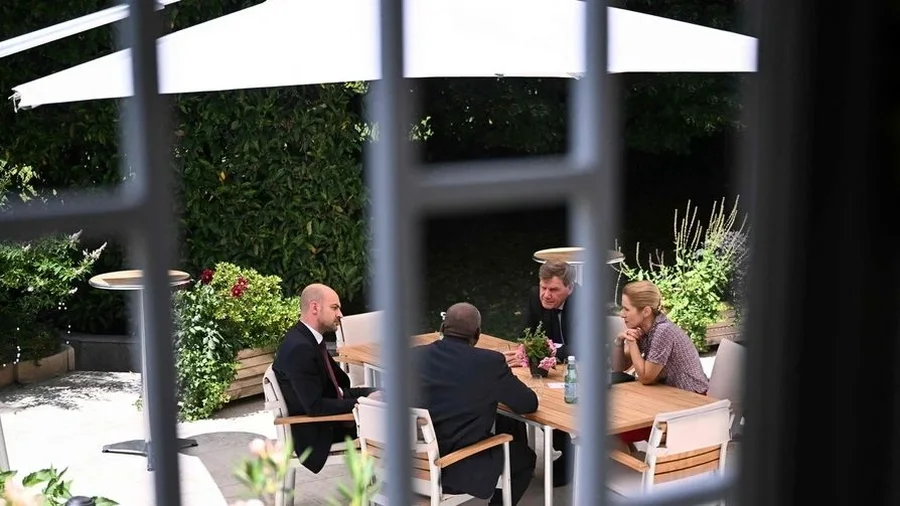
It remains unknown whether the Europeans, and especially the British, conveyed an American message to Iran following Donald Trump's decision to give diplomacy a chance by announcing that he will make a decision on whether or not to intervene within the next two weeks...
The meeting between the Foreign Ministers of the United Kingdom, France and Germany, the EU representative, and the head of Iranian diplomacy has concluded in Geneva, while fighting between Israel and Iran continues.
The messages sent by European officials to Iran on nuclear issues were clear: Tehran must give up its nuclear programs.
The talks were attended by the British, French and German Foreign Ministers, respectively David Lamy, Jean-Noel Barrot and Johan Vandeful, along with the EU High Representative for Foreign Policy, Kaya Kallas, and the Iranian, Abbas Araghchi.
"The discussions we have had with Iran are that regional escalation does not benefit anyone," said EU foreign policy chief Kaya Kallas. She added that "this is why we need to keep the discussions open with the UN."
For his part, the British Foreign Secretary noted that "we have been clear that Iran cannot have nuclear weapons and Europe has been clear for many years that this cannot happen."
"We are ready to continue ongoing discussions and negotiations with Iran and we call on Iran to continue its talks with the United States. This is a dangerous time and it is extremely important that we do not see a regional escalation of this conflict," he added.
French Foreign Minister Jean-Noel Barrot said the diplomatic initiative should pave the way for negotiations. He revealed that Iranian Foreign Minister Abbas Araghchi had said he was ready to continue talks.
Previously, citing sources close to the talks, the BBC revealed that during this meeting "the EU conveyed to Iran the message that it must give up uranium enrichment, a demand that Tehran has consistently rejected as a red line that violates its right to a peaceful nuclear program."
It remains unknown whether the Europeans, and especially the British, conveyed an American message to Iran following Donald Trump's decision to give diplomacy a chance by announcing that he would make a decision on whether or not to intervene within the next two weeks.
A US official revealed that the US envoy, Steve Witkoff, is in regular contact with the Iranians, through Qatar, which acts as an intermediary.
The Europeans also urged Tehran:
Resumption of the work of the United Nations Atomic Energy Agency (IAEA) with the aim of "zero enrichment" of uranium.
Monitoring Iran's ballistic missile activities.
Ending Tehran's funding of armed organizations in the region.
The release of "hostages" from Iran (a reference to foreigners held in Iranian prisons).
What does Tehran say?
Majid Farahani, a spokesman for the Iranian presidency, said that diplomacy with Iran could resume "easily" if US President Donald Trump orders Israel's leadership to stop its attacks on Iran.
"Iran believes in political dialogue," he said, adding "directly or indirectly, it doesn't matter."
"President Trump could easily stop the war with a single phone call to the Israelis," he said, reiterating the Iranian position that talks are impossible while Israeli bombs are hitting Iran.
Farahani reiterated that Iran would not support a ban on nuclear enrichment, something Tehran insists is for peaceful purposes, but added that concessions were possible.
Earlier, the Iranian foreign minister condemned the Israeli attacks as a "betrayal" of diplomatic efforts with the US, saying Tehran and Washington should have crafted a "promising agreement" on Iran's nuclear program.
"We were attacked in the middle of an ongoing diplomatic process," Aragchi told the UN Human Rights Council ahead of the crucial meeting.
The UN Security Council meeting on the Israel-Iran conflict is taking place on Friday afternoon, where there was no shortage of confrontations between representatives of Israel and Iran.
During his opening speech, UN Secretary-General Antonio Guterres warned that with the ongoing conflict between Israel and Iran, the world is "racing towards" a crisis.
"Expanding this conflict could ignite a fire that no one can control," he says.
Guterres added that he believes that at the heart of the conflict is "the nuclear issue."
"Iran has repeatedly stated that it does not seek nuclear weapons. But let's admit that there is a trust gap," he says.
"I call for an end to the fighting and a return to serious negotiations." /Adapted from Pamphlet/


Lini një Përgjigje