


 Shkruar nga Pamfleti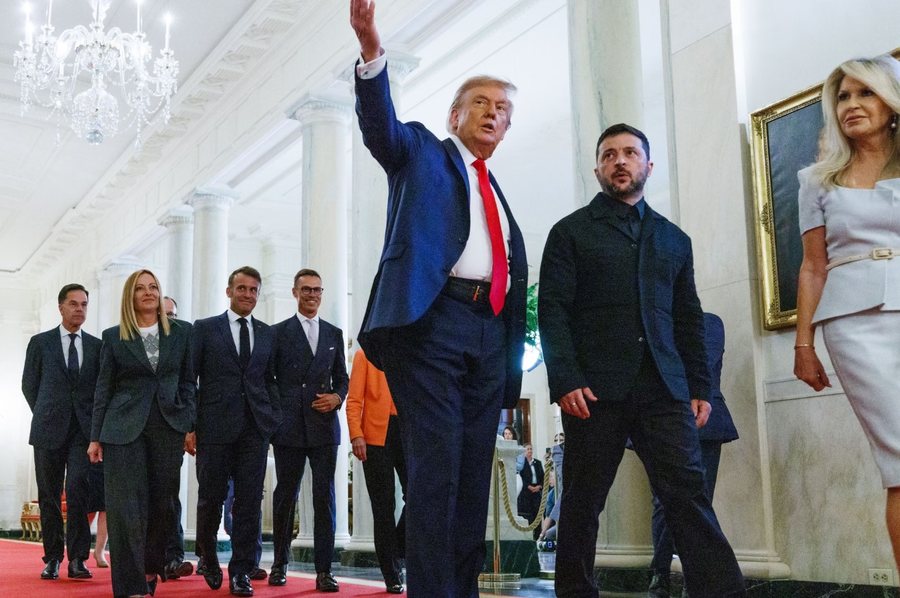
From the red carpet for Putin to uncertainty for Zelensky: American diplomacy remains in the shadow of the Kremlin...
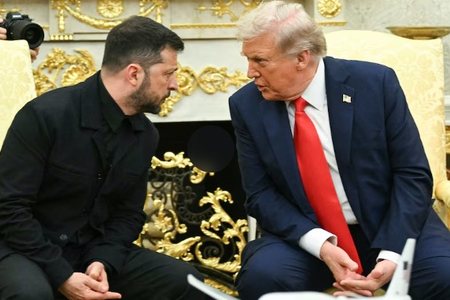
The results of Donald Trump's meeting with Volodymyr Zelenskyy and other European leaders on Monday depend entirely on how you measure them.
The main fear was that this meeting could end up as a disaster similar to the one the US president inflicted on the Ukrainian leader in February, a scenario so plausible that Sir Keir Starmer, Emmanuel Macron, Friedrich Merz and other European leaders dropped everything to go to the White House in person as a sign of support.
After a lavish red-carpet reception for Vladimir Putin in Alaska on Friday, Trump reportedly embraced the idea that Ukraine must give up Donbass in order to reach a peace deal. Even if one were naive enough to think that the Kremlin would see this as the end of the conflict, rather than a temporary plan for another future offensive, this would not be a “land swap” but a pure territorial grab, unacceptable to Kiev. Ukraine would be forced to surrender lands that Moscow has been trying to seize for years, but has failed.
Given the history of previous meetings, there was reason for some relief after the talks in Washington: it could have gone much worse. But by the standards of classical diplomacy, and even more so given Ukraine’s urgent needs, the outcome was alarming. Only last month, Trump had threatened tough sanctions on Russia. He even warned, on a trip to Alaska, of “very serious consequences” if a ceasefire was not declared within the day. On Monday, however, with Ukrainian civilians under heavy Russian bombardment, he declared that there was no need to stop fighting while the deal was negotiated.
Let alone the inability to grasp the details, the lack of preparation, and the constant inconsistencies of his administration. Let alone the failures to pursue the kind of committed, patient diplomacy that real peace requires. The facts show that Ukraine and its European allies are making every effort, from diplomatic overtures to arms purchases, to bring Trump closer to their position. But his compass always seems to turn toward Putin. Instead of clearly standing on the side of a democracy, alongside U.S. allies against a war criminal, Trump is acting at best as a cold mediator.
On the other hand, the Kremlin has not yet confirmed whether Putin will meet with Zelenskyy, as Trump has stated. The US president has said that the US will “help” Europe with security guarantees and will “coordinate” any efforts in this direction. But so far there is no sign that his administration is ready to offer real support that would encourage European allies to send troops to the ground or to continue to stand firm in case Russia is put to the test.
Ironically, the most important lesson of Monday came not from Washington, but from Europe: the ability of European leaders, with different political orientations, even Giorgia Meloni from Italy, to find common ground and coordinate. This is positive news, but it is not enough: avoiding a catastrophe is not the same as building a clear strategy for the future.
Meanwhile, despite Moscow’s military advances in recent weeks, fueled precisely by the idea of talks, the cost of the war for Russia is also very high. Putin may conclude that it is not worth continuing. But even if Trump were to stand firm in his current position, this remains a long way from what is required. Ukraine urgently needs concrete steps to guarantee the future of the thousands of children abducted by Russia, to keep the promise of justice in the future and, above all, for an immediate ceasefire, before more lives are lost. / Adapted from “Pamphlet” from “The Guardian”






Lini një Përgjigje