


 Shkruar nga Pamfleti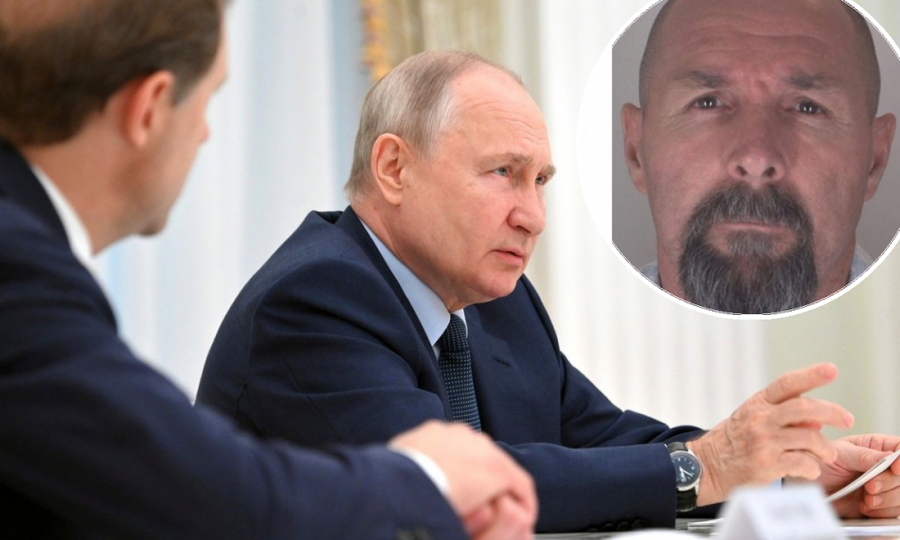
It's been almost a year since journalist Evan Gershkovich was detained during a reporting trip to Russia. His best hope for release may be Vadim Krasikov, who is imprisoned in Germany, convicted of an execution ordered by the Kremlin.
What happened?
In the summer of 2013, a Moscow restaurant owner was shot dead in the Russian capital. A hooded man got off a bike and shot his victim twice before running away.
Six years later, an exiled Chechen commander, Zelimkhan Khangoshvili, was killed in a crowded park in Berlin under similarly eerie circumstances, shot by a man on a bicycle with a silenced Glock 26. in the middle of the day.
The attacker was arrested after throwing a pistol and a wig into the River Spree near the Reichstag, the German parliament building.
A passport bearing the name "Vadim Sokolov" was found on the Berlin bomber, but authorities soon concluded that it was not his real name.
The bald, burly man they had arrested was actually Vadim Krasikov, a Russian national with ties to the FSB, Russia's security service - and the prime suspect in the 2013 Moscow murder.
In a recent interview with US talk show host Tucker Carlson, Russian President Vladimir Putin appeared to confirm reports that his country was seeking the release of "patriot" Krasikov in exchange for US journalist Evan Gershkovich.
It has now been a year since Gershkovich, a reporter for the Wall Street Journal, was arrested in Russia on espionage charges, which he has denied.
Gershkovich is not the only American in a Russian prison whose fate may be linked to Krasikov's. Former US Marine Paul Whelan and US-Russian citizen Alsu Kurmasheva are also detained in Russia on charges widely seen as politically motivated.
Even the late Russian opposition figure Alexei Navalny, who was serving a 19-year prison sentence in Russia, was said to have been part of an exchange involving Krasikov before he died, according to his allies. After the Russian election, President Putin said he had agreed to release Navalny in exchange for "some people" held in the West, but the White House said it was the first it had heard of such a deal.
If President Putin's price remains the same, it means that the most likely way to secure the release of the detained Americans would be a complex prisoner exchange for Krasikov that needs the cooperation of Germany, the US and Russia .
Why does Putin seem so desperate to get Krasikov back?
The first clues to a possible Kremlin hand in the Berlin assassination come from Krasikov's background — or rather, the lack of one.
Documents obtained by investigative website Bellingcat show he was wanted for the Moscow murder in 2013. However, two years later, the warrant was withdrawn and the identity "Vadim Krasikov" apparently disappeared.
Then "Vadim Sokolov", 45 years old, appeared. In 2015 he received a passport, and in 2019 a tax identification number.
A German court concluded that this dossier could only be sanctioned by the Kremlin, and therefore that Vadim Krasikov had state support for the Berlin murder.
"The Russian state authorities ordered the accused to liquidate the victim," said a German presiding judge after sentencing Krasikov to life in prison.
His victim, Zelimkhan Khangoshvili, was a Chechen rebel commander between 2000 and 2004, when Chechnya was fighting a war of independence against Russia.
To Western observers, Khangoshvili appeared likely to be part of a string of Moscow-ordered killings of Chechen exiles in Europe and the Middle East.
The Kremlin denied orchestrating the Berlin assassination and dismissed the verdict against Krasikov as "politically motivated."
However, in his Tucker Carlson interview, President Putin appeared to concede when he said negotiations were underway for a swap involving a Russian "patriot" who had "eliminated a thug" in a European capital.
FSB contract with assassins.
Vadim Krasikov belonged to the highly secretive 'Vympel' unit of the Russian secret service, the FSB, according to prosecutors at his trial.
"Its official task is counter-terrorism operations at home, but in many ways it has returned to its original roots, as a unit tasked with covert work - sabotage and assassination - abroad," a historian told the BBC.
Krasikov personally met Putin at a shooting range while serving with Vympel, owned a BMW and Porsche and traveled regularly for work, according to an interview his brother-in-law gave to The Insider.
An association between Krasikov and the FSB would provide an explanation for why Vladimir Putin, a former foreign intelligence officer himself, would be willing to hand over a prisoner of Evan Gershkovich's worth.
But whether Krasikov will ever be allowed to return to Russia ultimately depends on the German government.
Ulrich Lechte, whose Free Democratic Party is part of Chancellor Olaf Scholz's government, insisted that Germany "must not do Russia this favor".
"This is a kind of amnesty and sends a political signal that Russia can carry out further killings on our territory, which will then go free and thus go unpunished," Lechte told the BBC.
Jürgen Hardt, of the Christian Democrats, said he "did not see any political support" for the rumored prisoner swaps involving Krasikov.
Even if there were the political will in Berlin to release Krasikov, the legal mechanics that could do so are unclear.
He could be pardoned by the president or deported to serve the remainder of his sentence in Russia — something that almost certainly would not happen in light of Putin's comments.
A case in point is Russian "Death Merchant" Viktor Bout, a notorious arms dealer released from US custody as part of a prisoner swap with American basketball star Brittney Griner. Bout has now focused on politics and won a seat in local elections in Russia.
Nicola Bier, a German lawyer who focuses on extradition law, told the BBC that "there is no legal mechanism that is really designed for this particular situation", so any action would be highly controversial and political. . /Adapted from PAMPHLET



Lini një Përgjigje