


 Shkruar nga Diplomatico | Pamfleti.net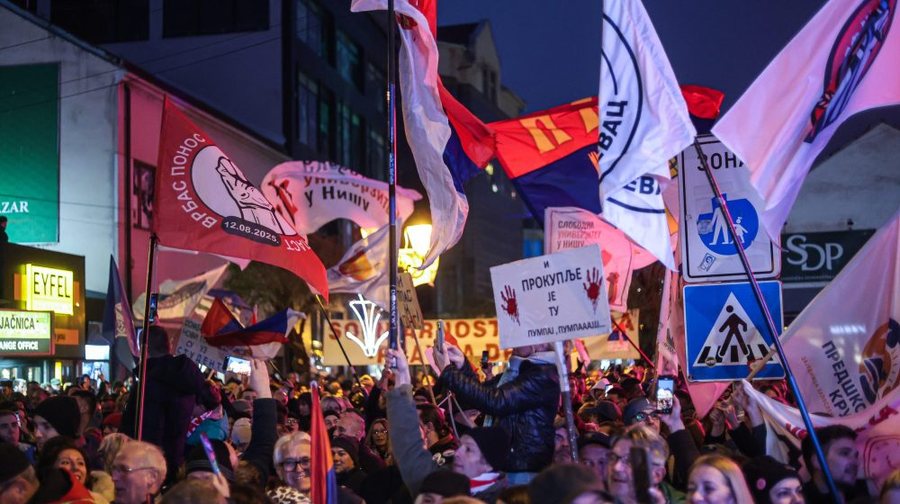
The Serbian president's statement is not a blunder, but a continuation of a policy that belittles Muslim communities and any protest that is not controlled by the government...
Serbian President Aleksandar Vučić's statement about the civic protest in Novi Pazar, which he described as "small" and "insignificant", was neither spontaneous nor innocent. It represents a political line consolidated for years in Serbia: belittling civic discontent, trivializing social revolt and avoiding any real institutional responsibility. When a president chooses irony and ridicule in the face of the protest, he is not showing confidence, but fear of a process he cannot control.
The protest in Novi Pazar was neither ethnic nor religious, despite attempts to read it that way. It was a direct reaction to administrative decisions that hit students and professors, at a time when universities in Serbia have become one of the main fronts of discontent with state capture. But the fact that this protest took place in a city with a Bosniak majority gave Vučić’s response an even more problematic charge: contempt for the periphery, for communities that have traditionally not been part of the circle of power, and for voices coming from outside Belgrade.
In reality, Novi Pazar was neither “small” nor “insignificant”. It was a symptom of a deep social fatigue from the arrogance of power and from a model of governance that does not recognize dialogue, but only discipline. Serbia's political history has clearly shown that student and civic movements are often precursors of major political crises. Precisely for this reason, Vučić's mocking reaction should be read as a sign of insecurity and not strength: a confident government does not minimize protests, but tries to neutralize them through institutions and dialogue.
For the region, and especially for Albanians who closely follow developments in Serbia, the case of Novi Pazar is a wake-up call. A state that aspires to be a factor of stability in the Balkans cannot build internal stability by belittling its citizens and making fun of social discontent. Stability that relies on contempt, fear, and control of the media narrative is only a false calm, destined to be shattered at the first serious moment of crisis.
In the end, Novi Pazar was not a peripheral episode on the political map of Serbia. It was a clear reflection of the way today's government sees the citizen: as a figurehead, not as a factor. And whenever the government chooses to laugh at the protest, it is usually because it understands that its message is more serious than it wants to admit./ Pamphlet





Lini një Përgjigje