


 Shkruar nga Gjergj Zefi
From the rhetoric of "regime change" to the demand for a deal with the same regime, Donald Trump's policy towards Iran leaves behind more questions than concrete results...
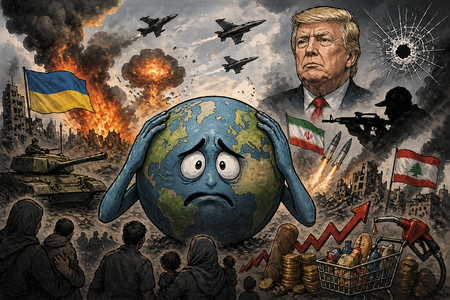
Donald Trump's next statement: "No more Mr. Nice Guy," no longer shocks anyone. Not because it's a routine diplomatic statement, but because it has become predictable.
In diplomacy, predictability can be an asset, but not when it is linked to threats that are repeated without producing any real effect. Then it becomes background noise.
The paradox is obvious: an administration that entered this conflict with the rhetoric of regime change in Tehran is now seeking agreement with the same regime it considered unacceptable.
This is not just a compromise; it is a reversal that exposes the gap between the initial ambition and the reality imposed on the ground. Because at the end of the day, diplomacy is not measured by statements, but by results. And so far, the result is a prolonged stalemate.
And here I am reminded of the anecdote of the father and his son. The son says to his father: “Dad, I caught the thief.” “Bring him,” says the father. “He won’t come,” replies the son. “Let him go,” says the father. “He won’t let me go,” replies the son.
This is the most accurate metaphor for the current impasse: a clash that began as a show of force and that today seems to have taken its own initiator hostage.
The irony is that the more the tone rises, the less Iran's behavior changes. Tehran has already read this pattern: maximum pressure, strong statements, then a step back to the negotiating table.
In this cycle, the threat does not function as a coercive instrument, but as a political ritual. And any ritual that is repeated without effect loses its power.
This situation raises a deeper question about the role of the United States at this stage: is this a well-calculated pressure strategy that takes time to bear fruit, or a constant improvisation disguised as strong rhetoric? Because the difference between the two is fundamental. One projects enduring power; the other, ambiguity.
In international perception, this zigzag does not go without consequences. Allies seek coherence, adversaries seek weakness.
When a superpower moves between threat and negotiation without a clear strategic line, it risks losing both: the trust of its allies and the fear of its adversaries. And this is where cynicism becomes an analysis: because we are no longer dealing with a “Mr. Nice Guy,” but with a model that is not convincing anyone.
In the end, perhaps the problem is not that America is acting too soft or too tough. The problem is that it is appearing both soft and tough, but not convincingly. And for a country that has historically built its power on strategic clarity, this is more than a contradiction. It is a signal of weakness disguised as strength./ Pamphlet



Ne ne kohen tone i quanim gango fshtati me çorape leshi. E pate se si e talli mbreti Anglise ne mes të Senatit dhe mori duartrokitjet e gjithë Senatit. Dy djali tha mbreti por i pati vend fjala e ndersa gango i fshatit fliste per caraca e ide e kumbulla të egra.