


 Shkruar nga Gjergj Zefi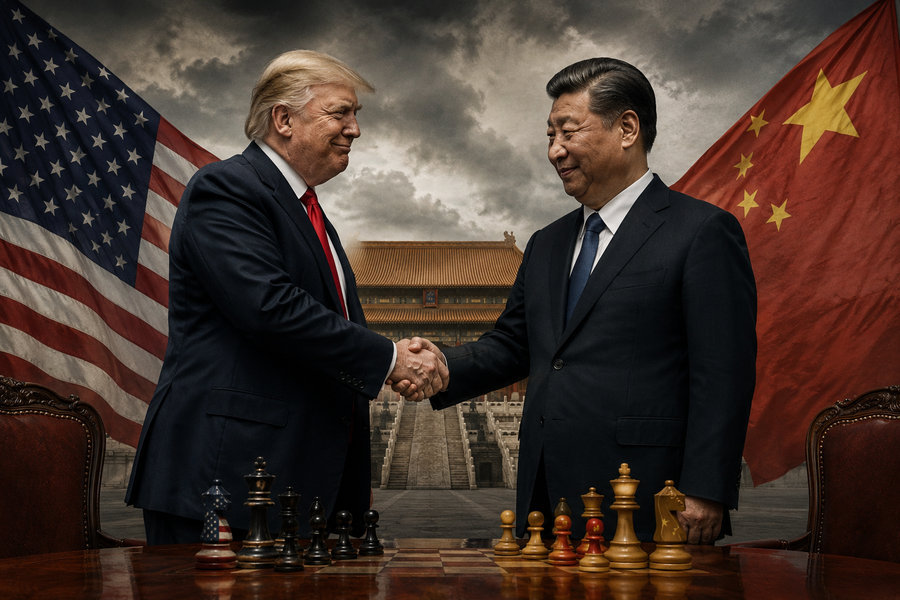
From Taiwan to artificial intelligence, the Trump-Xi summit in Beijing showed that the US and China are no longer negotiating cooperation, but are managing a great rivalry for dominance of the new world order...
The meeting between Donald Trump and Xi Jinping in Beijing was not a summit of grand agreements, but a brutal exposure of the new global reality: the United States and China are no longer seeking strategic understanding, but controlled management of rivalry.
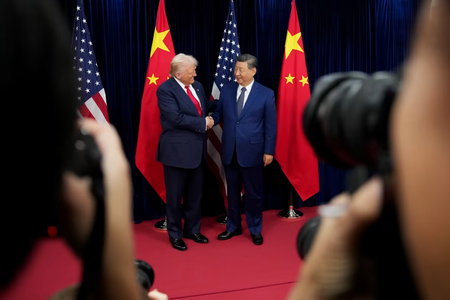
In the luxurious halls of Chinese diplomacy, there were smiles, flags, banquets, and optimistic declarations of "cooperation" and "stability," but behind the ceremonial facade it was clear that the two superpowers have entered a phase where they communicate to avoid conflict, not to build trust.
This is precisely the great irony of this summit: Trump and Xi seem to have agreed on only one thing: not to really agree on anything essential.
The Americans left Beijing talking about Boeing, trade and investment. The Chinese left talking about Taiwan, sovereignty and “red lines”. Two different conferences, two different narratives, two political realities that do not meet anywhere. And this is not a diplomatic coincidence. It is the clearest reflection of the new world that is taking shape.
There is a belief in Washington that China is gradually attempting to replace the US as the main center of global power, not necessarily through classical warfare, but through technology, economic chains, artificial intelligence, and control of strategic markets.
In Beijing, the perception is equally harsh: the Americans are seen as a relatively declining power that is using Taiwan, chips and military alliances in Asia to contain the Chinese rise.
This is why the summit produced no real agreement. Because the problem between the US and China is no longer trade. It is existential.
In years past, the clashes between the two countries were economic in nature: tariffs, imports, exports, trade deficits. Today, the conflict has shifted to a much more dangerous level: who will control the technology of the future, artificial intelligence, chip manufacturing, sea lanes, rare minerals, and the very political architecture of the 21st century. This is no longer a war for money. It is a war for historical dominance.
For this reason, even Beijing's smiles seemed cold. Xi Jinping did not need spectacular agreements. The political photo was enough for him: the American president in Beijing, at a time when China is trying to show the world that it is no longer a "factory", but a global pole equal to the US. The ceremony itself was a geopolitical message.
While Trump sought to sell the idea of an economic victory to the American public, Xi was playing a much longer-term game. China doesn’t think in four-year election cycles. It thinks in decades. And its objective today seems clear: the normalization of a bipolar world in which Washington is no longer the absolute center of global gravity.
Against this backdrop, Taiwan remains the silent bomb of the international system. Every diplomatic phrase about “stability” hides the real fear of a possible military conflict in the Indo-Pacific. Neither Trump has given strong guarantees for Taiwan, nor has Xi softened his tone toward the island. On the contrary, both sides seem to be testing each other’s limits, while the world hopes that the rivalry will remain economic, not military. But history shows that when two great powers enter a phase of total strategic distrust, diplomacy often becomes nothing more than a mechanism to buy time.
And perhaps this was the real meaning of the Beijing summit: not peace, not reconciliation, not a historic agreement. Just a nervous truce between two powers that know that a direct clash would be catastrophic for the entire planet.
So the photo of Trump and Xi smiling in Beijing may remain one of the most cynical images of modern diplomacy. Because behind it lies a much colder truth: America and China are no longer trying to convince each other. They are preparing for a world where each must survive against the other./ Pamphlet


Ne mandarin e pare beri disa here lutje per te takuar nje klloun si kim Yong. Gjoja u mor vesht qe te mos testonte raketat berthamore Korea e veriut, se ishte problem shum I madh.
Gjergj ke harruar që Musk do të investojë 50 mld për një uzinë çipash në SHBA dhe kjo do të jetë e pavarur nga prodhimi taiwanez dhe se pas kësaj gjërat do të ndryshojnë....Amerika nuk do të ketë më nevojën për Taiwanin...