


 Shkruar nga Anders Fogh Rasmussen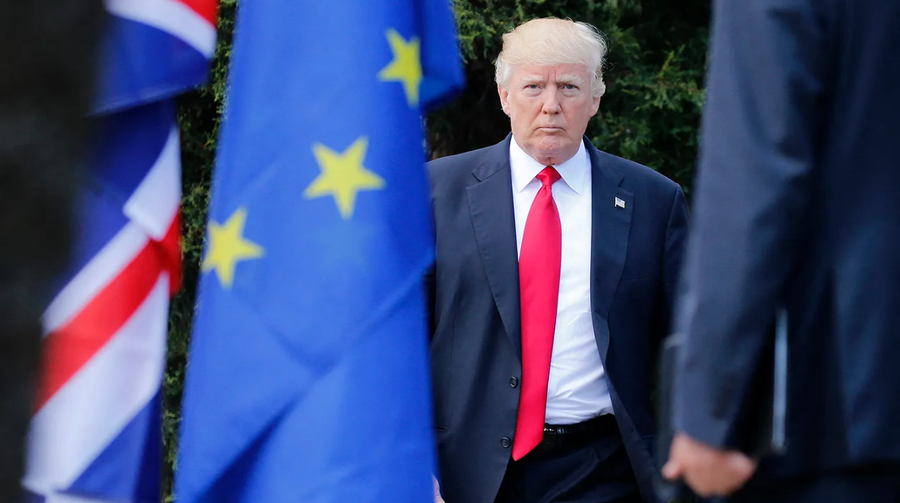
Donald Trump only recognizes and respects force. I hope that the new American administration will not end an international order that has created more security and more development for more people than any other order in human history...
The first weeks of Donald Trump's second administration have been difficult, even painful. I have dedicated much of my life to defending a rules-based international order led by the United States, and I worry that it is coming to an end.
The world needs a policeman, and since World War II, the United States has fulfilled that role. But what happens if the policeman no longer exercises his authority over geopolitical gangsters, or behaves abusively toward the most steadfast supporters of his rule in the world?
I never imagined that I would hear an American president proclaim his intentions to "expand our territory," as Donald Trump did in his inaugural address.
He continues to say that Canada should become the 51st state of the US, and has refused to rule out the use of military force to secure America's control over the Panama Canal and the autonomous Danish territory of Greenland.
Vladimir Putin and Xi Jinping are watching Trump's behavior more closely. If the US annexes Greenland, under the pretext of ensuring America's security, Xi will claim that he can invade Taiwan for the sake of China's security.
Under these conditions, even Vladimir Putin’s absurd arguments for invading Ukraine as a way to maintain Russia’s security would be legitimized by Trump. As a child, I admired US President John F. Kennedy, who said that America “would pay any price, bear any burden . . . to ensure the survival and success of freedom.”
As a young politician, I enjoyed Ronald Reagan’s 1985 State of the Union address, in which he said, among other things, that “America’s mission is to nurture and defend freedom and democracy.” As prime minister of Denmark, I worked with President George W. Bush because I believed that Denmark’s security was best guaranteed by a close alliance with the United States.
But after Trump's threats against some of America's closest allies - including my own decision - I have been forced to reconsider my views. Today, we Europeans must be prepared to defend ourselves from those who lurk outside our borders. Europe must develop a stronger and more effective defense to deter Russia and any other nation. NATO is still a cornerstone of European defense. But since Donald Trump has raised doubts about America's readiness
to fulfill its obligations in the alliance, and has even threatened two allies, Canada and Denmark, I see no other alternative but to ensure that we can remain independent in any situation.
We must build a coalition of European countries that are prepared to provide a strong European defense. We must strengthen the security dimension of the European Union, moving from unanimous to simple majority voting, to prevent pro-Russian members from vetoing important security measures.
We also need to sign a security agreement between the European Union and Britain as soon as possible to protect ourselves and our most important shared infrastructure. History shows us that trade wars only produce losers.
Consumers pay more, inefficient domestic companies are unfairly protected from competition, and the result is less economic growth, lower productivity, and less development for all.
But if Donald Trump challenges us with a tariff war, we Europeans must respond aggressively. Europe's response must be dollar-for-dollar retaliation, targeting American industries and businesses, where the damage will be greatest.
Donald Trump knows and respects only force. I hope that the new American administration will not end an international order that has created more security and more development for more people than any other order in human history. But hope is not a strategy. Europe must prepare, otherwise it will suffer the consequences. / Pamphlet from the “Wall Street Journal”
Note: Anders Fogh Rasmussen was Secretary General of NATO from 2009 to 2014 and Prime Minister of Denmark from 2001 to 2009.



Lini një Përgjigje