


 Shkruar nga Blendi Kajsiu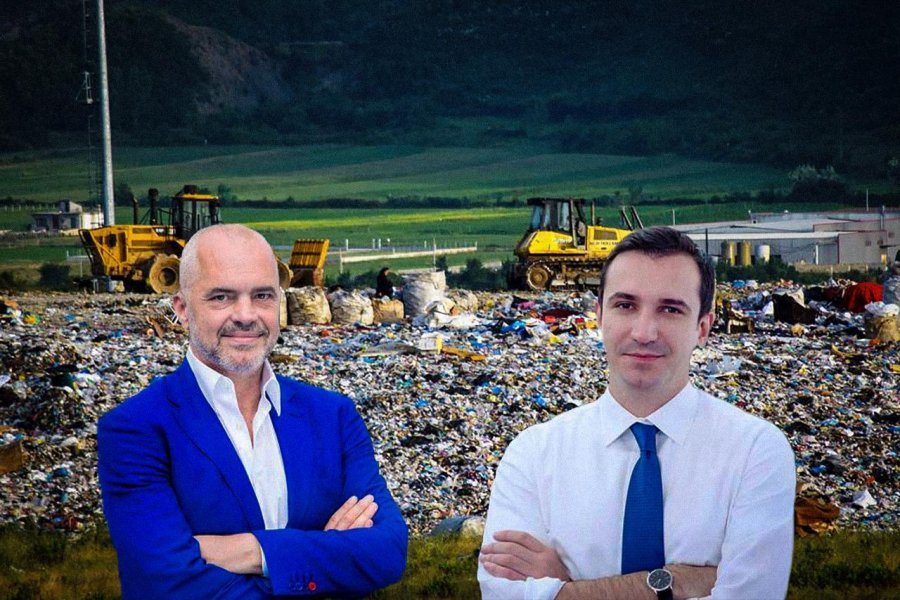
It is more reasonable to demand that the incinerator scandal be investigated at the highest levels of politics, up to Prime Minister Rama.
I have deliberately put the word "anti-Americanism" in quotation marks because I do not think that there is an anti-American political current in Albania, even among the critics of the USA. The left and the right today are divided into Ameri-kan, those who have America with them (socialists) and Ameri-kan, those who cry for America (berishists). Even the staunchest Berishists are not anti-American, because they cry more than they hate America.
Moreover, open and public criticism is the essence of democracy and of the American ideal itself. Therefore, the anti-American labeling of anyone who does not agree with the statements of Blinken, Biden, or the next American ambassador, is in fact an expression of the totalitarian mentality, and therefore pure anti-Americanism.
The problem is that criticism of American policy in Albania is as incoherent as it is unbelievable because it is done for narrow political interests and not for reasons of principle. The same people who today criticize the USA for violating democratic standards with its pro-Rama stance, support the Berisha-Meta political standard as a guarantee of Albanian democracy. The same people who accuse Blinken of ignoring the corruption of the Rama government, turn a blind eye to the corruption of the "oppositionists" who have been enriching their families with power for three decades.
Of course, it is more logical to worry and criticize Blinken's statements that Rama is an excellent prime minister, especially in the context of the incinerator scandal. But the same Blinken came out in open support of SPAK, which has long been investigating the scandal in question by arresting some of the highest figures of the current government, as never before. Therefore, it is incoherent to criticize the USA as a guarantor of Rama's corruption while denouncing any investigation of Berisha's or Meta's corruption as pure political persecution by SPAK.
It is more reasonable to demand that the incinerator scandal be investigated at the highest levels of politics, up to Prime Minister Rama. But such an investigation can only be done by independent institutions of justice that still need to be strengthened, such as SPAK, and with strong international support from the USA. Therefore, it does not make sense that the same voices that demand that SPAK investigate the prime minister criticize his main supporter, the USA, as a guarantor of government corruption.
It is more reasonable to criticize the US intervention in Albanian politics for its anti-democratic dimension. The problem is when the same voices that criticize the US for trying to appoint the Albanian opposition in an anti-democratic manner ask it to appoint the government.
There are many who think that the declaration of Berisha's non-grata could only be justified if Rama was also declared non-grata. On the one hand, many critics of the USA complain that Berisha's non-grata declaration is anti-democratic because it violates the will of the opposition voter, which is a minority of the Albanian electorate. On the other hand, the same people think that the USA should declare Rama non-grata and remove him as prime minister, even though this would violate the will of the majority of the Albanian electorate that voted for him.
So at best the critics of the USA declare that they can establish a democratic standard only if they violate both the will of the minority and that of the majority. In the worst case, they claim that the sovereignty of the minority (the opposition) should be respected, but not that of the majority (the government). Both are contradictory positions.
Of course, it is more reasonable to criticize the statements or attitudes of American ambassadors or officials in Albania. Often they have been problematic. Ambassador Arvizu declared Berisha a "statesman" after the January 21 murders. Ambassador Limprecht had deeply anti-opposition and pro-socialist government attitudes. Ambassador William Ryerson went to rallies with Berisha and supported the arrest of Fatos Nano. Such examples can be found endlessly.
But it is difficult to find long-term orientations of American foreign policy that have harmed Albanian democracy. Historically, the alignment of the USA in Albania has been on the right side. In 1991, they lined up against the Labor Party. In 1996, they rallied against the theft of the parliamentary elections. In 2005, they were neutral, but very critical of socialist corruption. Without mentioning the geopolitical support given to Albania and Kosovo, of course also for the geopolitical interest of the USA itself.
In fact, geopolitical support to Albania has often been in conflict with its democratic standard. It is enough to remember that Albania's membership in NATO in 2009 came after the explosion of atomic corruption in Gërdec. A clear example of how the democratic standard was violated in function of geopolitical interest. Even in this case, the violation of the democratic standard was done in function of Albania's geopolitical interest.
To some extent the same phenomenon is happening even today and may pose a danger to our fragile democracy. The geopolitical importance of Albania in the context of regional instability may push the US to turn a blind eye more and more to the corruption of the current government, especially when they have no alternative partner in Albania. In other words, there is a possibility that the standards of Albanian democracy will be sacrificed on the altar of American geopolitical interests.
But it is a big incoherence to ask the US to sacrifice its geopolitical interest on the altar of the narrow and anti-democratic interests of the current opposition. From the point of view of real-politics, it is absurd to ask the USA today to give up their current partner in Albania, which obeys them in foreign policy, does not directly attack their creation SPAK and enjoys the support of the electoral majority in the country.
And for what? To create a new partnership with an opposition that is either an electoral minority, or is divided, or is perceived as deeply corrupt by the electorate, and that daily attacks SPAK and declares that the State Department is a puppet of Soros. Maybe Blinken makes an alliance with Berisha if the latter withdraws the famous lawsuit he filed against him in Paris. But the lawsuit must be withdrawn.
Unfortunately, the state in which the Albanian democracy is located is not the fault of the USA or their attitudes. On the contrary, the degradation of Albanian democracy has occurred despite, and not as a result of, American attitudes. It is not Blinken's fault that Berisha chose to drag the DP in view of his family situation, that Basha did not know or did not want to face Berishism, or that Gaz Bardhi and his friends lick at dinner what they spit at lunch, only for a deputy post.
It is even less the USA's fault that Rama has long since turned Albania into a prime ministerial republic, where the parliament has been reduced to an extension of his mood. The roots of this phenomenon are in the Rama-Berisha constitutional changes of 2008, which assassinate our fragile democracy. Just as we cannot blame the US for power grabbing our media or for degrading it in furtherance of the narrow interests of the owners.
The fault for the degradation of our democracy is and continues to be all of us. Including the author of these series who was an associate of Berisha in the 2005 elections. At the core of this degradation lies the reduction of politics to narrow personal interests that produces the inability to distinguish, articulate and protect the public interest. It is what Hannah Arendt called the banality of evil.
The banality of our evil originates in Tirana and not in Washington. The banalization of our democracy has reduced politics to a war of narrow and petty interests, without any principles, norms or political ideals. Therefore, today our politics is immersed in deep incoherence, both in the opposition and in power. But this is another topic./Lapsi.al





Lini një Përgjigje