


 Shkruar nga Afrim Imaj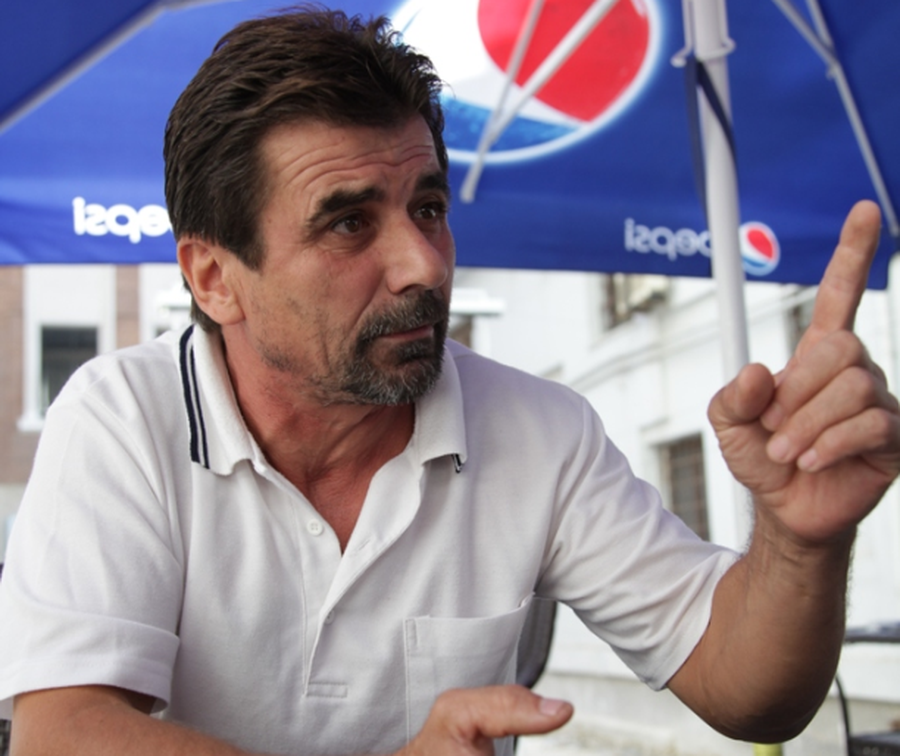
"Kavaja was the first to participate in democratic processes".
The man in front of us in the "Demokracia" cafe is convinced that the revolt of March 25, 1990 in the Kavaja stadium was the first public demonstration against the communist regime.
Even, according to him, the official articulation for the beginning of democratic developments in the country intentionally reserves a peripheral role. Rexhep Rrugeja, one of the organizers of the demonstration, returns from time to time to this approach, as he remembers the unusual event during the Besa-Partizani match at the end of March '90, where the whole city stood up and protested strongly with the slogans "Down with the dictatorship" , "Enver-Hitler" "Freedom-democracy", "Down with Nexhmije Hoxha".
Other developments, he argues, singling out the storming of embassies in July of that year and the student protests known as the December movement, belong to a later period. Beyond that, the rest of the 60-year-old Rrugeja's narrative follows the chronology of the event with a detailed description from the first moment to the bloody confrontation with the police. "It was not something spontaneous, but a movement thought and prepared beforehand", he adds, recalling the circumstances of the protest, the organizers, the slogans thrown, the dynamics of the event, the names of the injured, the arrested, etc. And while concluding the story, Rrugeja hastens to reveal its determination, according to which the protest of March 25, 1990 remains the prelude of the anti-communist movement in Albania.
Mr. Rexhep, in the documents of the Security it appears that in the spring of '90 you were convicted for agitation and propaganda, being registered as the last victim of the communist regime.
Under what circumstances did you become an object of the Secret Police and how do you remember the repression of those days?
I was indeed arrested in March 1990, but I was not the last in the ranks of political convicts. At least in Kavaja, until September 1990, for genuine political motives, they were arrested along with dozens and dozens of others. It was the time when the regime was writhing in its last throes and was taking revenge with all its fury, like a wolf when it gives its soul. Our city, which had two or three policemen all its life, became a large barracks with detachments of sampistas, policemen and reservists of the Secret Service. A situation was created with people arrested, detained and brutally beaten, with demonstrations of force in every alley, neighborhood and public environment.
What were the reasons that the regime made Kavaja the arena of repression and persecution?
Kavaja was the first to start rebelling against him. Reactions had started after the fall of the Berlin Wall, in the form of anti-communist tracts. Then this became the ruling spirit of the entire city, which was finally appearing to disagree with the regime. Everywhere there was talk against the dictatorship, against the communist leadership. At home, in workplaces, on the streets, in shops. From spontaneous, illegal actions, the movement took the form of massive public developments. In the early days of 1990, it became more organized and compact. Kavaja was struggling to break the shackles of the dictatorship and was opposing it by any means and in any form. This resulted in the state repaying the city. Precisely for this reason, the communist dome brought Agron Tafa, the number two of the Ministry of the Interior, to the head of the Party Committee of the district. The transition of the deputy minister of State Security to the position of first secretary was, as expected, accompanied by an increase in terror in the cities. The chief executioner, newly arrived from Tirana, tried the entire arsenal of oppressive structures, to reintroduce his fellow citizens under the regime's heel, but he did not succeed, until he was forced to leave with his tail in the saddle. The time of Tafa's reign is imprinted in Kavaja's memory as the time of great explosions, of culminating events that preceded democratic developments in the country. Therefore, it is also known as the period of mass arrests and strikes. In their flow, my arrest also happened.
Was your arrest related to any specific event?
I was arrested on March 26, 1990, after a sensational demonstration against the regime in Kavaja stadium.
What do you mean when you single it out as a sensational demo?
It was the first anti-communist demonstration in a public setting with a large turnout. Enver Hitler was cheered there for the first time. The idea of the organizers to use the presence of many fans in the Besa-Partizani match for a rally against the regime worked perfectly. That day, for the first time, Kavaja publicly showed his hatred for communism, for the dome of the dictatorship, for the tyrant's widow, for the Secret Police. He said "No" in a Stalinist beast voice that took our breath away.
This, while the Besa-Partizani meeting was taking place in the city's stadium?
More precisely, right at the end of the match, as decided by the organizers...
So there was a plan with a detailed script?
Without a doubt, there was one with the announcement of what would happen in the stadium, about the banners that would be thrown, about the way to react to the police, about the moment when it would explode.
And did it work all the way?
Something was off from the start. In the announcement illegally broadcast earlier, it was predicted that the first flags would be thrown in the 88th minute of the match, but they erupted earlier. From here the stadium was lit up by loud cheers. For the other details, the script was obviously not put into work. The first sparks were enough to get the situation out of control. The scuffle with the police and sampistas then brought unforeseen complications. A real, unimaginable duel. A duel with the barbarism of the state, which followed with a painful epilogue, with wounded, arrested and persecuted...
How did the protest start in the stadium during the Besa-Partizani meeting?
That day the stadium was filled more than any other time. The part of the "20s", as predicted, became the epicenter of the protest. Everything started from there. I became the cause, quite spontaneously. Unconsciously. As someone shouted for a clash on the pitch, I stood up and started chanting "Down with Communism!", "Freedom-Democracy!", all the way to the 88th minute. The two friends I had next to me grabbed my arm, reminding me that the right moment had not yet come. I sat down again, but emotions and hatred would not let me hold back. Every now and then I stood up and called out loud. On two or three occasions I climbed the bars of the stadium and loudly shouted "Down with the dictatorship!" This caught the eye of the cameraman filming the match and pointed the camera at me. So, the noise attracted the attention of the police who had overflowed the track of the field. One of the eyes beckoned me to come to them. "Yes, you're good, come on!", his friends replied, irritated as if in chorus. This freaked them out and they rushed towards the "20s"
Meanwhile, the rest of the stadium was watching the match...
The moment the policemen jumped over the bars, the entire stadium rose to its feet and began to chant "Down with communism!", "Freedom-democracy!" "Down with the dictatorship!", "Down with Nexhmije Hoxha!" A group in front of the tribune started the song "Enough of slavery, oe wretched Albania". Others threw stones at the police who sought to make arrests. The crowd of sampistas who were fighting with us, for a moment retreated to return with reinforcements in vehicles and men. Tabors armed to the teeth appeared at the gate. As soon as they got out of the car, they rushed towards the crowd. It was a bloody fight, a tremendous explosion that went on for moments. There were injured, traumatized. There were violent arrests. The arrested were first taken to the Kavaja Police, then to the Durrës branch. The tortures against them were among the most terrible.
Do you remember the moment you were arrested?
That day, my brother, Iliri and several others were arrested. I was arrested the next day at the next demonstration that was organized in their defense. This, which was a demonstration larger than that of the stadium, shocked. Kavaja was shocked in those days, the authorities were shocked, and not only the local ones./ Pamphlet




Lini një Përgjigje