


 Shkruar nga Irena Beqiraj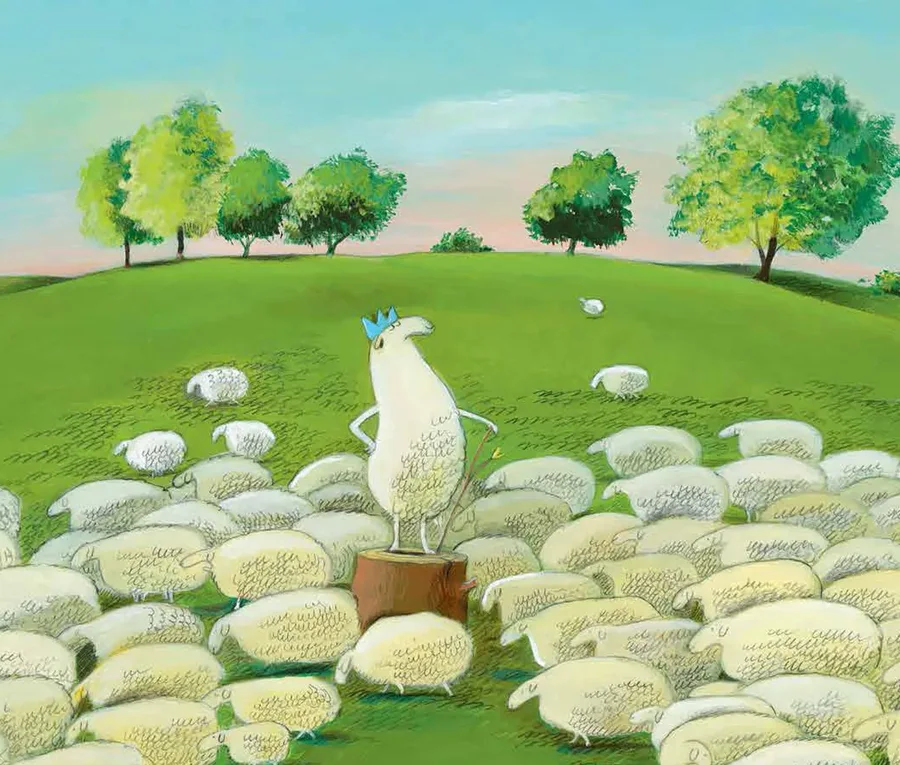
When people in power become addicted to it, they end up as willing slaves to their own ambition. They try to dress beautifully, remodel their faces or bodies, but they still remain ugly because they make ugly choices.
A strong wind blows a paper crown over the pasture. The ram Louis places it on his head. And accordingly he proclaims himself Louis I, King of the Sheep. With a crown on his head, Louis knows exactly what kind of king he will be: erudite and all-powerful. He feels perfectly suited to royal life. As the members of the kingdom continue to graze and digest their food, Louis gives a speech over the loudspeaker, announcing that from now on, others must serve him.
He is so intoxicated by power that he thinks that order should be established in his rule, so he decided to expel all the sheep who are not like him.
But Lugji shouldn't have gotten too comfortable, as he couldn't have predicted the approaching storm. The winds started blowing again, taking away his crown.
Louis the Sheep King is a children's story by French author Olivier Tallec, which with meticulous precision and depth, depicts a pattern of behavior sadly known as 'intoxication by power'.
Being drunk or addicted to power is more harmful than any other form of intoxication or poisoning. This addiction is created when power is exercised without limits and in a complete lack of balance, that is, when it is considered mostly as a right and not as a responsibility.
People in power, when they become dependent on it, remain willingly in a situation they often complain about as unbearable. But if you delve into their true feelings, you will find only whining about an evil they cannot do without. After all, it is not easy to break away from a commitment if you become dependent on its rewards.
When people in power become addicted to it, they end up as willing slaves to their own ambition. They try to dress beautifully, remodel their faces or bodies, but they still remain ugly because they make ugly choices.
They try to differentiate themselves through position, office, eloquence, or status, but inside they remain small people, forgetting that what makes you powerful is how you stick to your principles, and above all, how you manage to govern yourself.
Power never made its holders powerful. On the contrary, it revealed how powerless, how weak, or how fearful they were at their core.
This is the hardest lesson to teach adults, no matter how intelligent or open-minded they may seem.
Therefore, the Frenchman Olivier Tallec, with humor, sensitivity, and extraordinary warmth, offers it as an important lesson learned in childhood, when we first touch upon the first raw dynamics of power, which determine the desperate dependence on power that many human beings experience in adulthood.






Lini një Përgjigje