


 Shkruar nga Emin Azemi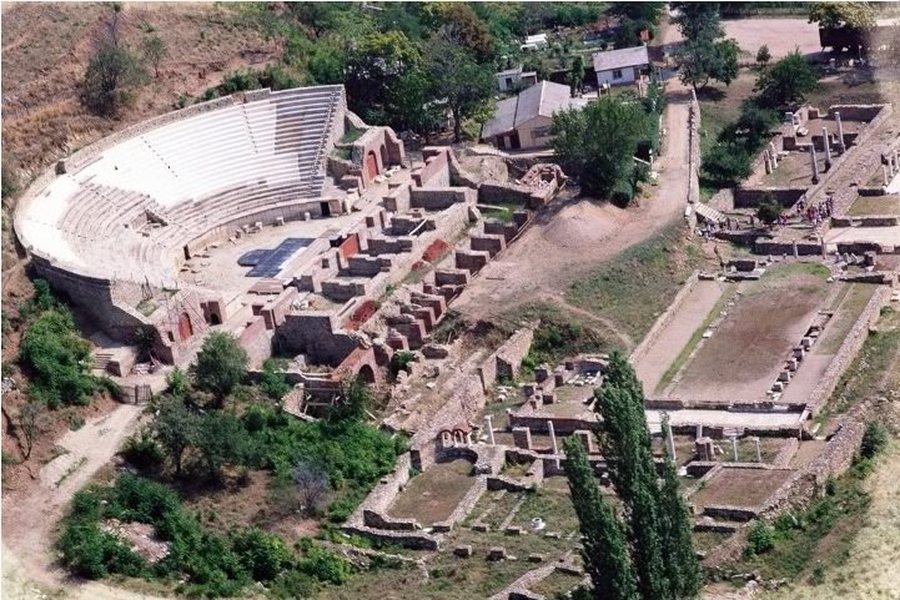
The boy from Sweden will long remember Manastir, not as the birthplace of the Albanian alphabet, but as the last landfill of Europe where the remnants of an unrestrained chauvinism are still jealously preserved.
A 32-year-old immigrant from Dibra living in Sweden had planned to visit the city of the alphabet, Manastir, but he had no idea that instead of hospitality he would be “rewarded” with insults and humiliation. He came to Manastir inspired by readings and patriotic songs, but he had forgotten that this very city has not been inhabited by coexistence for decades. There, the Macedonians have become the all-powerful masters and they decide how much air and how many drops of water Albanians should consume.
The Albanian from Dibra would continue to live with these illusions about Manastir, if an unexpected incident had not happened to him. On the most famous street, 'Shirok Sokak', founded by the Albanian aristocracy at the end of the 19th century and the beginning of the last century, a group of young Macedonians forcibly forced the immigrant from Sweden to take off his shirt with an eagle, a symbol that for the Macedonians of Manastir is considered a gogol that should scare children at night.
This ugly act, which occurred on Thursday evening, not only left a bitter taste in the public's mind, but confirmed once again that certain sections of Macedonian society are still not free from xenophobia and hatred towards Albanians.
This shameful act proves that young Macedonians are unfamiliar with the subject of interethnic coexistence and harmony, which is why they behave like mad geese at any symbol of Albanians.
This is perhaps also the reason why Albanian students who finish primary school in Manastir are forced to continue their secondary education in Dibër, Struga, Kicevo and elsewhere. In Manastir, the opening of secondary schools in the Albanian language is not allowed, because the ideators of ethnically pure spaces have designed this city as an oasis without Albanians for decades. These ideators are greatly disturbed by the fact that Manastir is the birthplace of the Albanian alphabet, so they work hard to erase the traces of this history and in its place retouch a new reality, without Albanians and without their historical and spiritual heritage.
Albanophobia, established in the consciousness of a Macedonian stratum, galvanizes primitive nationalism with anti-Albanianism. In this unique type of nationalism, surprisingly, there is no room for a reactive nerve to the denials of Macedonian identity coming from Serbia, Bulgaria and Greece, but, surprisingly, a landfill that reeks of chauvinistic pus against Albanians has become a den there.
Everyone in the Balkans imposed conditions on others before joining the EU and NATO, only official Tirana has stubbornly expressed a certain naive attitude towards official Skopje, both when it was the first country to recognize the independence of Macedonia without any conditions (1991), and now when it has opened the chapters of negotiations with the EU, where Albanian politics once again leads a kind of delirious life as if it were on an isolated island, surrounded by an earthly paradise, where Albanians in Bitola, Kumanovo, Plav, Presevo, Bujanovac and Medvegja refresh themselves with fig leaves. Not a single note of protest came from official Tirana about the systematic erasure of Albanian addresses in the Presevo Valley, while the Tirana leadership has long been worried about Vučić's bad image in the eyes of the international community (!).
To understand today's Monastery, it is perhaps worth taking a look at Albanian journalism, where we will find the most vivid description of Mit'hat Frashëri's Monastery at the beginning of the last century. "Oh, how bitter this journey today seemed to me, with all the beauty of the road! But what has become of Albanian in these places, where our language has gone? Why, since I left Leskovik, have we not heard it on the road, as it used to caress our ears until now?"
("Liberty", No. 83, p. 3. Thessaloniki, April 10, 1910).
However, the boy from Sweden will long remember Manastir, but not as the birthplace of the Albanian alphabet, but as the last landfill of Europe where the remnants of an unrestrained chauvinism are still jealously preserved.
What has become of Albanian in these countries, where has our language gone?!







Lini një Përgjigje