


 Shkruar nga Thoma Gëllçi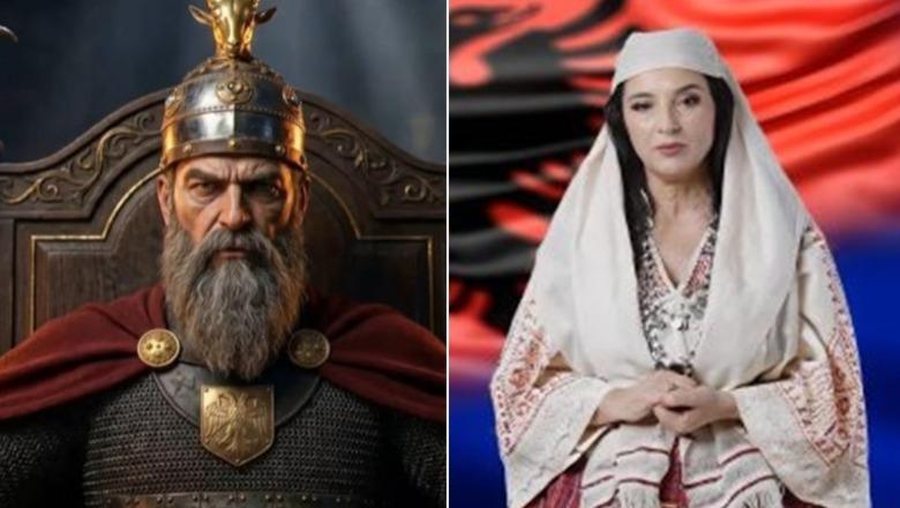
She does not have children in emigration and who herself suffers from loneliness and lack of medicine. According to the virtual Skanderbeg of the opposition himself, it cost four million euros...
The government brings out the Sun. The opposition brings out Skanderbeg. This is the panorama of Albanian politics in 2026. On the one hand, a virtual character created with artificial intelligence, presented with pomp as part of the governing team. The Sun appears curated down to the last detail, with precise movements, perfect lighting, hair that doesn't move even in the wind and a smile that knows no economic crisis, emigration or low pensions. She doesn't have children in emigration and who herself suffers from loneliness and lack of medicine. According to the opposition's virtual Skanderbeg himself, she cost four million euros.
On the other hand, the Democratic Party decides to open the Renewal Assembly with a virtual Skanderbeg. The idea itself could have been interesting if it had not been realized with a quality reminiscent of the cartoons of the 70s by the Kinostudio "New Albania". The lips moved in one direction, the words came a second later in another direction, while the figure looked as if it had been hastily lifted from a forgotten warehouse of the transition. According to the Skanderbeg of the DP himself, the realization had cost only a hundred euros.
The opening message of the Democratic Party's Skanderbeg was that the Democratic Party's office for producing videos with artificial intelligence had a lower cost than the corresponding government office. It looked like a competition between the American Microsoft Azure and the Chinese DeepSeek.
In fact, it doesn't really matter whether Diella costs four million or four euros, nor whether Skanderbeg costs a hundred or a thousand. What matters is the symbolism that both unintentionally produce.
The sun represents the polished politics of power. Everything seems perfect. Everything seems modern. Everything seems controlled. Like many government presentations, where sometimes the image seems more elaborate, but which has no connection to the reality it is trying to describe.
Skanderbeg, on the other hand, represents the state of affairs in which the opposition has fallen. A political force that once claimed to be an alternative to government, but which today often seems stuck between nostalgia for the past and the inability to build a convincing vision for the future. Even the delay between the movement of lips and words seemed like a political metaphor: the opposition speaks, but always a little late to the problems of the time.
Thus, without realizing it, the two virtual characters became mirrors of the camps that created them.
One covered in the splendor of power.
The other with the dust of the years.
One designed to show success.
The other designed to remember glory.
But both have the same problem.
No one lives in the real Albania.
No one is faced with energy bills, food prices, the difficulty of buying a home, the emigration of young people, or pensions that run out before the end of the month.
While the government and opposition compete with avatars, Albanians continue to face real-world problems.
In this sense, Diella and Skanderbeg are not simply products of artificial intelligence. They are the most sincere product of today's Albanian politics.
A policy that invests more and more in appearance and less and less in content.
A policy that talks about virtual characters, while real people leave the country.
A policy that debates the quality of animation, while the quality of life remains the unanswered question.
Perhaps for this reason, the most significant moment is neither the appearance of the Sun nor the appearance of Skanderbeg. The most significant moment is the fact that no one seems surprised.
Because Albanians have long understood what technology simply made obvious: that such a gap has been created between politics and reality that virtual characters now seem more suitable than real people to represent it.


Lini një Përgjigje