


 Shkruar nga Enver Robelli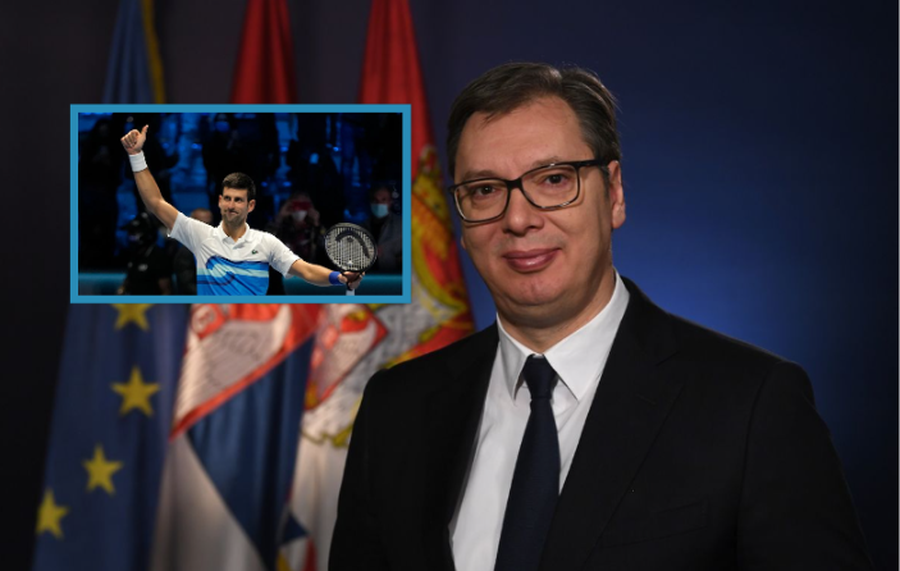
Now even renowned tennis player Novak Djokovic has been targeted as one of his most prominent opponents.
After slowly aligning himself with the protest movement in Serbia, tennis star Novak Djokovic is facing a pro-government media campaign in Belgrade. A chronicle of a conflict
Everywhere you look: Serbian President Aleksandar Vučić seems to be surrounded by enemies. If the regime-friendly media is to be believed, enemies await Vučić around every corner. Now even renowned tennis player Novak Djokovic has been targeted as one of his most prominent opponents.
The tabloid newspaper "Informer" recently attacked the protest movement against Vučić in harsh words: its only ideological model, according to "Informer", is Adolf Hitler. Vučić himself has described the protesters as "crazy", "foreign mercenaries" and "careerists".
Many Serbian citizens are shocked by the fact that the collapse of the roof of the train station in the city of Novi Sad last November took the lives of 16 innocent people. That is why they are taking to the streets. The tragedy would probably not have happened if there were functional and uncorrupted institutions in Serbia. These institutions would have been able to effectively control the Chinese construction company that was responsible for the renovation of the station.
In early August, when eleven senior officials of the ruling SNS party were arrested on suspicion of embezzling over 90 million Swiss francs during the construction of a railway line in the north of the country, tabloid media raised the alarm. They saw a “judicial coup” against Vučić on the horizon.
For several weeks now, tennis star Djokovic has also been targeted by the regime's media. For years, he has been praised as a national hero, honored with many state decorations, and hailed as Serbia's greatest ambassador and patriot since the Battle of Kosovo in 1389 against the Ottomans. But now, this national icon is being portrayed by some Serbian media almost as a traitor.
Since the mass protests began in Serbia nine months ago, Djokovic has gradually distanced himself from the regime. On December 18, he wrote: “ As someone who strongly believes in the strength of young people and their desire for a better future, I consider it important that their voices are heard. Serbia has incredible potential and educated youth is its greatest strength. What we all need is understanding and respect. I am with you, Novak.”
Although Djokovic did not directly criticize Vučić, his cautious support for the student movement alone caused government-affiliated news platforms to stop reporting on his sporting successes. He was simply ignored.
During the Australian Open in January, Djokovic expressed solidarity with a seriously injured student in hospital - hit by a suspected regime-linked hooligan who drove a car onto the pavement during a student blockade. In recent months, protesters have been repeatedly attacked by masked men suspected of being sent by the ruling party. " Violence against students is a great loss for Serbian society ," Djokovic criticized from Australia.
Newspapers and some politicians immediately reacted with a counterattack: Djokovic's behavior was called "shameful." He was even accused of doping. The once-vaunted patriot was suddenly labeled an enemy of the state and a doping user who, together with hooligans, was allegedly causing chaos in the country.
On social media, he is being portrayed as a tool of anti-Serbian forces, a mercenary paid by the US, UK and other eternal enemies. One user wrote on Facebook: “Stop that bastard from playing under the Serbian flag, he is destroying his own country.”
The smear campaign seems to have left its mark on Djokovic. According to Greek media, he plans to move with his wife and two children to Athens. In a few days, he met twice with Greek Prime Minister Kyriakos Mitsotakis. The Belgrade Open, which is licensed by the Djokovic family, will not be held in Belgrade this year, but in the Greek capital.
After his Wimbledon semi-final loss in early July, Djokovic was targeted by the press. The reason was a rhythmic movement he made, resembling pumping with an air pump, interpreted as a sign of solidarity with the protests in Serbia. The protesters' slogan is "pumpaj" - which in Albanian can be translated as "pompo" - and signifies increasing pressure on the regime.
As the media continues their smear campaign against Novak Djokovic, President Vučić maintains a restrained tone: "He can say whatever he wants against me, support political opponents, but to say something bad about him would be foolish and stupid ," he declared.
Vučić knows very well how popular Djokovic is among the people in Serbia, all the polls show this. If he were to openly attack him, it would not bring him political gain. There are voices among students who are calling for the most successful athlete in the history of Serbia to run for the opposition in the parliamentary elections, and thus challenge Vučić. But for the unpopular president, early elections are not an option at the moment.


Lini një Përgjigje