


 Shkruar nga Ylli Pata
They even seized weapons to fight the regime of Muhamet Riza Pallavi. With whom they clashed so badly that it created problems for this organization, which was declared a terrorist group by the US State Department...
Albania is the country that has accepted shelter from a large group of political dissidents of the Iranian regime, who live in a housing complex built with their own money, near the town of Manza.
They are men and women who have been politically engaged in opposition to the regime of the ayatollahs of Iran since the early 1980s. Opponents of the Shah's monarchical regime, ideologically Marxists but also revolutionaries, the "People's Mujahideen" became the black sheep of the former king, who imprisoned them, fought with Iranian leftist groups, who in the late 1960s were not such a peaceful movement.
They even seized weapons to fight the regime of Muhammad Riza Pallavi, with whom they clashed so badly that it created problems for this organization, which was declared a terrorist group by the US State Department.
The People's Mujahideen were among the first to take part in popular protests to overthrow the monarchy, and supported religious groups led by exiled cleric Ruhollah Khomeini, who was granted political asylum in France.
The popular fury in 1979 caused Pallavi to flee and take refuge in the US. He took with him a large amount of money and gold, which was deposited in American banks.
Khomeini was placed at the head of Iran, calling himself Ayatollah and establishing a theocratic regime, where he himself was the supreme leader, commander-in-chief of the army, state, judiciary, director general of Television and editor-in-chief of newspapers, as well as the chief imam not only of Iranians, but of all Shiite Muslims throughout the world.
The secular Mujahideen were immediately declared enemies, even though they were the ones who brought the people and youth of Tehran and the major cities out in massive protests against the Shah. MEK leaders were hanged from public cranes in the squares and streets of Tehran, just like the Shah’s loyalists, “agents” and “traitors.”
Some of the mujahideen, after the persecutions began, escaped by land to Iraq. Saddam Hussein gave them political asylum. With the outbreak of the Iran-Iraq war, the ayatollahs' regime accused the mujahideen of fighting against their country. But the accusations were more political and public, because there was no evidence of the MEK's involvement in this war.
However, accusations continued after the end of the war regarding espionage activities against the Iranian regime. In Iraq, the mujahideen were housed in the so-called Camp Ashraf, a complex of buildings near Baghdad.
With the overthrow of Saddam Hussein, after 2003, the mujahideen experienced a second persecution. In post-Saddam Iraq, pro-Iranian Shiites came to power, who behaved inhumanely towards the MEK.
Their torture was taken over by the notorious General Qassem Soleimani, who led the Quds Brigade of the Revolutionary Guard. He first installed amplifiers and giant loudspeakers outside the camp walls, where he broadcast pathetic threats 24/7 that all enemies of the revolution would be hanged.
Then the missile bombings began: on September 1, 2013, 52 members of the Iranian opposition were killed.
Iraqi authorities said the rocket had come from "unknown directions," but the mujahideen blamed pro-Iranian President Nouri Al Maliki, whom they considered a puppet of the ayatollahs.
During their stay in Iraq, following the US administration, the mujahideen developed closer relations with the US government, to the point that the latter removed the organization from the blacklist.
The cooperation was so close that a group of opposition figures, most of whom graduated from the best Iranian universities, mainly in nuclear or electronic engineering, managed to uncover the nuclear program of the ayatollahs' regime.
This relationship led the US to seek a safe haven for the mujahideen. They were looking for allies in a country that does not have close trade and economic relations with Iran and its allies, Russia and China.
Albania was found. At that time, Sali Berisha, who was the prime minister of Albania, accepted only a limited number, 500 people. When Edi Rama came to power, he agreed to shelter the entire Iranian opposition in Albania. Which was first settled near City Park, and then in Manzë.
The inauguration of the arrival of all MEK members was made by the US Secretary of State, John Kerry. Meanwhile, in the premises of Ashraf 3, as the Manza complex is called, high-ranking figures of American politics have arrived, from Mike Pompeo to John Bolton, Nancy Pelosi and many, many others. Also, the mujahideen are supported by very well-known figures of European politics, mainly parliamentarians and well-known diplomats, of course retired from office.
Pandeli Majko, Sali Berisha and Fatmir Mediu have also often gone to Manzë to eat Ashura and Iranian ice cream. They have used their pro-Iranian opposition speeches as a pro-American affiliation to look good in the eyes of VIPs from across the Atlantic.
The Mujahideen are an organization that operates under conditions of permanent conspiracy. Especially when the Iranian embassy was in Tirana, they were followed non-stop by the intelligence service of the Revolutionary Guard, which used real and powerful operations of diversionary attacks. By bringing in suspicious and problematic characters that the Albanian media used to attack them.
In the Albanian media, narratives were spread that the Mujahideen are like a sect and do a thousand dirty things inside, putting a microphone on any person who attacked them, but they never took it themselves to balance the information.
The Mujahideen, led by 75-year-old engineer Maryam Rajavi, who lives in Paris along with the leadership of the Resistance Council, have an Albanian-language portal. Where they publish news and various statements, they have hired many lawyers and translators from Albania.
They have even taken care to choose people close to the opposition, so as not to attack its media. They give them salaries and honoraria. However, no one has been gentle with them, they attack them constantly, even in these days of the start of the war in Iran.
How is it possible that one of them is not invited to speak on the panels where the war in their country has been discussed since Saturday. They are first-rate experts, they know Iran and its people, they are educated and intellectual, so they have the right articulation to do it as well as possible.
Most of them write daily in various online media outlets in the Persian Gulf, of course not pro-Iranian but funded by Arab countries such as Saudi Arabia, the United Arab Emirates and, to a lesser extent, Qatar. Some others write in international media outlets, from European newspapers to American ones. But only the partisans of the ayatollahs appear on Tirana's screens. From the open and passionate militants, to the "independent" crypto experts, who have been telling us for years about the power of Ali Khamenei's regime.
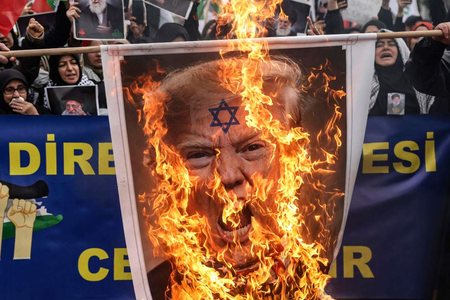
The Iranian opposition holds protests and demonstrations in all countries of the world with the Iranian diaspora and the participation is very large. The last one was the massive rally that took place in Munich before the big Security conference. Where the two oppositions, that of the Shah's son and the MEK, held two separate demonstrations, where the MEK won for the massiveness. It is enough to look at the organization's website to analyze the cold facts coldly and calmly through photos and videos. But at least when the ayatollahs of Tirana insult them with a book on television, why don't they also call the mujahideen to give their opinions?


Lini një Përgjigje