


 Shkruar nga Çapajev Gjokutaj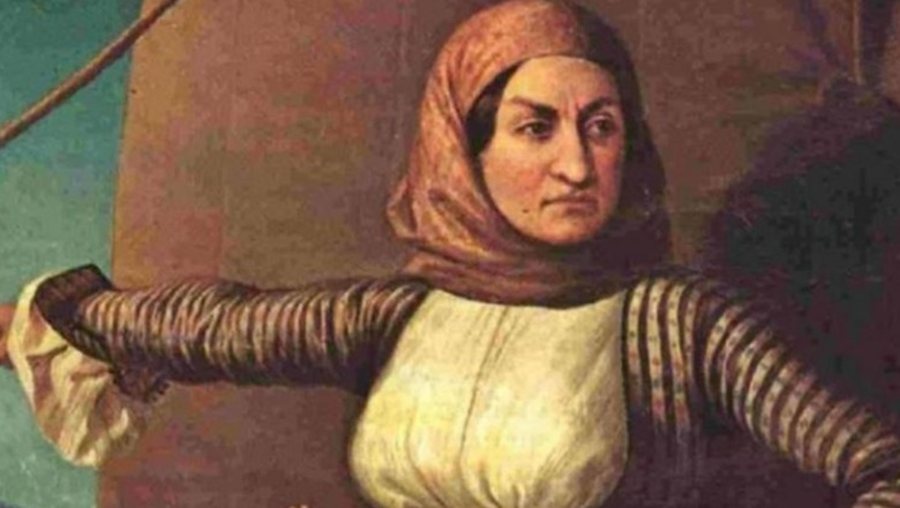
Constructing and reconstructing Bubulina as the heroine of the Greek revolution, our southern neighbors have not been interested in emphasizing her origins, nor lost in the multitude of conjectures about how she felt, what identities she recognized as her own: Arvanite, Greek, Orthodox, Vlachs, Ottoman citizens, etc.
Last week, in one or two "online" media, more precisely in their catacombs, that is, in the section reserved for anonymous comments, there was some discussion about Laskarina Bubulina, the Greek heroine of arboreal origin. Its affiliation, Arvanite or Greek, was discussed, did we give it to our southern neighbors or was it stolen from us, etc., etc., things of this type, which are usually conveyed by the anonymous "online" media with a lot of emotion and little logic, with insults, threats, quarrels and other tribal approaches of this kind.
For a completely heterogeneous group of people to be able to discuss anywhere and with some fruitfulness about such personalities, they must first agree on who they will discuss, the real historical personage or the hero, in our case: Bubulina or the heroine who was created based on her life and achievements. Intellectual quirks and sophistry, many would say, but anyone with even a modicum of knowledge of mirroring and reproduction theories knows that heroes are social constructs, meaning that they are individuals whom a society chooses to exalt as sources of inspiration and admiration.
Of course, these constructs are based on real-historical persons and events, but the process of their construction includes a mixture of factual accuracy, idealization, interpretation, etc.. Heroes are created and reproduced not for the sake of history, but for the sake of today, they are taken from the real person features that serve the actuality or the interests of this or that party and leave aside others that can create confusion or disrupt work. Constructing and reconstructing Bubulina as the heroine of the Greek revolution, our southern neighbors have not been interested in emphasizing her origins, nor lost in the multitude of conjectures about how she felt, what identities she recognized as her own: Arvanite, Greek, Orthodox, Vlachs, Ottoman citizens, etc.
The heroine created by the Greeks, (not the real Bubulina who may have known and accepted some of the identity we just mentioned) was and is a Greek cigar, even much more Greek than the ordinary Greeks, who for two centuries have kept it alive in their culture. I repeat, not that this is how he really felt, but that this is how the social and political interests of the day, decade or century wanted and want him. Well, many may say, the Bubulina constructed by our southern neighbors has a Greek identity, the Bubulina constructed by us has an Arvanitas identity that connects it to the arboreal lands where its great-grandfathers lived, so also to us today's Albanians. Even so it can be, only that our heroine, the one with the Arvanitas identity, is much paler than the heroine that the Greeks have constructed.
This one of ours exists and is reproduced in some studies of patriotic people and honest scholars and from there it visits us not so often, not to say rarely, only when one or the other has to build narratives of the type: the Greek revolution was made by Albanians, women ours are virile, why do Albanians become prominent in other lands, while here they remain mediocre and worn out, etc. You can list other narratives of this type, but almost all of them remind you of fireworks that are thrown once in the weather.
The Greeks have done another thing with their Bubulina. They have been keeping him alive among the living for two centuries, almost daily. The Greek state has given her the rank of rear admiral, making her the only woman in the world to hold this rank. It impresses you that this promotion was made 6 years ago, in 2018, and it goes without saying that it was not made for Bubulina, nor for her descendants, nor simply to increase the pride of contemporary Greeks, but it was also (or especially) made for business interests related to tourism and the fleet, two of our southern neighbor's biggest industries. Irene Papas has been immortalized in the film 'Bouboulina' produced in 1959, while two decades ago a successful documentary about her drew attention. Before the release of the euro, you could see her portrait on several Greek drachma coins. In different parts of Greece, I come across statues and especially busts of her, just as there are two or three museums, dozens of literary works, her life and deeds have long been part of school curricula, her likeness is often displayed on murals, when you visit Greece, etc., etc.
This difference between what we do for our Bubulina and what the Greeks do for theirs brings to mind the anecdote of those two neighbors who, having found a treasure under the hedge that divided their gardens, divided it into two equal parts, but they did not become equal because one invested it in several ventures, while the other locked it in a barrel and hid it somewhere in the barn. The first increased the portion that fell to him, the second reduced it over time as often as he needed to take a few florins from the pipe simply to pay off the expenses.
Every metaphor is lame, including that of the barrel, so many could jump and say that the Greeks have invested and are investing so much in the creation and circulation of Bubulina, because her feats, the efforts and sacrifices she made, have been for the benefit of Greece . And this sounds true, but our problem with Bubulina will be seen as a symptom of a wider disease or phenomenon.
How is it explained that to this day we do not have a pantheon of heroes accepted by almost all Albanians here in the homeland or in the diaspora. What name do you give to the fact that even for the main hero of our nation, Skanderbeg, dilemmas such as: was he a fortress of Western civilization and a knight of Christianity, or was he a savant of the Venetians and baker of the Ottoman sultans? Such theses not only have no scientific and maybe even cultural value, not only do not touch a hair of the main hero, they prove that our national cohesion is not as rosy as we think it is. But at the same time, they prove that much more elaborate and forward-looking strategies and policies are needed, which see today, tomorrow and the day after tomorrow for the solution of our national issue.



Lini një Përgjigje