


 Shkruar nga Anna Zafesova
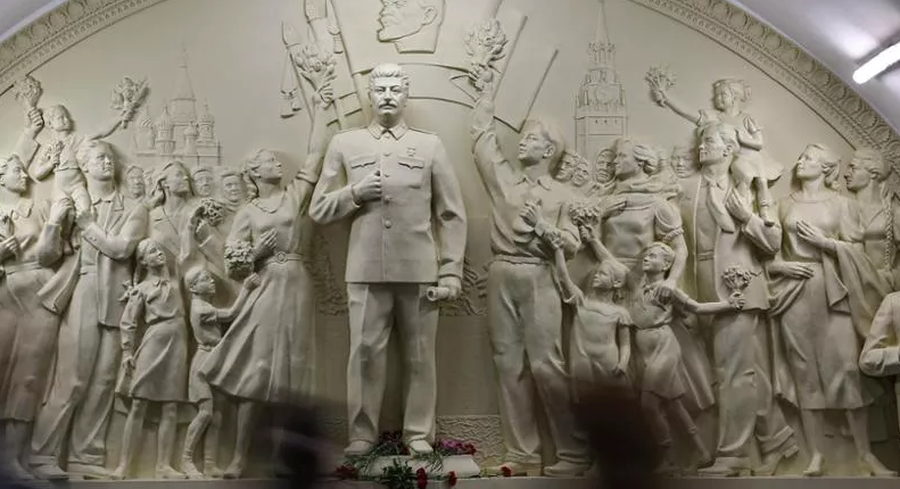
Dozens of monuments to Stalin are being returned to Russia, the latest being a bas-relief in the Moscow metro. The Kremlin wants to impose a parallel between World War II and the invasion of Ukraine, and therefore between Putin and the dictator as leaders leading Russians to victory.
He is back. He watches Muscovites as they get off the train at Taganskaya metro station, his gaze indifferent to the figures of women and men who adore him, his hand tucked inside his military jacket in a Napoleonic gesture.
Joseph Vissarionovich Dzhugashvili, also known as Stalin, has regained his place in the bas-relief "The Gratitude of the People to the Leader and Commander", an act accompanied by much debate.
It was dismantled 60 years ago by the Moscow Metro. It was recently secretly restored for several months, during which everyone wondered what was hidden behind the signs that read “work in progress.” In just a few days, this act has polarized Russian public opinion.
As bouquets of flowers are being piled at the foot of the work, and some elderly people are kneeling in respect, activists have called for a protest with banners containing Vladimir Putin's quote on Stalinism as a "crime against the people."
The latter were stopped by police, while the former were not. It is not the first monument dedicated to the Soviet dictator to be erected in Russia after the end of communism, which had erased Stalin's name and image from street and square names following revelations made in 1956 by Nikita Khrushchev about the millions of people who died in the Gulag.
Various non-governmental organizations that protect human rights have counted at least 100 statues, memorials and busts of Stalin, of which at least 90 have been erected in the last 25 years, during the era of Putin's rule.
But until now they had been “private initiatives”, undertaken by some association of nostalgics or local politicians or entrepreneurs (the latest case is a poster, in which Stalin shakes hands with Vladimir Putin, in a bar in the town of Belgorod).
Meanwhile, the Moscow Metro is a strategic structure, and the possibility that its managers acted without consulting the Kremlin is practically zero. Government sources who wish to remain anonymous have confirmed leaks on Telegram, according to which the placement of the bas-relief was desired and monitored by the Russian presidency.
Polls reportedly show that 20-25 percent of Muscovites are against the return of Stalin's image to the metro, while 15-18 percent are in favor. The majority remains indifferent, or preferred to pretend to be so, in the face of an operation aimed at cleaning up the totalitarian past in order to legitimize a present that would like to resemble it. It
is no coincidence that the Speaker of the Russian Senate, Valentina Matvienko, recently declared that Stalin "can be criticized and condemned, but it was precisely the faith in him that united Soviet society, giving it the certainty of victory over Nazism."
The faithful of Putinist ideology continues by theorizing that “the institution of the national leader is not written in the Constitution, but is part of political reality.” Even the head of the Russian parliament, the DUMA, Vyacheslav Volodin, in an incredible historical-ideological turn, criticized the Russian communists for denying Stalin: “If you have revised your positions, then now is the time to repent!”
Very clear signals of desires coming from very high up, as the Russian president insisted on the eve of the celebrations for the victory over Hitler, to restore the name of Stalingrad at least to the city's airport, which for more than half a century has been called Volgograd.
The Kremlin wants to impose a parallel between World War II and the invasion of Ukraine, and consequently between Putin and Stalin as the leaders who led the Russians to victory.
Even in the last prisoner of war exchange, Russian soldiers were returning from Ukraine waving equally the white-blue-red tricolor flag of modern Russia, the white-yellow-black tricolor of the Romanov Empire, and the red flag with the hammer and sickle of the Soviet Union.
A restoration that is clearly fake, compared to the original bas-relief of the triumphant Stalin. A work criticized even by critics of the regime's art, such as Elizaveta Likhachova, former director of the Pushkin Museum. In fact, it is a 3D print of the ceramic original, which omits decorative details and distorts the proportions of the bodies. / Pamphlet from "La Stampa"



Lini një Përgjigje