


 Shkruar nga Andi Bushati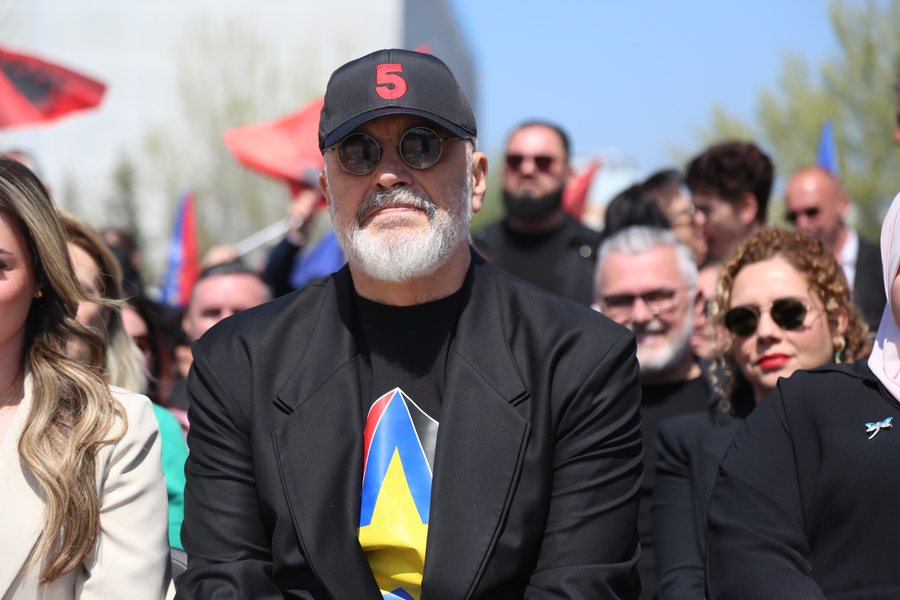
Rama hid rampant corruption, avoided accountability for things not done, and forgot about unfulfilled promises!
The Socialists broke every political code by opening their electoral campaign as if it were the start of a national folklore festival. In the manifestation where tallavaja and folk were combined, between Belinda Balluku who danced to the rhythms of the “fierakes me fustan me xixa” and Hulsi Manja who sat his people cross-legged in front of a lute player, several symbols were noticed that require explanation. First, none of the district leaders made a balance sheet of the four-year period, but were content only with placing a bet on the future. None of them mentioned the Socialist Party, but only Edi Rama. The wonder was that in Skanderbeg Square there was no flag of the SP that organized the rally, but only the national and EU flags were flying.
This atmosphere is not simply justified by the exaltation of the cult of the individual that has already taken root, in a party where everyone dreams of having Mamica's career, singing the praises of Skanderbeg.
The story may be a little different. It seems that the tendency is to exalt Rama and to overshadow the SP. Someone must surely be held responsible for Koka, Ahmetaj, Bllako, Beqaj, Dako, Gjici and finally Veliaj, who were sons of the party but who "worked behind the back" of its leader. Therefore, in this campaign, the former is staying behind the scenes, while Rama will occupy the entire stage.
The clearest and most concrete traces of this strategy, which aims to hide rampant corruption, to avoid accountability for things not done, to forget unfulfilled promises – from those about reducing inequality, the education budget, increasing jobs, free healthcare, etc. – were seen in Edi Rama's speech. He did not mention the name of the Socialist Party even once.
When, unlike the others, the prime minister ascended the podium alone, an attempt to distort time and distort the calendar was noticed in his verbal parade. During the monologue, what was missing was the present and the 12 years that he has governed. To cover this gap, Rama descended to the early Middle Ages, delved into the memories of monks who had traveled to Albania in the 11th-12th centuries, approached Skanderbeg and Gjergj Fishta, and then jumped, immediately afterwards, to the EU passport and Albania 2030. The artificial connection of this overcoming was that only through "Him" can Albanians make the European vocation of the former a reality. But the essence of this manipulation lay in the anxiety of facing the present and the fact of being the man with the most years of power in the post-communist period.
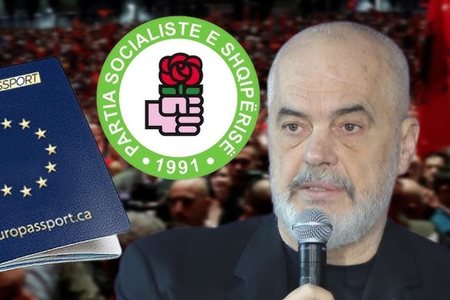
It is precisely for this reason that the government has decided to turn the European passport and the propaganda slogan that it can be achieved "only with Edin" into the campaign refrain.
Both Rama and those around him know well that in an electoral race, one cannot promise anything beyond a four-year mandate. They are aware that Albania has no real chance of becoming an EU member within these terms or for its citizens to have in their hands a passport equivalent to that of the French, Germans or Italians. But this is the only way they have found to escape from the present, from theft and successive failures. Precisely to avoid this, Edi Rama was forced to descend ten centuries in time to be catapulted immediately into the next decade. This also explains why the stoic opening of the campaign could resemble anything but an electoral demonstration. As with the folkloric rhythms, so with the tendency to disrupt the historical course, the goal was the same: avoiding accountability for 12 years of governance.


Lini një Përgjigje