


 Shkruar nga Mero Baze
The courage to reform the Justice Reform is contrary to the spirit of the EU, which sees the only positive aspect of the entire Justice Reform as the punishment of politicians...
Edi Rama demanded that the Socialists lay the foundation for a new constitutional reform in the country, aimed at reforming the Parliament, the administrative division of Albania, this also related to the electoral law and other constitutional aspects that may arise along the way. The idea of a new constitutional reform is conditioned by two decisive factors.
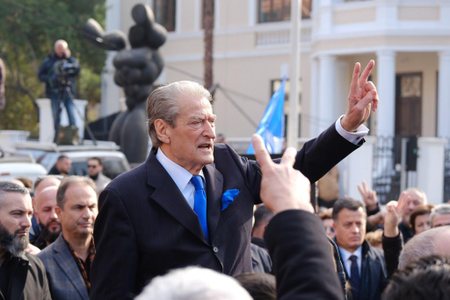
The first factor is Sali Berisha's opposition. In principle, Sali Berisha accepts reforms only in his political interest. In this specific case, Sali Berisha has a vital interest in political survival at the head of the opposition to continue to be a blocking factor even for such reforms. So any attempt at constitutional reform must go beyond Berisha's wishes for an electoral law that keeps him at the head of the opposition. One such was made in 2009. I do not believe that Albania owes Berisha, after almost 20 years, to make another law on old age. So there is little chance that he will agree to any constitutional reform. The Socialists would do well to present their option, but the chances that Berisha will vote for them are slim if they do not give him guarantees that he will maintain power at the head of the DP. So far, they have only given him financial guarantees, enabling his family to develop properties acquired in dubious ways and through corrupt means. But this is not enough for Berisha. He knows that he will lose them if he loses the DP. His greatest wealth comes from being the owner of the DP and not the owner of the lands on the coast. Therefore, this process may end up being one-sided and unvoted in the Assembly.
The second decisive factor is the European Union. Albania has exaggerated ambitions that it could join the EU in 2029. Personally, I do not hope that this will be achieved, not simply as a prediction, but as an inability for us to carry out substantial and concrete reforms in the areas of the rule of law, the environment and agriculture, three major problems that Albania is far from real attention.
In an effort to win European consensus at all costs, Prime Minister Rama has ordered MPs to have no hesitation in approving the laws offered by the EU and the directives coming from them.
One of their strongest directives is the battle of justice with corruption, which in many cases has paved the way for political lynchings, the lack of legal procedure in investigations and deprivation of liberty, as well as debates over the legal security of Albanian citizens, who are receiving worse justice than they had before the Justice Reform.
The mountain of files in the courts, the endless wanderings of Albanian citizens, the return of many cases for retrial by the Supreme Court, etc., have made Albanian citizens more hopeless than ever about the results of the justice reform.
The courage to reform the Justice Reform is contrary to the spirit of the EU, which sees the only positive aspect of the entire Justice Reform as the punishment of politicians.
I agree, but the Reform was made to give justice to Albanian citizens and not as a guillotine for Albanian politics. As such, if we leave the situation like this until 2029, the entire political class will have been criminalized here and on the other hand hundreds of thousands of Albanian citizens will have received less justice than they had before 2016. Then the balance will be even worse. We will appear to be a country stained by justice and at the same time a country without justice. And this requires political courage to face. As Konica said, in anticipation of dreams, our desires will rot.
I'm not talking about the technical aspects of EU standards, which they will have to turn a blind eye to. The property issue, the primitive state of the countryside, the environment, and other areas of development such as agriculture are problems in themselves, but to which there may be a wink.
So before the Constitutional Reform, Edi Rama has the opportunity to make several legal reforms to the country's important laws: the Criminal Code, the Civil Code, territorial division, electoral law, press law, etc., to pave the way towards a complete constitutional reform.
And to do all this, he must return to a governance with high political accountability. Technicians are the greatest asset of this country to enter the European Union, but governance and the government must be reformed based on political accountability. Technicians can lead any agency or integration unit in the country, but not the government. When you ask deputies to connect with the base and maintain relations with the electorate, you must do this, and when you maintain political representation in the government in all districts so that they have somewhere to knock. Deputies who go to the electoral zone every day and have to answer the phone of a minister who is not an MP, it is a bit paradoxical.
In conditions where the socialists seek to involve them in a long-term battle to control the situation in Parliament, the situation on the ground, and the integration process, they must become great debaters in this country and people who gain political weight by confronting problems.
Today, the Socialist Parliamentary Group resembles a group of anonymous people, where everyone is careful not to mention Berisha and does not engage in any debate to either defend the government or the governance, as they truly feel alien to it.
No one knows them as fighters. Albanian politics has delegated political debate to television panels with paid journalists who ask before the show who they will be with during the show. This is the end of politics and the political accountability of the Socialist Party and Berisha's DP. It is so pronounced as a phenomenon that even Edi Rama himself chooses to have a political debate with Fevziu and Klodiana Lala instead of Berisha. And this is not an insult to the two journalists, but to Albanian politics, which has eliminated political actors and delegated political debate to the press, and then debates with it.
Return politics to the politicians and keep the political debate to them and you will realize that the press no longer matters. Except when it makes sins transparent.



Lini një Përgjigje