


 Shkruar nga Ilir Yzeiri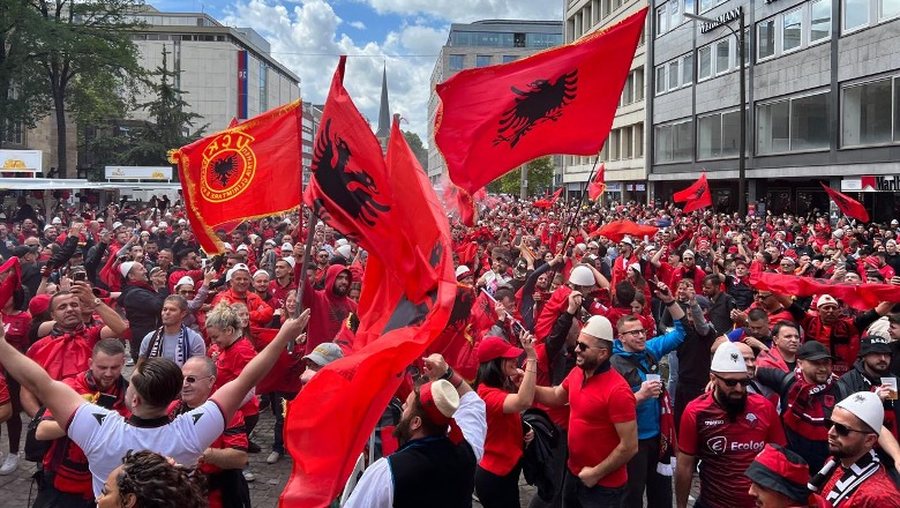
Everyone was impressed by the magnificent display of Albanian sports fans. The red and black signs, the t-shirts they were wearing, the flags in their hands or the pleats on their heads created a wonderful atmosphere of joy.
Such large manifestations, such as the European or World Championships, sometimes become giant shows where the nationalist ideologies that are hidden in the psyche of the crowd are paraded. It is perhaps the only case when the states represented there bring to the showcase of this giant manifestation or grand parade, not their chosen ones, but their spirit and identity, which is shown in the colors that characterize the national signs, in the symbols, characteristic clothing and the flag. The semantics of the vocabulary used in this case is that of war, in the sense that the large groups of fans who face each other in the stadium, want at all costs to beat the other, to "smash" him, to "take his breath away". », « crush it », « blow it up ».
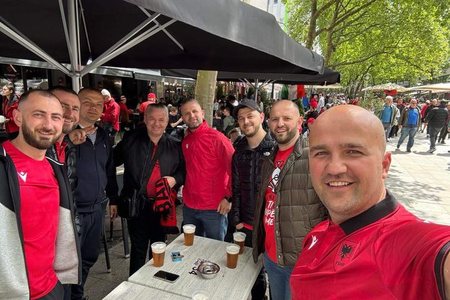
All these metaphors that are used to show this confrontation create the impression that the players who go down to the field have a mission to annihilate the opponent. But all this remains only in the sphere of vocabulary, then, in the subconscious of those who fill the steps of the stadiums, there is also the consciousness of the spectacle. This awareness appears especially in the "weapons" that sports fans hold in their hands, which are mostly beer glasses or water bottles. The transformation of such events, in a green field where two teams meet, that in the collective perception are marked as if two nations, two states, two ethnic groups meet, from war to spectacle, is part of the general game that characterizes human life.
Meanwhile, what has recently been noticed is that this popular manifestation shows at the same time the relationship that different countries have with their identity. It is now normal for a German player of Turkish nationality to hold the German captain's armband, just as Granit Xhaka, an Albanian from Kosovo, leads the Swiss team. In these cases, we all see materialized the idea spread especially by new and modern movements that the development trends of our era are not closure within ethnicity, but openness, that borders and ethnic reproduction should be an issue overcome.
However, in Europe, unfortunately, this does not happen. The recent elections for the European Union projected a different Europe. Right-wing and populist political forces that have raised their philosophy on deeply national identification and that are against what they call illegal immigration or that work to build ethnocentric policies are now a reality in the future Europe, the institutions of the image of the Frenchwoman Le Pen, widely known for the display of racist feelings towards Albanians, will also be mentioned. Therefore, manifestations such as this European one sometimes also serve to see how different nations display their identity.
Everyone was impressed by the magnificent display of Albanian sports fans. The red and black signs, the t-shirts they were wearing, the flags in their hands or the pleats on their heads created a wonderful atmosphere of joy. A German security employee, asked by an Albanian journalist how he valued the presence of Albanian sports fans in Düsseldorf, said that they need to appear, be seen, stand out with their presence. He, in fact, made a correct semiological finding. Albanians in Düsseldorf want to appear with their true image. Unfortunately, the Europe of the populists who are preparing to come to power in the EU, i.e. the Europe of Le Pen or that of Salvini, have built their narrative on nationalist and megalomaniacal clichés. For them, the treatment of nations or states must start from the hierarchy of race. The Italian, the German or the English are another thing and the Albanian or the others are the weak, backward side of Europe. They are the value, we are the problem. These clichés and stereotypes that they themselves have suffered on their backs, they now use for others. Meanwhile, finally, some Italian media as well as blogs of well-known influencers appreciated the European spirit of Albanian sports fans.
When the Italian anthem was sung, the Albanians in the stadium listened and applauded, they also sang and did not whistle. This was also noticed by the Italian media. Also, a group of fans had chosen a hilarious show to face the Italian fans. The Albanians had taken a package of macaroni and were breaking it in front of the Italians, telling them that they would boil it like a package of spaghetti. This humor and this show was also appreciated by the Italian media saying that this is exactly what the spirit of fandom should be. Our sports fans in Dusseldorf are showing Europe that they are not the heroes of the clichés and stereotypes with which Europe sometimes evaluates us. They are a cultured, dignified nation and have the spirit of the show. But they need to be recognized, shown and seen, as the German state security official rightly said. In the meantime, we must not forget the excessive folklore show, the wrapping with songs that have entered the fans' repertoire as a banal display of heroics or caricatures of our puppet show. We not only have to keep these in view, but we must be careful not to overdo our identification with banal or patriotic songs that are creations without any value and do not mark the characteristics of the heroism of those Albanian sons who sacrificed themselves for their nation.



Lini një Përgjigje