


 Shkruar nga Agron Gjekmarkaj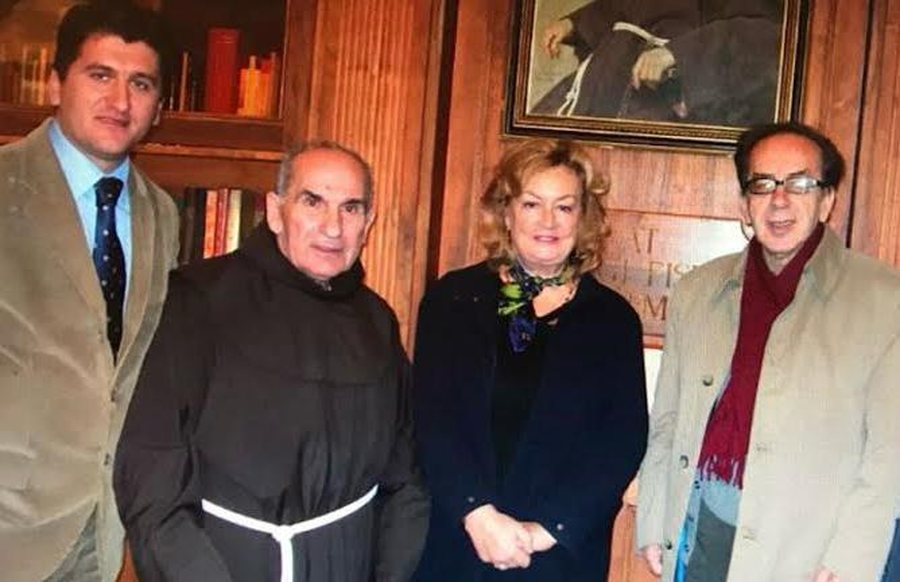
He was not even a little gloomy, he had a good sense of humor and laughed sweetly. He did not allow any form of banality to approach.
Today we all spoke at the tables of the "Piaca" restaurant where we gathered to remember Ismail Kadare, feeling his absence and confirming his presence among us.
None of us was there to determine his status in Albanian or world literature, he took care of that himself, as a son of his genius talent with the very dimensional work he left to our civilization.
Perhaps we were there as a witness, some more and some less, of a human relationship where everyone always has something to confess from their point of view.
Personally, I started communicating with the writer as his reader from the end of the 80s, where between the lines we looked for a path to the denied freedom and horizons for our hopes, influencing us in thinking, writing and speaking.
Likewise, and perhaps more so after the 90s, in his work, sometimes disappointed by the realities we were living in, we looked for the guide, the model, the principles and above all the intellectual pride of an Albania that, despite many struggles, wanted to become like the rest of Europe!
In the spring of 2005, when I was closing the cycle of studies at "La Sapienza" university with a paper on fantastic literature, the subject of my study was "Who brought Doruntina?" I tell the leading professor Francesco Mucioli what he thinks if I manage to get an interview with Kadare to confront our analysis with what he himself thought about the subject and his characters. I was surprised when he saw me "sei matto" (you're crazy) he kindly told me, how can you approach such a cyclops - adding - it would be a miracle if you succeed"?
We sat down and together we wrote 13 questions and as luck would have it, in Rome those days my friend Mark Marku shot me, who took it upon himself to try it, explaining to Kadare that he needed them for a friend in these circumstances!
After a few days, the mail arrives, an envelope with Mark's name on it.
Ismail Kadare had answered my questions by hand! Having those pages I felt the security of something that my colleagues did not have.
That same fall, we met Ardian Ndreca, the professor of Urbanism in Rome, at his house in Tirana. From that day a unique relationship was born for me. I can't say that I was a friend of Ismail Kadare, it seems to me a big, undeserved word, especially when I hear him being used without duty after his death with the ease of the day, even though he often invited us for lunch and dinner at his house in Tirana and Qerret for years or came to ours, in the cultural group of Mark Markun, Persida Asllanin, Dhurata Shehrin! He was interested in curricula, teaching, criticism, books in circulation, currents, magazines. He followed the cultural time of his country with great attention. A favorite topic with us was often derivatives of the Albanian language, attitudes and debates.
He was not even a little gloomy, he had a good sense of humor and laughed sweetly. He did not allow any form of banality to approach.
I consider myself fortunately privileged as a witness of several conversations between him and Father Zef Pllumi.
Mrs. Helena Kadare was also there! In the Albania of the Catholic clergy, of the prisons of communism, the writer, the bearer of the memoirs and the unusual and universal writer find harmony, strength and desire to unite in the great heritage while respecting diversity.
Pader Zefi and Babazoti from "Questions of stupidity", brothers in the novel separated for a long time by the Albanian hypostases, finally meet, that's how they seemed in the conversation. It was no longer divided into literature, it was approaching contemporary subjects or the latter became literature.
On the symbolic grave of Fishta in the Fretenve Church of Giuhadoli in Shkoder in 2007, where Kadare appeared thoughtful, Father Zefi approaches him and says in his sonorous voice that I do not know how to speak like him "Nigjo Ismail, I am old and towards the end but as long as I have breath, I support him, I have him by my side in the European trench of the Albanians.
Since the time of Ismail Qemali and Prince Vid, European citizenship has had enemies in Albania and they have never given up, they are activated like evil spirits every time it approaches, they have attacked it savagely"! It was the time when the essay "On the European identity of Albanians" had caused its own waves.
Last summer I met her for the last time at a dinner in July, it was Mrs. Helena and Alda Bardhyli and I with my family. Most of the time he talked with my daughter Sofina, who was 11 years old, and not with us adults.
I have always thought about this last meeting and his choice to talk longer with a child. He always had a message for the future and thus the writer who speaks to her will remain at the head of the "Prophet Group"!
At this lunch for him, these things came to mind!


Lini një Përgjigje