


 Shkruar nga Ilir Çumani
Some children are orphaned by their parents, but they grow up with memories. Eno Koço is the voice of that memory that never faded. He was an orphan in infancy who grew up to become one of the brightest figures in Albanian musicology...
In the history of Albanian culture, we rarely find figures who carry so naturally a weight of artistic heritage, and at the same time, a personal burden of pain, as is the case of Eno Koço, son of the great artist Tefta Tashko Koço and musicologist Kristaq Koço. Eno was orphaned at the age of 4 by his mother and at the age of 6 by his father. However, this did not stop him from becoming an internationally respected name, a missionary of Albanian music, but also a voice of humility and nobility in national culture.
"It's not necessary to have a misfortune to become strong, but life teaches you to suffer, to fight, to try to win..." - he says in a heartfelt story that does not leave the reader without an inner shock.
"I didn't see the light in childhood, but I found it in sound. And since then, I haven't left it. I say that some things die with a person.
I want to say that I have lived and gone through three phases in my life professionally. The first phase was that of a violinist, which made me realize that I was not some brilliant violinist, but I worked in opera for 6 years.
The second phase was that of conducting, a profession that I still practice today. But I would like to emphasize that there are much better conductors in the world than me….
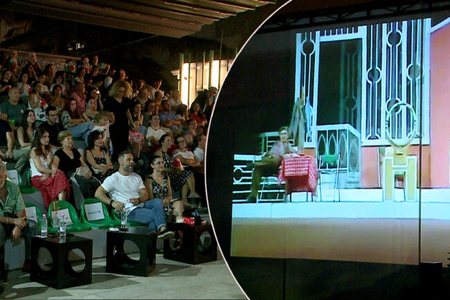
At that time, we were the two most engaged conductors in that closed and isolated Albania, Ferdi and I at the Radio who also did festivals. Ferdi (Ferdinand Deda), was the natural one, I was the unnatural one…. Because I was also attracted to this classical part….,” the musicologist and master of conducting would confess before a select audience in the “Aleks Buda” hall of the Academy of Sciences on the occasion of his 80th birthday.
This is not just the story of an individual, it is the story of a child who was not crushed by trauma, but who built upon it a lifetime of dedication to art.
His mother, the great artist Tefta Tashko Koço, was a captivating voice who brought to Albania the elegant spirit of French music, but who immersed her talent in the spirit of Albanian folk music. A woman of rare elegance, who represented an era in herself. And it was precisely this inspiration, coming from memories, from the sounds of her tours, from the echoes of the songs she sang, that became for the little boy Eno, a silent but confident and powerful guide.
Although he physically lost his mother at a very young age, her memory, along with the figure of his father (another man of letters and music), remained an indelible legacy for him that had to be lived, protected, and honored.
His path was not easy in a poor, isolated Albania, at a time when childhood pain was usually covered with silence... Because Eno Koço managed to preserve the memory of his parents as an act of love, but also as an act of resistance to oblivion.
He was not content with nostalgia for the past that was not so generous to him, but built a successful academic and artistic career, promoting Albanian music on international stages, researching, collecting, analyzing and publishing everything related to the passion, dreams and true history of artistic life not only of his family, but also beyond... He gave voice to that Albania that was afraid to speak about its art, about its heritage, about its silent pains and prides.
In the life of Eno Koço we see a rare symbolism: growing from ruin and blossoming in dedication, being a child abandoned by fate and at the same time becoming a dignified representative of a culture that often leaves talent homeless. He is the most significant testimony to remind us that heritage is not only a matter of blood, but also of choice and dedication.
The Albanian feature film "Concert in 1936", by the well-known director Saimir Kumbaro with a script by Kiço Blushi, where the figure of his mother is resized, is a strong example that art has the power to revive the past, to make it visible through sounds, images, and memory. And Eno Koço is one of those people who have done this with dedication and humility.
Stories such as that of maestro Eno Koço must be told not only to honor individuals, but to inspire and motivate younger generations, to remind Albanian society that the greatest strength often stems from the deepest wounds, that a great artist is not born only from talent, but also from pain, memory, love and dedication.
Undoubtedly, Eno Koço remains a silent but bright figure of our national culture. A name that has not made a noise, but has left deep traces through numerous studies and publications in books, in musical analyses, in research, in the promotion of Albanian music everywhere in the world, through the appreciation of that great spiritual treasure that is often forgotten: the Albanian civic song.


Lini një Përgjigje