


 Shkruar nga Francesca Rigotti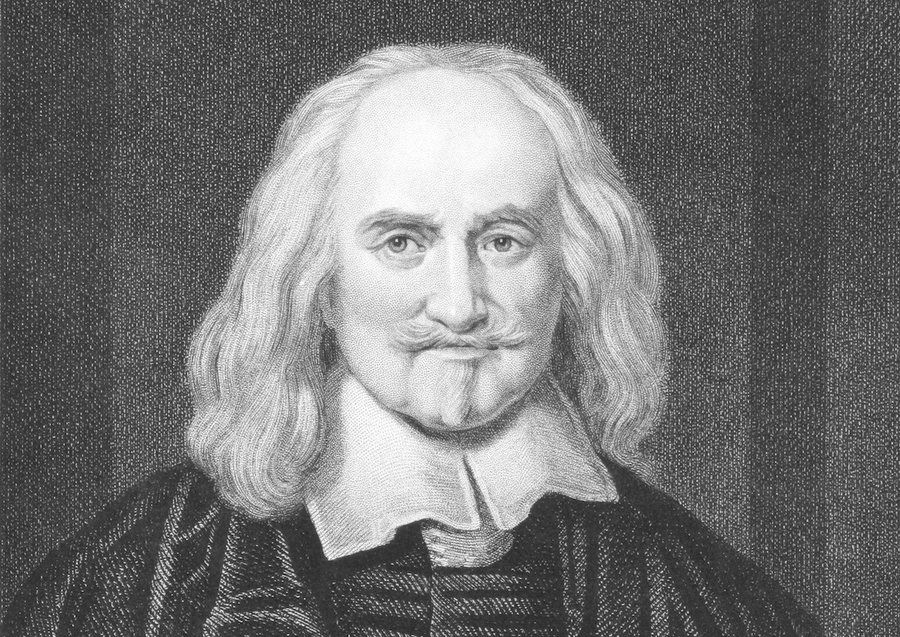
Individuals agree to create civil society and submit to sovereign power...
A key element in understanding the thought of the English philosopher Thomas Hobbes is fear, a feeling that, according to him, accompanied him from birth. Hobbes recounts that his mother, terrified by the threat of an invasion of the British coast by the Invincible Armada of Philip II of Spain, prematurely gave birth to two "twins": him and fear. The invasion never happened, but fear remained and became a central theme of his political thought. Throughout his life, Hobbes sought to find a way to tame it by building an order that guaranteed security.
A great connoisseur of classical Greek and Latin literature and a master of these languages, Hobbes was an eclectic thinker, a convinced materialist and a strong critic of traditional metaphysics. He made contributions to various fields of knowledge, such as history, jurisprudence, geometry, optics, theology, ethics and the theory of translation. In his philosophical system he addressed almost all the major disciplines of the time, organizing them into three parts: natural philosophy or physics, dedicated to the body; anthropology, dedicated to man; and political philosophy, focused on the citizen and the state.
This project was embodied in three fundamental works, which constitute a single philosophical system: De Cive (The Citizen, 1642), De Corpore (On the Body, 1655), and De Homine (On Man, 1658). Through them, Hobbes aimed to explain the laws that govern matter, man, and the state, relying on the mathematical method and especially on the principles of mechanics, which he considered the basis of all natural science.
Materialism and mechanism: the body at the center of philosophy
Hobbes was not only a materialist, but also a mechanist. He was convinced that it was possible to build a science as rigorous for the human and political world as for the physical world. For him, a body is everything that occupies a part of space and exists independently of our thought. The fundamental properties of bodies are extension and movement. From this perspective also stems his materialism: there are no immaterial substances, as the soul is traditionally considered.
Even feelings, instincts, desires, the instinct of self-preservation and the will, according to Hobbes, are nothing more than special forms of movement of the body. It is precisely the instinct of self-preservation, a fundamental impulse of human nature, that forms the basis of his ethics and politics. This explains why the question of security, as a way to overcome fear, occupies a central place in his entire philosophical system.
This idea finds its fullest expression in his most famous work, Leviathan (1651), one of the masterpieces of political philosophy, which has exerted a profound influence on modern thought. Leviathan, the biblical monster mentioned in the Book of Job, becomes for Hobbes the symbol of the modern state. It represents a powerful and indivisible power, endowed with extraordinary authority to guarantee order and security.
According to Hobbes, the state exists to protect the lives and safety of its citizens. People turn to it for protection and freedom from fear. This idea is also symbolically presented in the famous engraving on the frontispiece of Leviathan, where the giant representing the state is made up of thousands of little human figures, men and women, who come together to form his body. They are seen from behind, facing the sovereign, as individuals seeking refuge and security. In this way, the state appears as an artificial man, created to protect natural man.
The state exists to protect the lives and security of its citizens; the giant figure symbolizing it on the cover of Leviathan is constructed by a multitude of people, united in a single political body.
Contractualism: from the state of nature to civil society
Hobbes was a supporter of absolute monarchy, but also a theorist of contractualism, according to which political power stems from the agreement of individuals. Contractualism claims that the state arises from a contract, a symbolic pact between individuals, through which they decide to leave the state of nature.
In this hypothetical state, people are free and equal, but they enjoy no guarantee of their lives and property. For this reason, each becomes a threat to the other. This is where Hobbes' famous formula, homo homini lupus, "man is a wolf to man," comes from. In the absence of a common authority, people would fight each other and live in a state of constant uncertainty.
To escape this reality, individuals agree to form civil society and submit to sovereign power. In Hobbes' theory they give up almost all of their rights in favor of the sovereign, while later contractualist philosophers, such as John Locke, Jean-Jacques Rousseau, and Immanuel Kant, defended the idea that individuals surrender only a portion of their rights, paving the way for a more liberal and democratic concept of the state.
The theme of fear, and consequently of security, also appears in Hobbes's conception of religion. Drawing on the Latin poet Statius and especially Lucretius, Hobbes claims that religion arose from human fear. He quotes the well-known Latin phrase primus in orbe deos fecit timor, "fear was the first to create the gods in the world".
Although it accompanied him throughout his life, fear did not prevent Hobbes from living and creating until a very old age. He maintained a sharp mind and an uninterrupted intellectual activity. From his philosophical system, expressed mainly in the works De Cive, De Corpore, De Homine and Leviathan, three fundamental ideas remain particularly important: the fear-security binomial, the materialist and mechanistic conception of man, with the body at the center of the analysis, as well as contractualism, through which humanity passes from the state of "wolves" to the construction of civil society. / Adapted from "Pamphlet" by "Corriere della Sera"






Pamfleti, termi "shoqeri civile" eshte perkthyer gabim. Termi korrekt eshte "shoqeri e civilizuat". Qe prrfaqeson nje stad me te avancuar te marrdhenieve shoqerore se ajo e "shoqerise natytore". Mire do te ishte ta korrektonit! Keshtu edhe vete perkthyesi do te mesonte pak me shume!