


 Shkruar nga Maurizio Ferrera
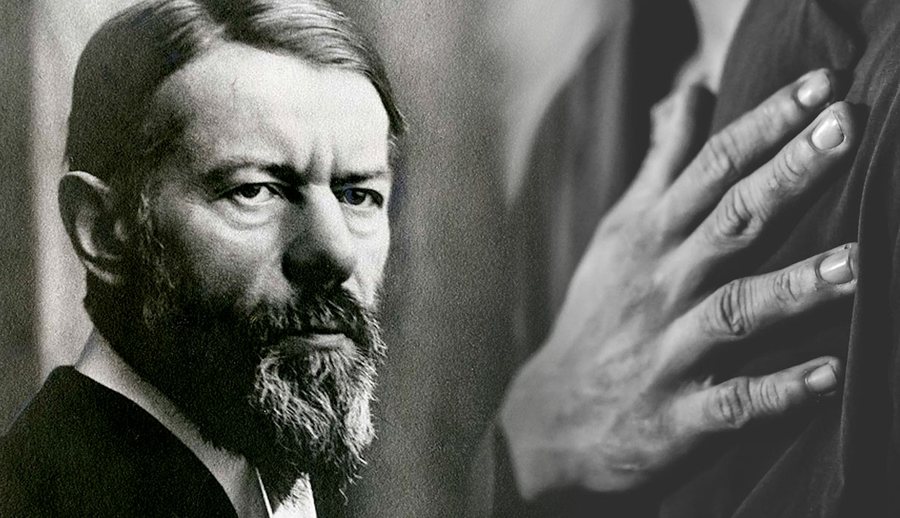
The dominance of instrumental rationality and bureaucracy can imprison individuals in an "iron cage", a way of life dominated by rules, procedures and demands for efficiency that limit freedom and spontaneity...
Max Weber was one of the most prolific and multifaceted thinkers of the twentieth century. His interests ranged from economics to philosophy, from law to history, and even religious studies. He is considered one of the founders of modern social sciences, especially sociology and political science.
Weber developed several fundamental concepts for the analysis of society and developed a famous theory of power and legitimacy, distinguishing between traditional, charismatic, and legal-rational authority. He also analyzed the role of bureaucracy and capitalism, seen as typical organizational forms of the contemporary state and economy.
-Neo-Kantian philosophical premises
Weber's reflection is permeated by a common thread that begins with certain philosophical premises and leads to a diagnosis of modernity. For Weber, influenced by the neo-Kantianism of the Freiburg school, man knows only phenomena, while reality itself remains inaccessible. Phenomenal knowledge is necessary both to satisfy material needs and to attribute meaning to existence.
Like Kant, Weber asks what the conditions of valid knowledge are. He distinguishes between the natural sciences and the human sciences. The former explain phenomena through general laws; the latter study historical and social phenomena, produced by actions and motivations.
Their specific method is understanding. Understanding inevitably implies a relationship with values. The researcher chooses the object of research based on his cultural interests, but once the choice is made, he must pursue objectivity.
In the historical-social sciences, this is based on three methodological principles: 1-Evaluation: avoiding personal judgments on the phenomena studied. 2- Empirical evidence: basing interpretations on verifiable facts and documents. 3- Conceptual and logical rigor: using precise analytical tools and coherent causal reasoning. Weber emphasizes here the central role of ideal types: abstract concepts (such as bureaucracy, power, market) that extract some essential features from observed phenomena and relate them systematically, without claiming to faithfully describe concrete cases.
While history aims to reconstruct individual events by capturing their uniqueness, sociology aims to identify similarities between phenomena, however conditional they may be. Ideal types serve as terms of comparison to highlight similarities, differences, and deviations from the abstract type.
Social phenomena do not develop deterministically, but represent one of many possibilities open to actors in a given context and at a given point in time. To assess the significance of an event, Weber often uses counterfactual reasoning: he asks what would have happened if that event had not occurred. For example, if the Athenians had not defeated the Persians, the philosophical culture that gave rise to Western rationalism would not have developed.
Man knows only phenomena, while reality itself remains inaccessible. Phenomenal knowledge is necessary both to satisfy material needs and to give meaning to existence.
-Western rationalization
From these premises stems Weber's theory of modernity. Weber argues that Western modernity, unique in universal history, arises from the progressive decline of religious hegemony and the subsequent disenchantment with the world: explanations based on mysterious and incomprehensible forces, including God, are replaced by rational interpretations.
This rationalization process favors the autonomy of different spheres of social life:
- science, oriented towards objective knowledge;
- politics, founded on the state and modern bureaucracy;
- the economy, characterized by capitalist enterprise and rational calculation;
- law, organized according to the principles of formal rationality.
The process was gradual and, in some cases, driven by religion itself. In The Protestant Ethic and the Spirit of Capitalism, Weber argues that Calvinism contributed to the spread of a rigorous discipline of work and accumulation, which gave impetus to the entrepreneurial spirit of modern capitalism.
Rationalization has led to great progress, but also to a growing danger: the dominance of instrumental rationality and bureaucracy can imprison individuals in an "iron cage", a way of life dominated by rules, procedures and efficiency demands that limit freedom and spontaneity.
-Ethics, Politics and the Steel Cage
The only sphere capable of countering this trend is politics. It performs a dual function: it guarantees order through the monopoly of legitimate coercion and allows for the comparison of different visions and values.
Two ethical orientations correspond to these functions:
- An ethic of responsibility, attentive to the consequences of actions, to avoid destructive and violent conflicts, and therefore an ethic inclined to adapt to the world;
- An ethics of conviction, inspired by values considered absolute and therefore oriented towards transforming the world to realize these values (think of communism or nationalism).
Bureaucratic rationalization tends to suppress the polytheism of values, the formation and comparison between different normative beliefs. To avoid this scenario, professional politicians are needed, inspired by an authentic call to a cause and capable of combining conviction and responsibility, while preserving a free and pluralistic order.
Weber remained pessimistic about the possibility of success of this project; for this reason his has been defined as a tragic liberalism. However, developments in the second half of the twentieth century show that politics can strengthen the liberal order, expand individual freedom and promote important economic and political transformations, reconciling both ethics and keeping the field of historical possibilities open./ Adapted from “Pamphlet” by “Corriere della Sera”





Lini një Përgjigje